The skillet-roast chicken
The chicken you cook when you've stopped trying to impress anyone. Spatchcocked, cast-iron, lemon and thyme. Forty-five minutes.
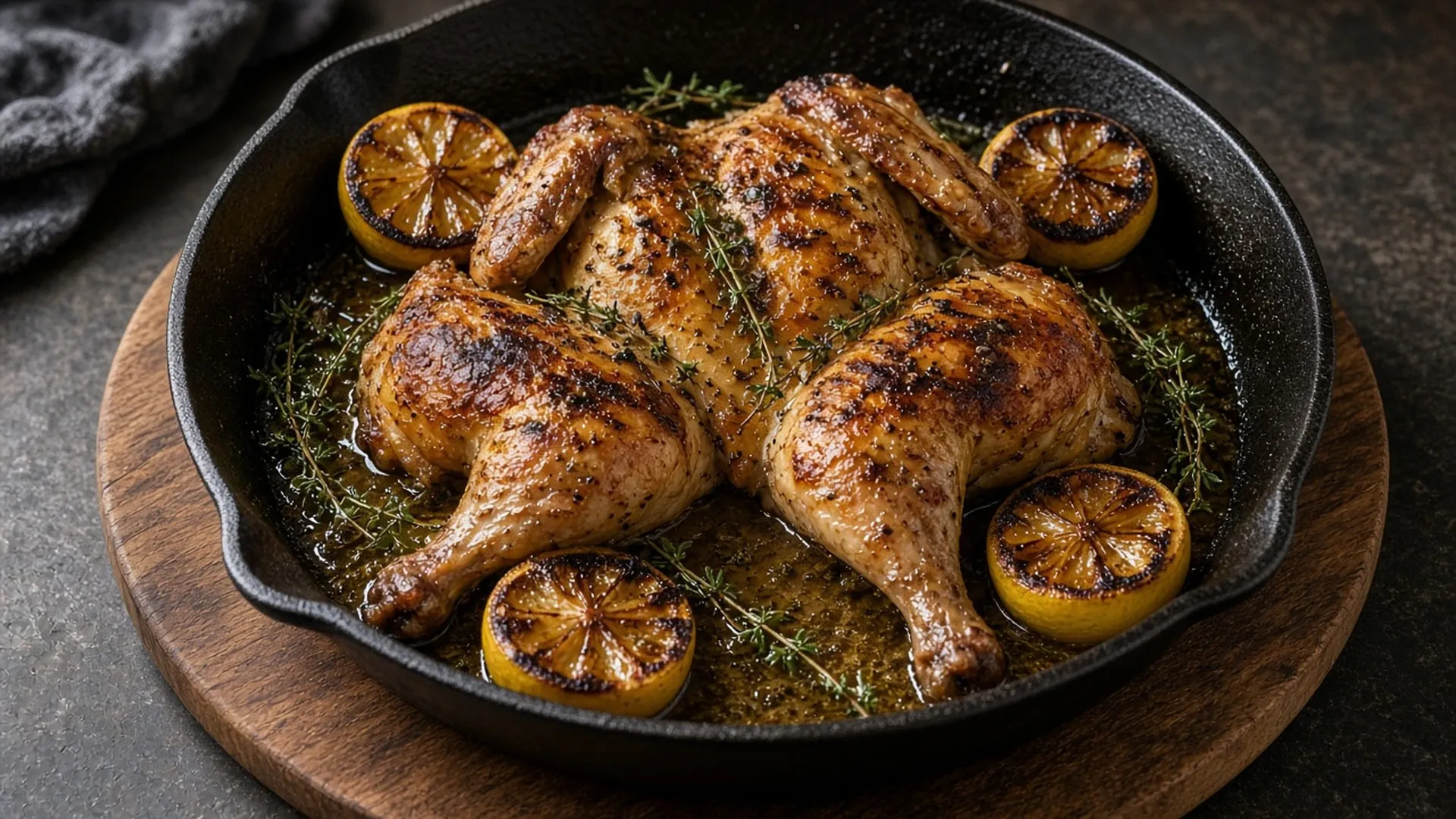
The chicken you cook when you've stopped trying to impress anyone. Spatchcocked, cast-iron, lemon and thyme. Forty-five minutes.
- Hands on: 15 min
- Total: 45 min
- Serves: 4
- Difficulty: Weeknight
There is a version of roast chicken that takes four hours and a basting schedule and a kitchen full of roasting pans and a confidence I do not always have. This is not that recipe. This is the version I make on a Thursday when the day has been long and the refrigerator has a chicken in it and I want something that tastes as though I tried, without actually having to try very hard. The cast iron does the work. I am mostly a spectator after step three.
The technique is simple enough to be a formula: flatten the bird, sear it hard on the stovetop, finish it in a hot oven, rest it, eat it. The lemon and thyme and garlic are not complicated. They are aromatics doing what aromatics do — perfuming the fat that bastes the meat from inside the cavity, flavouring the drippings that pool in the pan, giving you something to do with your nose while the kitchen fills with the smell of a Sunday dinner on a Thursday evening.
The skin should sound like paper when you tap it. Not like rubber. Like paper.
The spatchcock — the removal of the backbone — is the move that makes this recipe reliable instead of anxious. A whole chicken, roasted as-is, is a gamble: the breast cooks faster than the thigh, and unless you are very experienced with your oven or very lucky with your chicken, one part of the bird will be right while the other is either underdone or dry. Remove the backbone, flatten the bird, and everything cooks to the same moment at the same time. I learnt this from a cook in the Midi who called it en crapaudine — like a toad. It is not a flattering name for a beautiful method.
A note on the chicken itself: buy the best you can comfortably afford. A bird that was raised with some room to move and some time to develop muscle has more flavour than one that was not. This is not a complicated food politics position — it is a flavour statement. The bird is the whole recipe. It should be worth the rest.
— Gusto · The kitchen · Thursday, later than planned
I. What you need
Six things · a cast-iron pan · an oven that you trust
- 1 whole chicken, 1.5–1.8 kg — air-chilled if you can find it; the drier the skin, the better the sear
- 1 lemon — halved; one half for the cavity, one half for squeezing at the end
- 6 garlic cloves, unpeeled — smashed flat with the side of a knife
- 8 sprigs of fresh thyme
- 2 tbsp neutral oil — grapeseed or sunflower, not olive; we need a high smoke point for the sear
- flaky salt, black pepper, and 30g cold unsalted butter for finishing
II. What you do
Seven steps · forty-five minutes · the pan does most of the work
Preheat the oven to 220°C / 425°F. Put the cast-iron skillet in the oven while it preheats. It should be ripping hot when the chicken goes in. This is not optional — a cold pan will steam the bottom of the bird.
Spatchcock the chicken. Set the bird breast-side down. Using kitchen scissors or poultry shears, cut along both sides of the backbone and remove it entirely. Flip the bird over and press down firmly on the breastbone with the heel of your hand until you hear and feel a crack. The bird should now lie flat. Pat completely dry with paper towel. Season very generously with salt and pepper on all surfaces.
Sear the skin side — stovetop, cast-iron at high heat. Remove the hot skillet from the oven. Add the neutral oil and immediately place the chicken skin-side down in the pan. It will smoke. This is correct. Press down firmly with a spatula or the back of a heavy pot to ensure full contact. Cook over high heat for eight minutes without moving the bird. The skin should be deeply golden. It will release on its own when it is ready — if it sticks, give it another minute.
Add the aromatics. Flip the bird skin-side up. Scatter the smashed garlic cloves and thyme sprigs around the chicken in the pan. Tuck the halved lemon, cut-side down, alongside. The aromatics will perfume the dripping fat as the bird roasts.
Into the oven. Transfer the skillet to the oven. Roast for 25–30 minutes, until the thickest part of the thigh reads 74°C / 165°F on a probe thermometer, and the juices run clear when pierced. The skin should be mahogany and crisp — if it looks pale, give it another five minutes.
Rest the bird — ten minutes, no shorter. Transfer the chicken to a cutting board and tent loosely with foil. Do not skip this. Meanwhile, set the skillet over medium heat. Add the cold butter and swirl it through the pan drippings. Squeeze the roasted lemon half over it all. This is your sauce. It is four ingredients and it is the right amount of everything.
Carve and serve. Using a sharp knife, separate the legs and thighs from the carcass, then cut down either side of the breastbone to remove the breasts. Arrange on a warm platter — not a cold one, never a cold one. Spoon the pan sauce over the top. Finish with flaky salt. If you have a few thyme sprigs left over from the bunch, scatter them across the platter. This is presentation without effort, which is the only presentation that matters.
Why this works
On heat, flatness, and what crispy skin actually means.
The skin of a chicken is composed primarily of fat and collagen. To achieve crackling skin, both must be rendered — the fat must melt out, and the collagen must first hydrate and then dehydrate, contracting into the stiff, blistered texture we mean when we say crispy. This requires sufficient heat, applied directly to the skin's surface, over sufficient time. The stovetop sear provides the initial direct contact heat that begins this process. The oven provides the sustained heat that completes it. This is why a stovetop-only method produces skin that is golden but flexible, while an oven-only method produces skin that is cooked but not deeply crisp: neither alone provides both the intensity and the duration.
The spatchcock geometry solves the most persistent problem in roasting a whole bird: the differential cooking rate between breast and thigh. The breast meat — leaner, less insulated, positioned directly above the heat source — cooks faster than the thigh. In a whole bird, the thigh is deeper in the cavity, further from the heat, and surrounded by more mass. In a flat bird, both surfaces are exposed equally to the oven's heat. The breast reaches temperature at almost exactly the same moment as the thigh. There is a narrow window — a few minutes — where both are correct simultaneously. The spatchcock widens that window significantly.
The resting period is not sentiment — it is protein chemistry. During cooking, the muscle fibres of the meat contract and squeeze moisture towards the centre of the meat, where it gathers into pools of hot liquid under pressure. If the meat is cut immediately after leaving the heat, those pools are under enough pressure to flood out of the cut surface onto the board. During a ten-minute rest, the muscle fibres relax partially — not fully, the meat remains warm throughout — and the moisture redistributes. A properly rested bird, carved on a warm board, retains its juices. This is the whole argument for resting.
The aromatics — lemon, garlic, thyme — are not decoration. They perfume the fat in the pan as it heats, and that fat continuously bastes the underside of the chicken as the bird roasts skin-side up. The garlic cloves caramelise in the pan alongside the bird and can be squeezed out and spread on bread like a very good butter. The thyme sprigs char slightly and release their volatile oils into the smoke that circulates inside the oven. What smells like cooking is cooking.
If this interests you — the physics of heat in whole-bird roasting is a genuinely deep subject. Poulet rôti, poussin, turkey, Cornish hen. The method adapts; the principles do not.
If you must vary it
- With anchovy butter. Make a paste of three anchovy fillets, 40g softened butter, and one minced garlic clove. Push it under the skin of the breast before roasting. The chicken will taste of itself, but more so. Do not tell people what is in it until after they have eaten it.
- With rosemary and preserved lemon. Replace the thyme with rosemary. Replace the fresh lemon with a quarter of a preserved lemon, rinsed, the pulp discarded, the rind finely sliced. A North African intrusion. It is not subtle. I approve.
- With a mustard glaze. Mix 2 tbsp Dijon mustard with 1 tbsp honey and brush it over the bird before the oven phase. It will caramelise and stick. The result is a bird that the French call poulet rôti à la moutarde and that everyone else calls embarrassingly good.
- With nothing at all. Salt, oil, a hot pan, a hot oven. This is the base recipe with the aromatics removed and it is still an excellent dinner. Gusto has served this to guests and watched them ask what the secret is. The secret is salt and a hot cast-iron pan. There is no other secret.
The pan matters as much as the bird. If your cast iron has gone orange in a cupboard, restore it in an afternoon before attempting this sear. For a tray-based alternative with thighs and vegetables cooked together, see the one-pan formula, and give the reserved backbone a dated label as described in the freezer inventory system.
Recipe by Gusto · tested in a twelve-inch cast-iron skillet, a fourteen-inch cast-iron skillet, and a very heavy carbon steel pan that belonged to someone else · the twelve-inch is correct.