A lemon spaghetti, eaten standing up
Four ingredients. Ten minutes. An emulsion you will understand forever after.
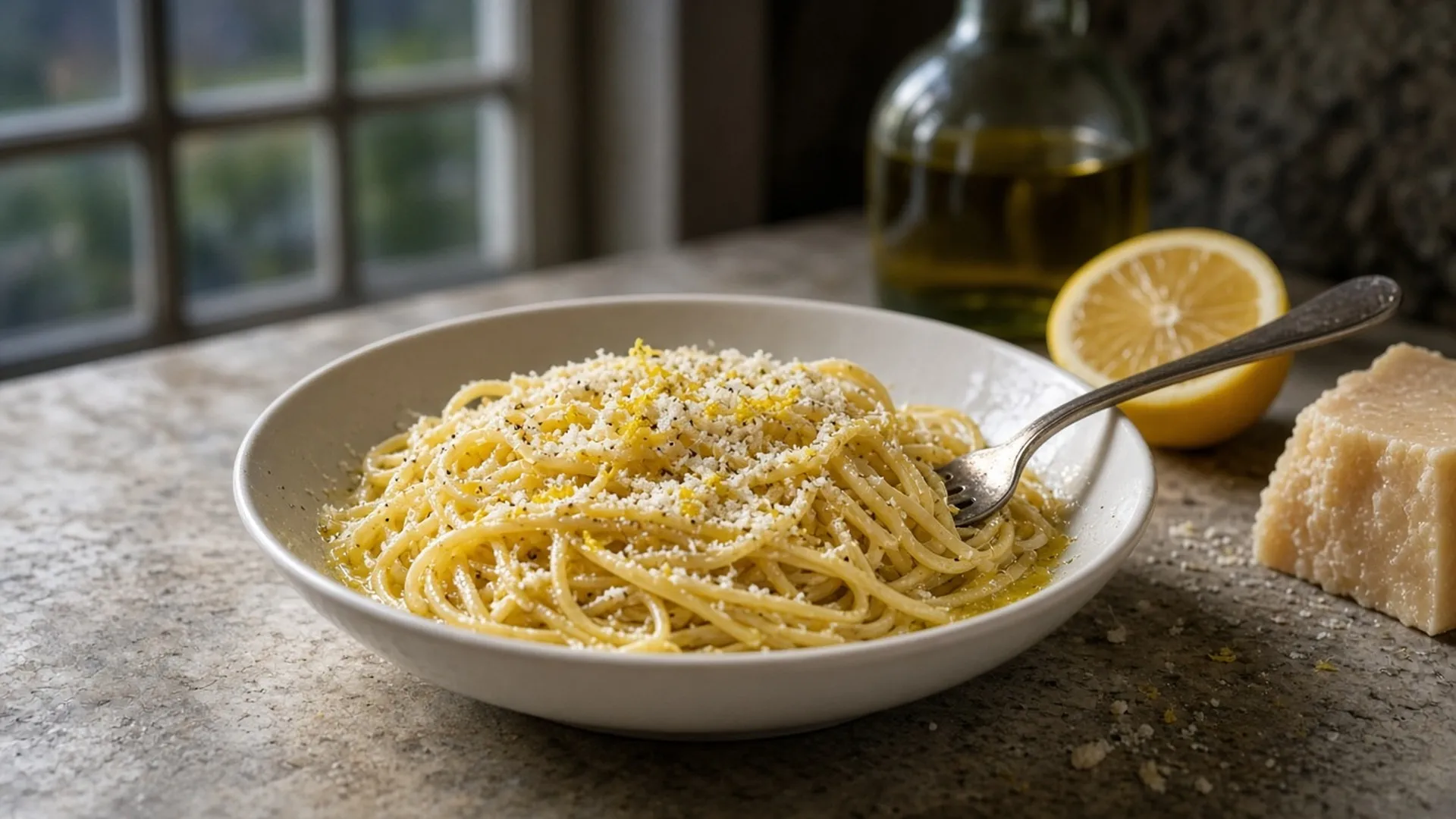
Four ingredients. Ten minutes. An emulsion you will understand forever after.
- Hands on: 15 min
- Total: 15 min
- Serves: 2
- Difficulty: Beginner
There is a pasta for nearly every mood a person can have, but this one is for the mood that has no name — the hour after work, the fridge looking at you with some version of contempt, the kitchen light unkind, the question of what, exactly, hovering over the whole apartment like a lost balloon. This is the pasta for that. It takes ten minutes. It uses four things. It will not fight you.
The trick, if we must call it a trick, is the emulsion — the marriage of starch-thickened pasta water with olive oil and lemon juice, whisked hot against a handful of cheese until the whole business turns into a sauce instead of a puddle. People have made entire careers out of this move. I will teach it to you in four paragraphs and we will never speak of it again.
The pasta water is the whole sauce. Hoard it like a raccoon.
A word on ingredients, because I know you. Buy a good olive oil. Not the one from the bottom shelf that costs the same as a coffee. The one that, when you pour it into a spoon and taste it, tastes alive — peppery at the back of the throat, grassy, maybe a little bitter. That oil is the whole recipe. The lemon should be a Meyer if you can find one. If not, a regular lemon, rolled hard on the counter until it softens. The cheese must be Pecorino. I will accept Parmigiano under duress, but Pecorino is the correct answer and we will speak of it no further.
Eat it standing at the counter, the bowl held under your chin, the fork held at a thoughtful angle. A pasta like this grows tired if you let it sit on a table and have a conversation with it. It is meant for the ten minutes between I cannot and I can.
— Gusto · The kitchen · Tuesday, quite late
I. What you need
Four ingredients · no substitutions, please
- 200 g spaghetti — bronze-die if you can, otherwise whatever is honest
- 60 ml very good olive oil — the peppery kind, the one you taste on a spoon and then think about
- 1 lemon, Meyer preferred — rolled on the counter, zested, then juiced
- 60 g Pecorino Romano, grated on the small holes of a microplane, never the big ones
- flaky salt & a brave grind of black pepper
- optional a small handful of parsley, if you like the theatre of green against yellow
II. What you do
Six steps · ten minutes · do not rush and do not dawdle
Salt the water like you mean it. Bring a large pot of water to a hard, loud boil. Add a generous pour of salt — about two teaspoons per quart. Taste it. It should taste pleasantly salty, like seasoned broth. Drop the spaghetti in and stir it once so it does not glue itself to the bottom of the pot.
Cook it al dente — the package time, minus two minutes. We are finishing the pasta in the pan.
Prepare the sauce base. While the pasta cooks, zest the lemon into a wide, cold pan — the widest you have. The zest is the soul; treat it gently. Squeeze the lemon's juice on top. Pour in the olive oil. Do not turn on the heat yet.
Grate the Pecorino into a separate bowl. Do not put it in the pan. We will speak of it when it is time.
Save the water. About a minute before the pasta is done, scoop out a full mug of the cooking water and set it aside. This is not optional. This is the sauce. You will use most of it. Hoard it like a raccoon hoards a crisp.
Drain the pasta — briefly, still dripping, and tip it straight into the cold pan with the lemon and oil. Turn the heat to medium. Add a good splash of the pasta water — a quarter-cup to start. Toss.
Now we emulsify. Turn the heat off. Add the cheese in a steady snowfall while you toss the pasta with tongs — fast, circular, insistent. Add more pasta water as you go: a splash, a toss, a splash, a toss. The sauce will go from loose and oily to silky and glossy. This is the emulsion. It is a real thing happening in your pan.
If the sauce breaks or gets pasty, add a splash more water. If it gets too loose, toss longer. The starch will sort it out. It always does.
Plate, or do not. Twirl the pasta into a warm bowl using tongs — build a tall nest, do not dump. Finish with flaky salt, a lot of black pepper, and a little more Pecorino over the top because what are we, animals? Eat it standing up. Now. The sauce waits for no one.
Why this works
A little physics, briefly.
The whole of this recipe is a study in controlled emulsification. Olive oil and lemon juice, left to themselves, will sit in a pan and refuse to make eye contact — fat and water are, chemically, strangers. What makes them speak is the starch in the pasta water and the casein protein in the Pecorino. Both are surfactants: molecules with one end that likes water and one end that likes oil, which coat tiny droplets of oil and hold them suspended in the watery phase. The result reads, on the tongue, as sauce.
The second lever is temperature. Add the cheese to a pan that is too hot and the casein proteins seize — knotting into rubbery clumps instead of dispersing smoothly. This is the great sin of a cacio e pepe gone wrong, and the whole reason we turn the heat off before the cheese goes in. A gentle warmth disperses the protein. A ripping heat breaks it. Patience, here, is literally physics.
The third lever is agitation. The tongs, the tossing, the small violence of the motion: this is what keeps the droplets broken up small enough to stay suspended. Stop tossing, and the sauce will separate within a minute. So toss, even past the point of feeling foolish. Especially past that point.
If this interests you — emulsions are the whole family of sauces. Hollandaise, mayo, beurre blanc, vinaigrette. Same trick in a tuxedo.
If you must vary it
- With a shallot. Slice one very thin, soften it in the olive oil for three minutes before the lemon goes in. A small sweetness. A French intrusion. I allow it.
- With anchovy. Two fillets melted into the oil. The pasta becomes savage. You did not hear it from me.
- With chili. A pinch of peperoncino. Do not be a hero about the amount.
- With butter. Swap half the olive oil for cold butter added at the end. You will have made something closer to piccata. I will pretend not to notice.
The same starch-and-oil emulsion carries aglio e olio, the garlic-and-chili weeknight pasta, with no cheese in the pan at all. When there is a whole Sunday instead of ten minutes, the slow end of the pasta repertoire is the four-hour ragù. Every recipe in the series is listed on Gusto's contributor page.
Recipe by Gusto · tested on a Tuesday, a Saturday, and on a person who claimed not to like pasta.