The weeknight shortcut
Aglio e olio. Twelve minutes. One pan. No time and even less mercy — this is Tuesday's discipline.
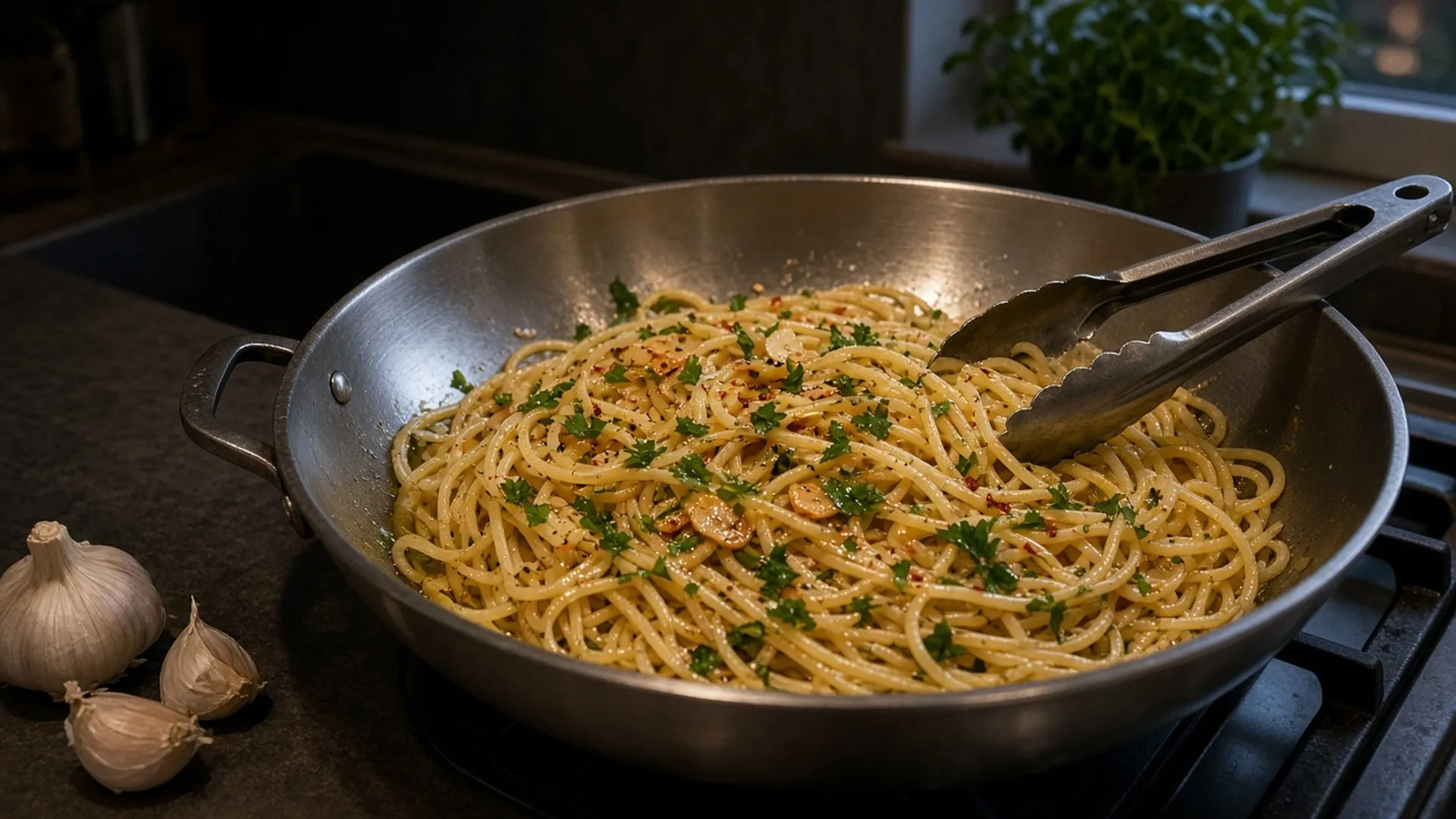
Aglio e olio. Twelve minutes. One pan. No time and even less mercy — this is Tuesday's discipline.
- Hands on: 12 min
- Total: 12 min
- Serves: 2
- Difficulty: Tuesday
Aglio e olio is the recipe the Italian nonnas make when there is nothing left to make. It is the recipe that proves the whole argument: that cooking does not require abundance to produce something worth eating, that four things done correctly will beat thirty things done carelessly, that the cook who understands the fundamentals will never go hungry even when the refrigerator is largely philosophical.
The name — garlic and oil — is also the complete ingredient list, more or less. Pasta, garlic, olive oil, chili flake, and the pasta water that makes them cohere into something that reads, on the tongue, as a sauce. That last bit — the pasta water — is the technique. It is the same emulsification that lives at the heart of lemon spaghetti and cacio e pepe and every great Roman pasta. The starch in the cooking water is the glue. Once you understand it here, you will find it everywhere.
The garlic must not brown. It must perfume. These are different verbs, and the difference is sixty seconds.
A word on urgency. Aglio e olio is not a recipe for a leisurely evening — it is a recipe for a Tuesday at eight-thirty when dinner was supposed to happen at seven-thirty and you are running on the last of your patience and the stove is the only thing standing between you and the decision to eat cereal. This is where the dish lives. It was made for this. The Italians who invented it were not cooking for pleasure that evening; they were cooking for survival. The recipe respects that. It asks for twelve minutes and delivers something that will make you feel, briefly, like the evening was worth the bother after all.
Do not skip the chili flake. It is not decoration. It is a structural part of the recipe. The heat cuts through the richness of the oil and lifts the garlic. Without it, the dish is good. With it, the dish is right.
— Gusto · The kitchen · Tuesday, obviously
I. What you need
Four ingredients · one pan · no apologies
- 200 g spaghetti or linguine — not angel hair, which will overcook before the sauce has time to form
- 6 garlic cloves, sliced thin on a mandoline or by hand — uniformly thin, so they bloom evenly
- 80 ml very good olive oil — this is not the time for the cheap bottle. This oil is the sauce.
- ½ tsp dried red chili flake — peperoncino if you have it; otherwise any good-quality dried chili
- flaky salt and a small handful of flat-leaf parsley, roughly chopped (optional, but correct)
II. What you do
Six steps · twelve minutes · do not burn the garlic
Start the pasta water. Bring a large pot of water to a hard boil. Salt it generously — about two teaspoons per litre. Drop the spaghetti in. Stir once. Set a timer for two minutes less than the package time. We are finishing it in the pan.
Bloom the garlic — from cold oil. While the pasta cooks, add the sliced garlic and the olive oil to a wide pan together, before any heat. Turn the heat to medium-low. The garlic and oil will warm together, the garlic infusing the oil as the temperature climbs. Cook like this, stirring occasionally, until the garlic is pale golden — about four to five minutes. The moment you see the first hint of gold at the edges, add the chili flake and stir once.
Save the water. One minute before the pasta is done, scoop out a full mug of the starchy cooking water and set it next to the pan. This is the sauce. Every drop of it. Do not pour it down the drain.
Drain the pasta and add it to the pan immediately. Do not shake the colander dry — the pasta should still be dripping. Add it directly to the garlic oil. Turn the heat to medium. The oil will spit when the wet pasta hits it. This is correct. Toss quickly with tongs.
Build the sauce with pasta water. Add the reserved pasta water in three stages — a large splash, toss vigorously until absorbed; another splash, toss again; a third, toss until the pasta is glossy and every strand is coated. The sauce will not look like a sauce at first — it will look like oily water. Keep tossing. The starch will do its work and the liquid will tighten around the pasta and turn silky and cohesive. This takes about ninety seconds of active tossing. Do not stop early.
Plate and eat. Twirl the pasta into two warm bowls. Finish with flaky salt and, if you have it, the roughly chopped parsley. The green against the gold is not decoration — the parsley's bitterness is the fourth flavour that holds the dish together. Eat immediately. This is not a dish that waits. It does not get better warm. It only gets better hot. You have twelve minutes from pot to plate. Use them.
Why this works
On infusion, emulsification, and the philosophy of simplicity.
Aglio e olio is a study in the efficiency of heat and fat as flavour carriers. Oil is a better solvent of aromatic compounds than water — the fat-soluble flavour molecules in garlic and chili dissolve into olive oil far more completely than they would into a water-based liquid. When the garlic blooms in the oil from cold, the oil's temperature rise is slow enough that the Maillard reaction barely begins at the surface of the garlic slices, allowing the infusion to be mostly gentle and complete before any browning sets in. The result is an oil that has been completely saturated with garlic flavour, without the acrid edge of scorched garlic protein.
The emulsification that follows is the same mechanism present in every great Roman pasta. The starch released by the pasta into its cooking water — predominantly amylopectin and amylose — acts as a surfactant at the water-oil interface. These starch molecules have regions that are hydrophilic and regions that are hydrophobic, and at the boundary between the water and oil phases, they orient themselves with the hydrophobic region in the oil and the hydrophilic region in the water, stabilising tiny oil droplets in a continuous water phase. The result is an emulsion: a suspension of oil in water that reads on the tongue as sauce. The agitation of tossing keeps the droplets small and the emulsion stable. A pan that sits still will separate.
The chili flake is doing more than adding heat. The capsaicin in the chili binds to TRPV1 receptors on the tongue — the same receptors that respond to thermal heat — creating the perception of warmth that cuts through the richness of the oil. This is why the dish feels balanced even though the primary flavours are fat and garlic: the chili provides a counter-sensation that resets the palate between bites. The dish without chili is technically the same dish, but it is heavier and less alive. The chili is the grammar of the recipe, not the vocabulary.
The parsley, if you use it, adds a chlorophyll-forward bitterness and a grassy aromatic note that cuts through the garlic in a different direction than the chili. The two finishers — chili and parsley — are not redundant. They work in different registers. The chili cuts at the back of the palate; the parsley cuts at the front. Together, they give the dish a finish that is vivid and complete rather than one-dimensional.
If this interests you — the family of Roman pasta sauces all use this same emulsification trick. Cacio e pepe, carbonara, lemon spaghetti. Same structure, different dressing.
If you must vary it
- With anchovy. Melt two or three fillets of good tinned anchovy into the oil with the garlic. They will dissolve completely — you will not find them in the finished dish. But they will have done their work. The depth they add is umami, and the dish will taste as though it has been cooking longer than twelve minutes. This is my preferred version.
- With breadcrumbs. Toast fine breadcrumbs in a separate pan in butter until golden and crisp. Scatter over the finished pasta as a sort of grana — a poor man's Parmesan. In southern Italy, this is called pangrattato. It was invented by people who could not afford cheese. It is often better than cheese. I say this as someone who has a strong relationship with cheese.
- With fried capers. Fry drained capers in the garlic oil for the last two minutes until crisp. They will burst and shatter when you toss the pasta. The saltiness and the brine will make you feel like a person with opinions about food. You are. This proves it.
- With nothing added. Salt, garlic, oil, pasta water. This is the base recipe and it is also the final recipe. If you have this dish mastered, you have mastered the skeleton of Roman pasta cooking. Everything else is variation. Benissimo.
When the weekend allows more time, the Sunday ragù is the slow counterpart to this dish. Thin, even garlic slices depend on a blade that is genuinely sharp, so test yours on a sheet of paper before you start slicing.
Recipe by Gusto · tested on a Tuesday, a Wednesday, and on a Saturday at midnight when no one planned it that way · the midnight version is the best version.