Gusto's signature ragù
Four hours. A four-ingredient soffritto. This is not a Sunday stew — this is a declaration.
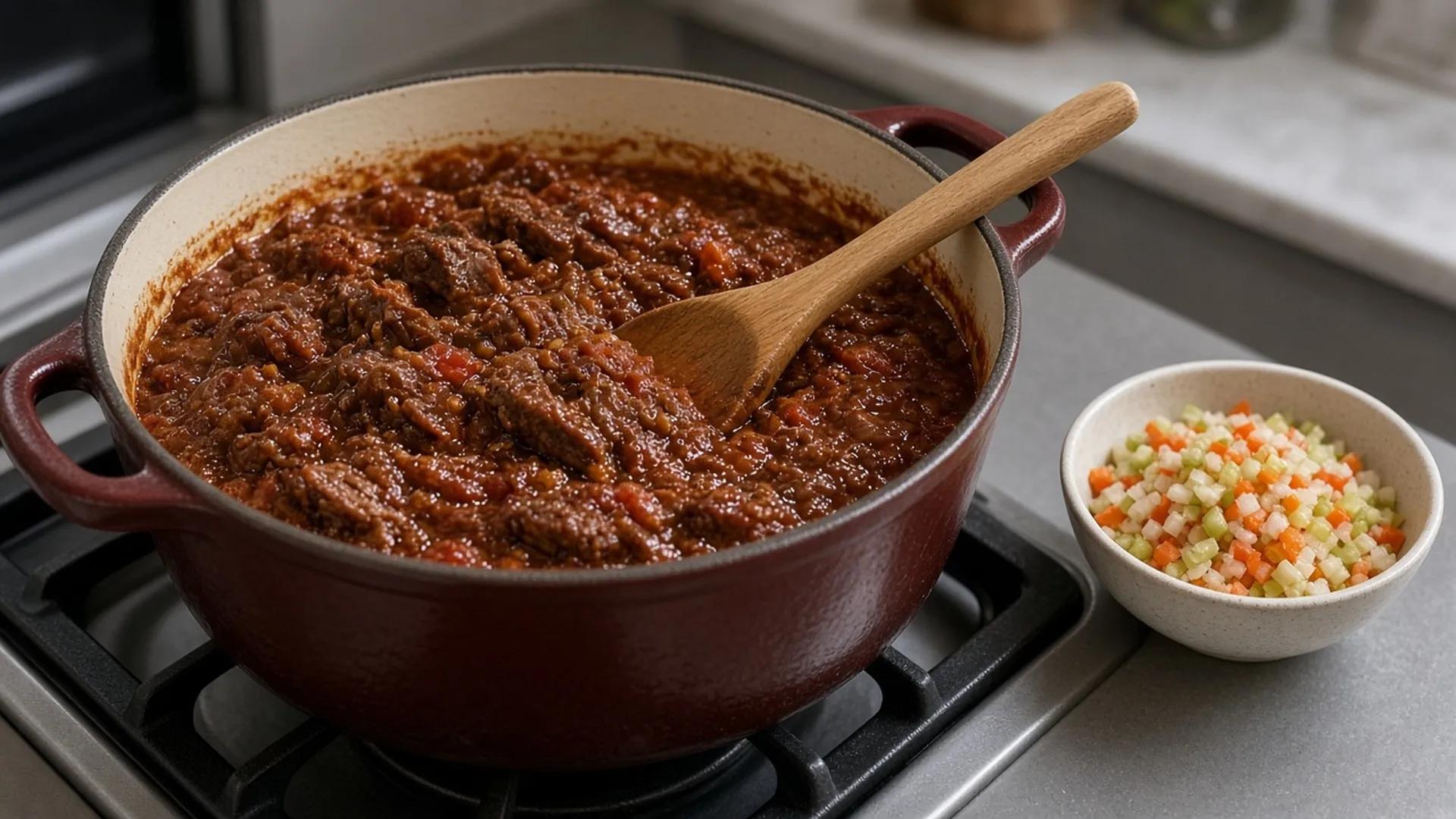
Four hours. A four-ingredient soffritto. This is not a Sunday stew — this is a declaration.
- Hands on: 45 min
- Total: 4 hours
- Serves: 6
- Difficulty: Weekend
There is a category of dish that is not really about the cooking — it is about the decision to cook it. The ragù falls into this category. You cannot make a proper ragù in a hurry. You cannot make it while checking your phone. You can make it while listening to the radio on a grey Sunday, with nowhere to be and the light coming in flat across the kitchen floor, the pot doing its slow work on the back burner while you read something or do nothing in particular. That is when the ragù gets made. That is the only time.
The recipe I am giving you is the one I have been making for twenty years. It started in Lyon, where I learned that a braise is not a recipe — it is a method, a posture, a particular relationship between the cook and time. My maître there had a saying I will not translate because it does not survive the translation. The gist of it: you cannot rush what needs to go slow, and if you try, you will end up with something that tastes of the hurry. The ragù agrees.
The soffritto must dissolve. If you can still find the onion, you have not waited long enough.
Four ingredients in the soffritto: onion, celery, carrot, and patience — and patience is not a figure of speech here, it is an instruction. Twenty minutes on low heat, stirring occasionally, until the vegetables are soft and sweet and completely without colour. The rest of the recipe depends on getting this right. Cut the time short and the sauce will taste of raw aromatics underneath everything. Do it properly and you will not be able to find where the vegetables end and the sauce begins. That is the point.
The meat. Do not use lean beef. Do not use anything labelled "stew meat" in a package. Ask the butcher for beef short ribs, bone-in, or a well-marbled chuck shoulder with the connective tissue left in. The collagen in the connective tissue is the whole sauce. It converts to gelatin over the four hours and gives the ragù its body, its gloss, its ability to coat a strand of pasta the way a sauce must coat a strand of pasta — not sliding off, not clumping, but clinging. This is the difference between a braise and a thin stew. It is not a small difference.
— Gusto · The kitchen · Sunday, a quiet one
I. What you need
The soffritto + the braise · no shortcuts
- 1.2 kg beef short ribs, bone-in — or beef chuck shoulder, well-marbled. Do not trim the fat.
- 2 medium yellow onions, finely diced — not the sharp red
- 3 celery stalks, finely diced — the inner stalks with the leaves, please
- 2 medium carrots, finely diced — the orange ones, not the rainbow nonsense
- 375 ml dry red wine — something you would drink. A Chianti, a Barbera, a Côtes du Rhône. Not cooking wine.
- 400 g San Marzano tomatoes, whole, hand-crushed — DOP if you can find them. The sweet ones, in the tall cans.
- 2 tbsp olive oil — for browning the meat and softening the vegetables
- salt, black pepper, a bay leaf, a sprig of fresh thyme
- to serve: pappardelle or rigatoni, a knob of cold butter, and Parmigiano-Reggiano aged 24 months
II. What you do
Eight steps · four hours · do not rush a single one of them
Brown the meat — in batches, in a hot pan. Pat the short ribs completely dry with paper towel. Season heavily with salt and pepper. Heat the olive oil in your heaviest pot — a Dutch oven, a cocotte, something with weight — until it smokes. Brown the meat in a single layer, without touching it, for four minutes per side. You want a dark mahogany crust, not a grey sear. Do this in two or three batches; do not crowd the pan or you will steam instead of brown. Set the browned pieces aside on a plate.
Build the soffritto. Lower the heat to medium-low. Add the onions, celery, and carrot to the same pot, scraping up the fond as you stir. Add a pinch of salt. Cook, stirring occasionally, for a full twenty minutes. The vegetables must be completely soft, sweet, and translucent — not browned, not caramelised, just dissolved into their own sweetness. If you can still find individual pieces of onion, keep going.
The wine reduction — this is a discipline. Raise the heat to medium-high. Pour all of the wine into the pot. Do not stir immediately — let it hit the hot vegetables and start to steam. Then stir once, scraping the bottom clean. Let it reduce, uncovered, until only a third of the original volume remains — about fifteen to twenty minutes. The liquid should be syrupy and the raw alcohol smell should be completely gone. If it still smells like wine, reduce it longer.
Add the tomatoes and the meat. Crush the San Marzano tomatoes by hand directly into the pot, discarding the seeds. Nestle the browned meat back in, along with any resting juices from the plate. Tuck in the bay leaf and thyme. The liquid should come about halfway up the meat. If it does not, add a splash of water or stock.
The braise. Bring to a bare simmer, then lid the pot and reduce the heat to the lowest setting your stove will manage. The surface should barely murmur — one or two bubbles every few seconds. Set a timer for three and a half hours. Check it every forty-five minutes or so, turning the meat once and adding a splash of water if it looks like it is drying out. But mostly: leave it alone. That is the instruction.
Check for collagen conversion. After three and a half hours, the meat should be falling apart at the touch of a fork. If you press a piece gently and it holds together, give it another thirty minutes. The connective tissue must be completely dissolved. You are looking for meat that shreds without effort and a sauce that coats the back of a spoon thickly and with some resistance.
Shred and finish the sauce. Remove the meat from the pot. Discard the bay leaf and thyme stems. Using two forks, shred the meat coarsely — not fine, not stringy, but in generous rough pieces. Return the shredded meat to the pot and stir it into the sauce. Taste for salt. Adjust. The sauce should be deeply savoury, rich but not heavy, with the wine a background note underneath everything else.
Dress the pasta. Cook the pappardelle until very al dente — two minutes short of the package time. Reserve a full mug of pasta water. Drain and add directly to the pot of ragù. Add the cold butter and a splash of pasta water. Toss over medium heat until the pasta is glossy and every strand is coated. Finish with a generous amount of Parmigiano grated tableside. Eat immediately. The ragù will wait in the refrigerator for three days and in the freezer for three months. It improves on the second day. Consider making it on Saturday.
Why this works
On time, collagen, and the Maillard reaction.
A braise is, at its core, an exercise in controlled protein chemistry. When you sear the meat at high heat, you are triggering the Maillard reaction — a cascade of chemical transformations between amino acids and reducing sugars at temperatures above 285°F that produces hundreds of flavour compounds simultaneously. The dark brown crust that forms is not merely colour; it is a library of flavour. The fond — the sticky brown bits left in the pan — is the same reaction concentrated. This is why browning the meat well, in a very hot, uncrowded pan, is not optional. It is the whole first act.
The soffritto works through a different mechanism. At medium-low heat, the cell walls of the onion, celery, and carrot break down and release their sugars. The Maillard reaction is present but barely — there is not enough heat to trigger the browning cascade. What happens instead is a gentle caramelisation of the vegetable sugars and the dissolution of the volatile aromatic compounds that, at high heat, would dissipate as steam. This is why a soffritto cooked properly disappears into the sauce while one rushed at high heat stays sharp and identifiable. Patience, here, is a thermodynamic choice.
The wine reduction is the most misunderstood step. The goal is not to add wine flavour to the sauce — it is to concentrate the wine's structural components while driving off the alcohol, which, in large quantities, gives a braise an astringent, hot quality. After a proper reduction, what remains is the wine's acidity, its fruit character, and its tannins, all without the alcohol's interference. The acidity of the wine also helps break down the collagen over the long braise, speeding the conversion slightly.
The collagen conversion is the centrepiece. Collagen — the protein matrix of connective tissue — begins breaking down into gelatin at around 160°F. At the low simmer of a proper braise, this process takes three to four hours. Gelatin is a hydrophilic molecule: it attracts and holds water, and when dispersed in the braising liquid, it gives the sauce its viscosity, its gloss, and the lip-sticking quality that makes a braise feel luxurious and not merely filling. The cook who uses lean cuts gets none of this. The cut matters as much as the technique.
If this interests you — the science of braising crosses into almost every slow-cooked dish. Cassoulet, pot-au-feu, ossobuco, short ribs. Same chemistry, different expressions.
If you must vary it
- With pork shoulder. The fat content is different — slightly more forgiving, slightly sweeter — and the braise time drops to two and a half hours. My Brooklyn version uses pork. My Lyon version uses beef. I make both.
- With a battuto of pancetta. Dice 80 g of pancetta very fine and render it in the pot before the soffritto goes in. This is the Bolognese tradition. The depth it adds is not subtle. Do it.
- With milk in the braising liquid. The Bolognese tradition again — a splash of whole milk added with the tomatoes, which softens the acidity of the wine and rounds the entire sauce. I find it almost too gentle, but I understand why people love it.
- Without tomatoes. A ragù bianco — white ragù, no tomato, finished with cream and a grating of nutmeg over the pasta. The depth comes entirely from the meat and the wine. This is a northern Italian tradition. It requires a longer reduction but repays the patience.
The ragù's opposite number is the twelve-minute aglio e olio, for nights when four hours are not on offer. Because the sauce keeps for months frozen, labelling it and filing it flat stops the Sunday batch from becoming an unidentified bag. A sharp knife makes the fine soffritto dice far less tedious, and this column on whetstones and honing rods explains which kind of sharpening a blade needs.
Recipe by Gusto · tested in Brooklyn, refined in Lyon, argued about in both places · the version in this issue is the Sunday version, which is the only version that matters.