San Francisco Sourdough
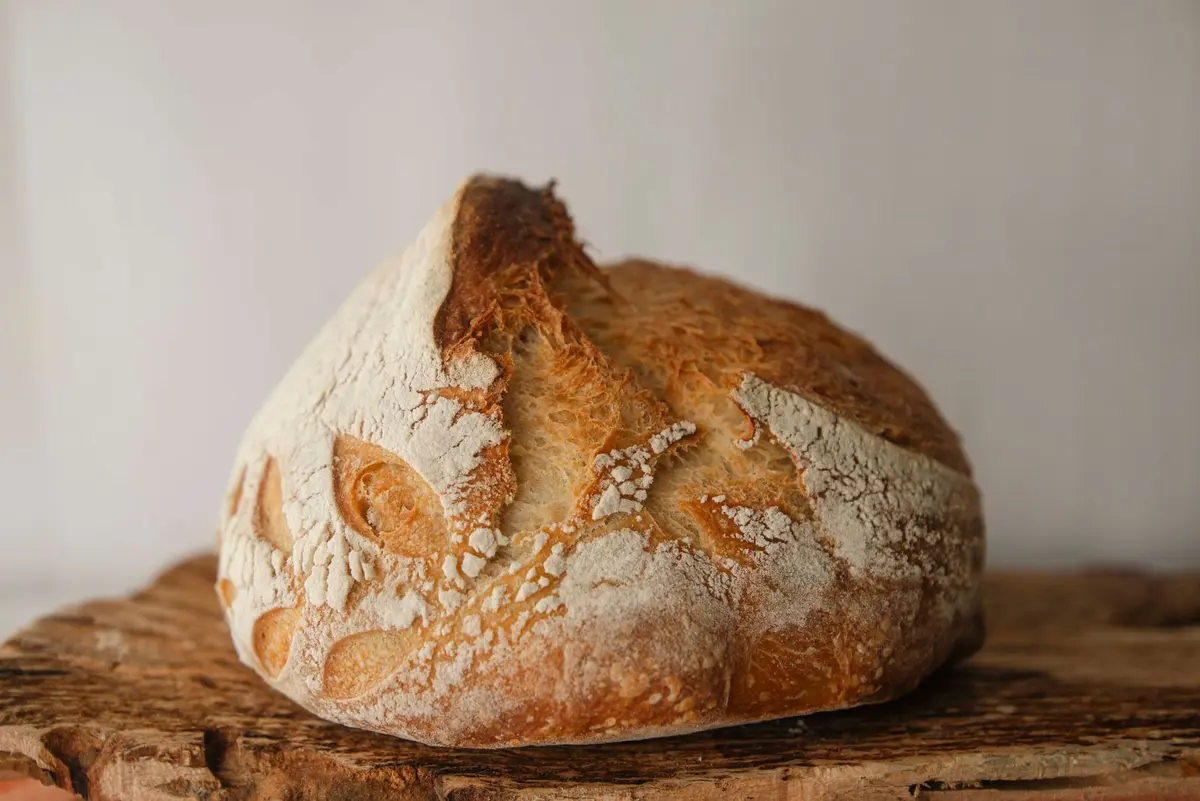
San Francisco sourdough is built on a wild yeast starter that lives in your kitchen, fed daily or weekly depending on how you keep it. The dough ferments long and slow—anywhere from 12 to 18 hours—developing the distinctive tang and open crumb that made this bread famous. You shape it, proof it overnight in the fridge, then bake it in a Dutch oven until the crust cracks open and the interior turns to sour clouds.
- Difficulty
- Intermediate
- Total time
- 18 to 24 hours over 2-3 days (mostly hands-off)
- Hands-on
- 30 minutes
- Serves
- 1 loaf
- You will need
- Dutch oven, kitchen scale, bench scraper, banneton or cloth-lined bowl, lame or sharp knife, parchment paper, wire cooling rack
Ingredients
- 500 g bread flour (or all-purpose)
- 350 g water (70% hydration)
- 100 g active sourdough starter, fed 4-8 hours prior
- 10 g salt
Step by step
Mix the dough
Combine flour and water in a bowl. Let sit 30 minutes (autolyse). This rest hydrates the flour evenly. Add the active starter and salt, then mix until no dry flour remains. The dough will be sticky and shaggy—this is correct.
Fold and build strength
Leave the dough in the bowl at room temperature (68–72°F is ideal). Every 30 minutes for the next 2 to 2.5 hours, wet your hand and fold the dough over itself four times, rotating the bowl as you go. This builds strength without kneading. After the last fold, let it rest undisturbed for 1 to 2 hours until it's visibly puffy and jiggly.
Pre-shape and relax
Tip the dough onto an unfloured counter. Using a bench scraper, gently fold it into a round. Let it sit uncovered for 20 minutes. This relaxes the gluten so the final shape holds.
Form the final boule
Flip the round seam-side down. Fold the far edge toward you, seal with the heel of your hand, then fold the sides in and roll the dough toward you, sealing as you go. Flip it seam-side up into a floured banneton or a bowl lined with a floured kitchen towel.
Refrigerate overnight
Cover the banneton loosely with plastic and refrigerate for 12 to 16 hours. During this time, the dough continues to ferment slowly, building sour flavor and developing a taut, shiny surface. This is the magic step.
Heat the oven and Dutch oven
Remove the dough from the fridge 30 minutes before baking (optional—cold dough works fine too). Heat your oven to 500°F with the Dutch oven inside for at least 30 minutes. The pot needs to be screaming hot.
Score and bake covered
Carefully turn the cold dough onto parchment paper. Using a sharp knife or lame, make one confident slash across the top at a 30-degree angle, ¼ inch deep. Transfer the dough on the parchment into the preheated Dutch oven. Cover with the lid. Bake at 500°F for 20 minutes. The steam trapped inside creates the oven spring and crust.
Remove lid and brown
Remove the lid. Lower the oven to 450°F and bake for 25 to 30 minutes more until the crust is deep amber to dark brown. The loaf should sound hollow when you tap the bottom. If the bottom is pale, place the Dutch oven on the lower rack for the last few minutes.
Cool before slicing
Remove the loaf and cool on a wire rack for at least 1 hour before slicing. The crumb is still setting during this time—cutting too early releases steam and makes the inside gummy.
Questions people ask
Why is my sourdough bread not sour enough?
Sourness develops during slow fermentation. A longer cold proof (up to 24 hours) gives bacteria more time to produce acid. Keeping your starter at room temperature between bakes also tends to develop more wild yeast variety, which contributes to tang. A very young starter (less than 2 weeks old) also tends to be milder.
Can I bake straight from the fridge without the 30-minute rest?
Yes. Cold dough bakes fine and sometimes gives better oven spring. The 30-minute warm-up is optional and mainly helps the dough proof slightly faster. If you bake it cold, add 2 to 3 minutes to the covered baking time.
My starter is sluggish. What's wrong?
Starters need warmth and food. If your kitchen is cold (below 65°F), fermentation slows dramatically. Feed it with equal parts flour and water, and keep it at room temperature. Discard half and feed it daily until it's reliably doubling within 4 to 6 hours. This usually takes 3 to 5 days.
How do I store sourdough?
Cut side down on a bread board at room temperature for 2 to 3 days. After that, wrap it and freeze for up to 3 months. Don't refrigerate—cold starch accelerates staling.
Can I use all-purpose flour instead of bread flour?
Yes, but expect a slightly less open crumb and less chew. Bread flour has more protein, which builds stronger gluten networks. All-purpose works fine, especially if you increase the water by 10–15 g to compensate.
What if I don't have a Dutch oven?
A covered baking vessel (any heavy pot or even a baking sheet with foil tented over it) traps steam, though results won't be quite as dramatic. Some bakers use a preheated baking stone and create steam by pouring hot water into a shallow pan on the oven floor below the bread.
Tips
- Keep your starter at room temperature and feed it once a day if you bake weekly, or once a week if you bake less often. A fed starter should double within 4 to 8 hours and show bubbles throughout.
- Water temperature matters. Cold water (50°F) slows fermentation; warm water (80°F) speeds it. Aim for 70–75°F dough temperature for predictable timing.
- Don't overproof during bulk fermentation. The dough should increase 30 to 50% in volume, not double. If it's too puffy, it will collapse in the oven.
- The overnight cold proof is forgiving. You can leave the dough for up to 24 hours in the fridge. Longer fermentation = more sour flavor.
- A sharp blade matters. Use a lame, fresh razor blade, or very sharp knife for scoring. A dull blade pulls the dough and ruins the score.
- Parchment paper makes transferring much easier. It won't burn at 500°F and slides right out of the Dutch oven.
- If your kitchen is cold (below 65°F), bulk fermentation will take longer. Use the visual cues (puffiness, jiggle) rather than timers.
Variations
- Whole wheat sourdough: Replace 100 g of bread flour with whole wheat flour. Whole wheat absorbs more water, so add an extra 25 g of water. The fermentation times remain the same, but expect a nuttier flavor and slightly denser crumb.
- High-hydration (75%): Increase water to 375 g. The dough will be very wet and slack. Handle it gently during folds, and expect a more open, irregular crumb. Bulk fermentation may finish 15 to 20 minutes sooner.
- Shorter timeline: Skip the cold proof and do a 4 to 6 hour room-temperature final proof instead. The crust will be thinner and the crumb less sour, but it works if you need bread the same day.