Türkiye vs Paraguay: Meze and Chipa
One kitchen built for grazing, the other built for fire. Both built for eating after dark.
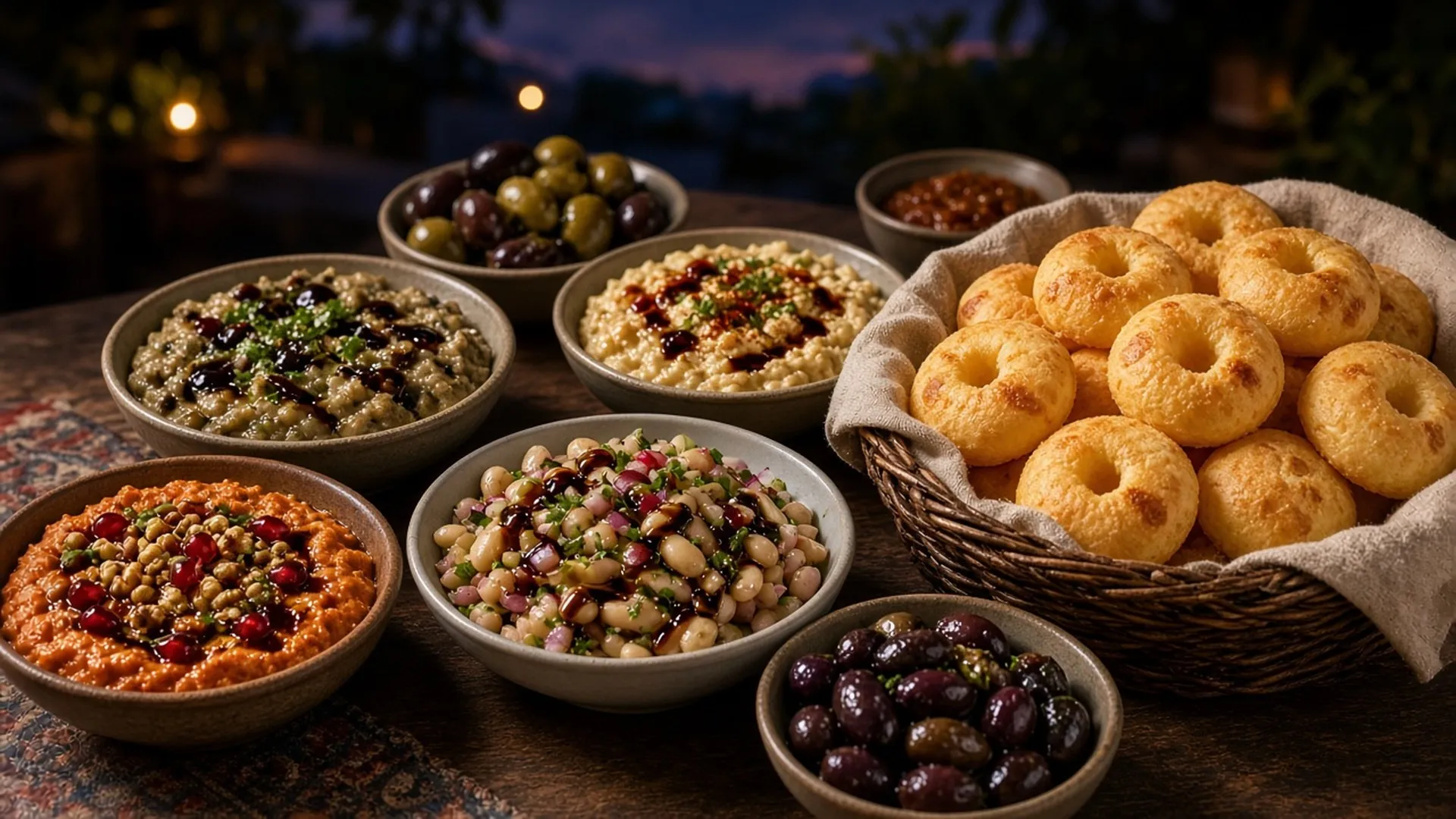
One kitchen built for grazing, the other built for fire. Both built for eating after dark.
- Türkiye: Meze
- Paraguay: Chipa
- Match: Group Stage · Santa Clara · June 19, 2026
This match kicks off at eleven o'clock on a Friday night. I am not going to suggest a full dinner. I am going to suggest a spread — the kind of table you can build in the afternoon, leave covered in the refrigerator, and pull out an hour before kickoff when everyone is arriving and nobody wants to cook.
Türkiye has a whole table for this occasion. The meze table is not appetizers. It is a philosophy: put many things on the table, eat slowly over a long time, let the meal be the conversation. Muhammarah is my anchor — a roasted red pepper and walnut paste that has more going on than any single ingredient deserves. It is the dish that makes people ask what they are eating and then ask for more before you answer.
Paraguay sends chipa — a small, chewy bread made with cassava flour and cheese, baked until the outside is firm and the inside pulls like mochi. They are addictive, they travel well, and they are the right size to eat standing up while watching football. Make both. Cover the table. Let people graze.
A late-night meze table and Paraguayan chipa.
Serves: 6-8 as a spread · Time: 1 hour 30 minutes · Active: 35 minutes
Ingredients
For the muhammarah:
- 4 red bell peppers, roasted until blackened and peeled
- 100g walnut halves, toasted
- 2 slices stale bread, torn
- 2 tbsp pomegranate molasses
- 1 tbsp olive oil, plus more to finish
- 1 tsp ground cumin
- ½ tsp dried chilli flakes (Aleppo pepper if you can find it)
- 1 garlic clove
- salt to taste
For the broader meze table (assemble as you like):
- good hummus (homemade or the best you can buy)
- stuffed grape leaves (from a jar — I allow it)
- olives, mixed and not from a can
- cucumber and tomato, roughly chopped with dried mint and olive oil
- flatbread or pita, warmed
For the chipa:
- 300g cassava flour (not tapioca starch — cassava flour)
- 200g aged cheese, finely grated (Paraguayan queso Paraguay is ideal; strong cheddar or parmesan work)
- 2 eggs
- 60ml full-fat milk
- 60ml neutral oil
- 1 tsp baking powder
- ½ tsp salt
- anise seeds, optional but traditional
Method
- For the muhammarah: char the peppers directly over a gas flame or under the broiler, turning, until the skin is blackened all over. Place in a bowl, cover with cling film, and leave 15 minutes. The steam loosens the skin. Peel, remove seeds, and tear the flesh roughly.
- Toast the walnuts in a dry pan over medium heat until fragrant — 3-4 minutes. Do not walk away. Burned walnuts go in the bin. Add the bread to the pan for 1 minute to dry it slightly.
- In a food processor, combine the peppers, walnuts, bread, pomegranate molasses, olive oil, cumin, chilli, and garlic. Pulse until you have a rough paste — not smooth, not chunky. The texture is between hummus and salsa. Season with salt. Transfer to a bowl, drizzle with more olive oil, and refrigerate. It improves over an hour.
- For the chipa: preheat oven to 200°C / 390°F. Combine the cassava flour, baking powder, and salt in a large bowl. Add the cheese, eggs, milk, and oil. Mix with your hands — this is not a delicate operation — until a firm, slightly sticky dough forms. If it is too dry, add milk one tablespoon at a time.
- Divide the dough into 16-18 pieces. Roll each into a small rope and form into a ring or crescent shape. Place on a lined baking sheet. Bake 20-25 minutes until the exterior is golden and firm but the interior still has give. They should sound hollow when you tap them.
- Assemble the meze table 30 minutes before kickoff. Everything at room temperature except the chipa, which should be warm. Flatbread last, straight from the oven or a hot pan.
The meze table is not appetizers. It is a philosophy.
— On the Turkish approach to time
Why roasting concentrates and pomegranate molasses amplifies.
Raw red peppers are sweet and slightly grassy. Roasted and charred red peppers are something entirely different: the sugars caramelize against the heat, the water content reduces by half, and the smoke from the char adds a bitter depth that balances the sweetness. You have transformed the ingredient before it enters the recipe.
Pomegranate molasses is reduced pomegranate juice — tart, fruity, and intensely concentrated. It functions in muhammarah the way a splash of red wine vinegar functions in a French vinaigrette: it cuts through the fat of the walnuts and olive oil, keeps the paste bright, and adds an acid note that prevents the dish from feeling heavy despite being a walnut paste.
Chipa relies on cassava flour's natural starchiness to create its characteristic chew. Cassava starch turns stretchy and elastic as it gelatinizes, so the interior of the chipa sets into something almost custard-like while the exterior bakes dry. This is why they are chewy inside and crisp outside with no extra technique required.
If you must vary it
- Vegan chipa. Replace the eggs with flax eggs (1 tbsp ground flax + 3 tbsp water per egg) and the cheese with nutritional yeast. The flavor is different. The texture is similar. I have made peace with this version existing.
- Muhammarah without a food processor. Chop the peppers and walnuts finely by hand, mash together with a fork. You will have a more textured, rustic paste. This is arguably the correct way. The food processor is the shortcut.
Paraguay's other table brings sopa paraguaya, a cornbread that is not soup, in USA vs Paraguay. Another late kickoff calls for midnight ramen in Tunisia vs Japan. The rest of the group-stage menus are on Eat the Match: World Cup Recipes.
Gusto / June 2026
Build the table before the match. It does not improve with speed.