Germany vs Curaçao: Currywurst and Keshi Yena
Currywurst and keshi yena — two dishes that were never supposed to exist, and both of them magnificent for it.
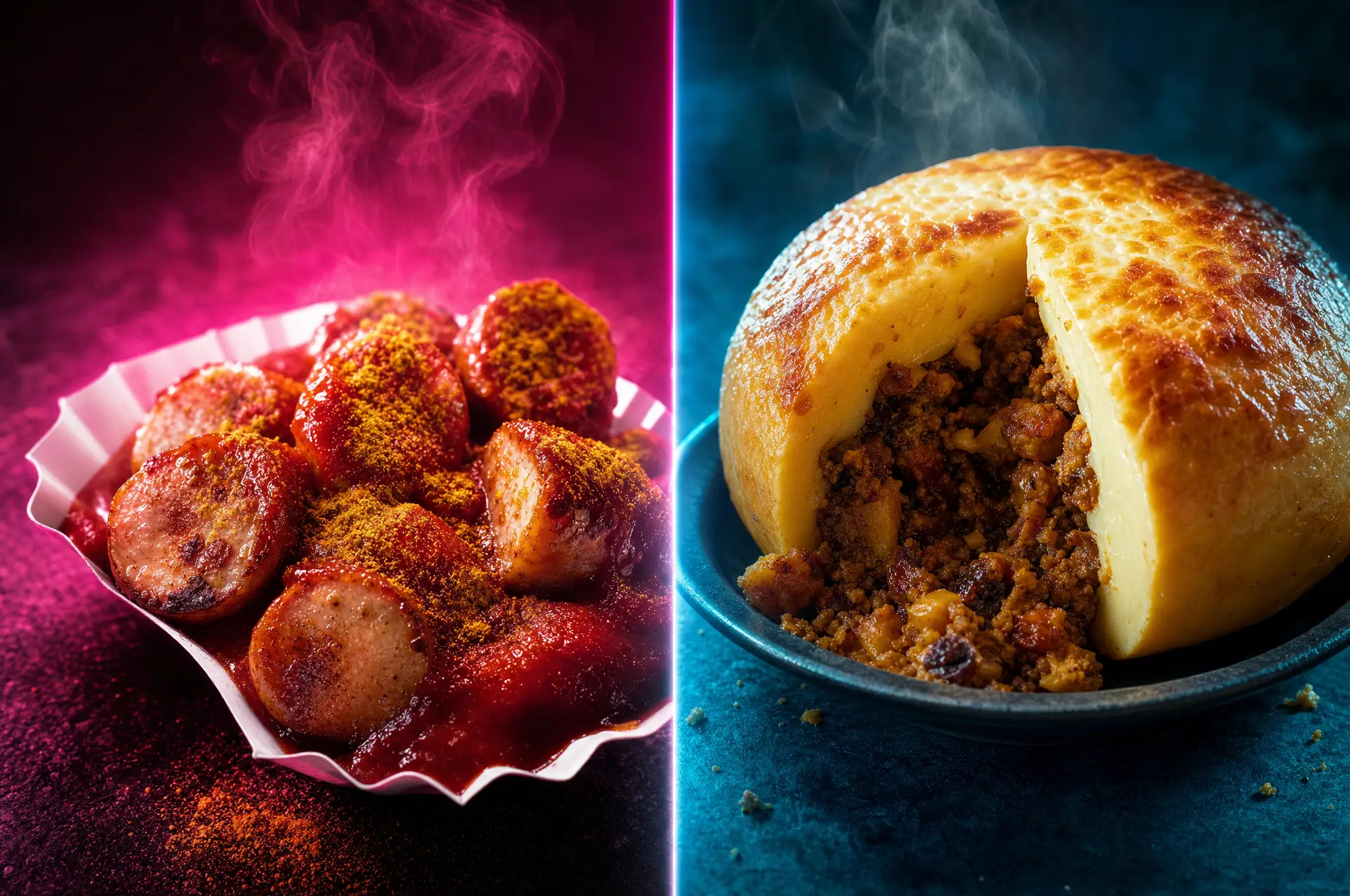
Currywurst and keshi yena — two dishes that were never supposed to exist, and both of them magnificent for it.
- Germany: Currywurst
- Curaçao: Keshi Yena
- Match: Group Stage · Matchday 1 · Houston · June 14, 2026
On paper, this is not the marquee match of the group stage.
Germany is ranked among the best sides in the world. Curaçao — a small island of roughly 150,000 people in the Dutch Caribbean, making its first World Cup appearance in history — is not.
But I am not interested in the ranking. I am interested in what these two nations put on a table, and on that question the match is even.
Currywurst. Keshi yena. One is a sausage chopped into rounds and drowned in a tomato-curry sauce invented by a woman standing in the rubble of postwar Berlin. The other is a hollowed-out Dutch cheese wheel stuffed with spiced meat by people who had been brought to a Dutch island against their will and given the rinds of what their colonizers ate. Two dishes that should not exist. Two dishes that became beloved exactly because of the constraints that produced them. Scarcity is the mother of invention, and both of these kitchens invented something worth sitting down for.
They share a football pitch on Sunday, and they share this table tonight, and on this table both of them deserve equal respect.
The German side — currywurst.
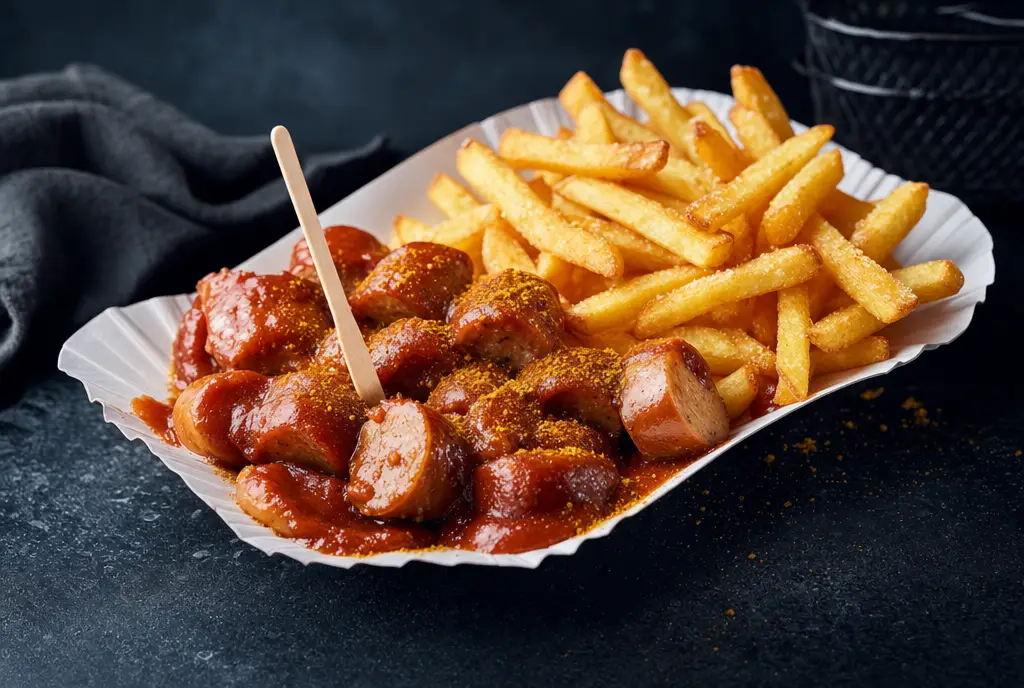
September 4, 1949. Berlin is still sorting through the rubble. Herta Heuwer is running a snack stand in Charlottenburg and she has, through a trade with a British soldier, obtained something almost impossible to find in postwar Germany: ketchup. Worcestershire sauce. Curry powder. She mixes them. She pours them over chopped fried sausage. She serves it to a customer who has never tasted anything like it.
By the mid-1950s, currywurst has spread across Berlin. By the 1960s, it is a national institution. Today Germans eat an estimated 800 million currywursts a year, according to Euronews. Berlin even had a museum dedicated to it for most of a decade. Herta Heuwer registered her sauce under the name "Chillup", and when she died in 1999 the exact recipe went with her. Nobody has exactly replicated it. Everyone has tried.
What currywurst is, technically, is a boiled-then-fried pork sausage, sliced into rounds, served in a paper tray with a sauce of tomato, curry powder, and Worcestershire, dusted with more curry powder on top. That is the whole thing. It is street food with the confidence of something that knows it does not need to be more than it is.
The sauce is where people get precious. Every currywurst vendor in Berlin has a version they will defend to the death. I am not going to tell you which spice ratio is correct because Herta Heuwer is the only one who knew and she is no longer available. What I will tell you is that the balance you are looking for is tangy, warm, and slightly sweet — tomato and curry in conversation, neither one winning. If it tastes like curry soup with sausage in it, your curry powder is too aggressive. If it tastes like ketchup with ambition, add more.
Serves: 4 · Time: 35 minutes · Active: 25 minutes
Ingredients
For the curry sauce:
- 2 tbsp neutral oil
- 1 small white onion, finely diced
- 2 cloves garlic, minced
- 200g tomato passata
- 2 tbsp tomato paste
- 1 tbsp Worcestershire sauce
- 1 tbsp apple cider vinegar
- 1 tsp sugar
- 2 tsp mild curry powder, plus more to finish
- ½ tsp sweet paprika
- ¼ tsp cayenne (adjust to your standard)
- salt to taste
For the sausage:
- 4 good bratwurst or bockwurst (pork, natural casing)
- 1 tbsp neutral oil
To serve:
- curry powder, for dusting
- crusty bread or frites
Method
- Make the sauce first. It needs time to come together and it improves as it sits. In a small saucepan over medium heat, warm the oil. Add the onion and cook until soft and translucent, about 7 minutes. Do not rush this. The onion sweetness is the counterweight to the acidity coming later.
- Add the garlic and cook 1 minute. Add the tomato paste and stir for another minute — you are cooking out the raw edge. Add the passata, Worcestershire, vinegar, sugar, curry powder, and paprika. Stir to combine. Bring to a simmer and cook uncovered for 15 minutes, until the sauce has thickened and the colour has deepened from bright red to a darker, brick-adjacent tone. Taste. Season with salt. Adjust curry powder and cayenne to your standard. The sauce should taste assertive. It will mellow when it hits the sausage.
- While the sauce finishes, cook the sausages. Prick them twice with a fork — not aggressively, just enough to let steam escape and prevent splitting. Place them in a pan with a thin layer of water (about 1cm). Bring to a simmer over medium heat and cook, turning occasionally, until the water evaporates and the sausages begin to fry in their own fat, about 12 minutes total. This is the boil-then-fry method that produces the proper texture: yielding inside, coloured outside. Do not start with a dry pan. Do not skip the boil. Both mistakes make a worse sausage.
- Once the water is gone, add the oil and let the sausages colour on all sides — another 4 to 5 minutes. They should be a deep golden brown with no grey patches.
- Slice the sausages into rounds on a cutting board, about 1.5cm thick. Arrange in a paper tray or shallow bowl. Spoon the sauce generously over the top — do not be shy, the sauce-to-sausage ratio is not a place for restraint. Dust with additional curry powder. Serve immediately with bread.
The Curaçao side — keshi yena.
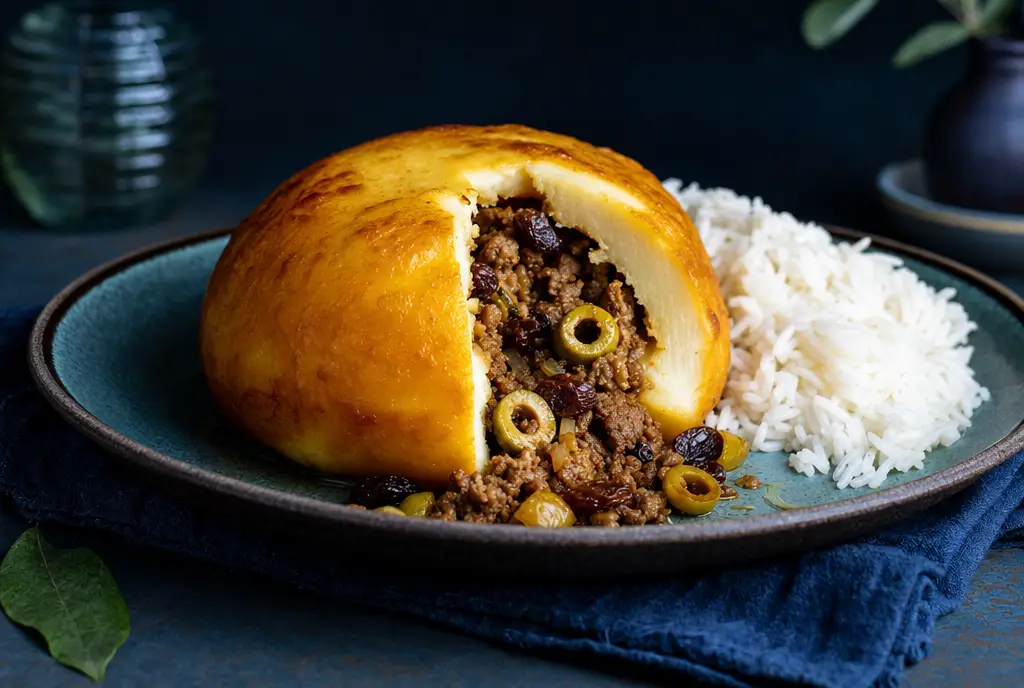
Keshi yena means, in Papiamentu, "stuffed cheese." The etymology is not complicated. What produced the dish is.
Curaçao was a Dutch colonial trading post, a central hub of the transatlantic slave trade, a place where Dutch merchant families ate Edam and Gouda and, when the cheese was finished, discarded the hollowed rinds. The people those families had enslaved took those rinds. They stuffed them with the spiced meat and olives and capers and raisins they had — the scraps of someone else's table — sealed the cheese around the filling, and baked it until the whole thing became something entirely new and entirely theirs.
That is what keshi yena is. A rind repurposed. A dish built from what was left over. It is, by any measure, an act of extraordinary culinary invention, and the fact that it became the national dish of the independent nation of Curaçao is not irony. It is the whole story.
Today keshi yena is made with full wheels of Edam rather than salvaged rinds — the dish has outgrown its origins without forgetting them. The filling is typically chicken or beef, spiced with the Krioyo flavours of the island: cumin, annatto, the slight sweetness of raisins and a mild heat that does not announce itself but is there when you look for it. The cheese melts around and through the filling as it bakes, and what comes out is something between a casserole and a savoury pastry, the cheese forming a golden, yielding shell that gives way to the filling inside.
You will need a whole small wheel of Edam for this. Approximately 1kg. Do not substitute with pre-shredded cheese in a bag. What are we, animals.
Serves: 4–6 · Time: 1 hour 30 minutes · Active: 40 minutes
Ingredients
- 1 small wheel of Edam cheese (approximately 900g–1kg), wax removed
- 400g ground chicken or beef (or a mix)
- 1 tbsp olive oil
- 1 small white onion, finely diced
- 3 cloves garlic, minced
- 1 small bell pepper (red or green), finely diced
- 2 medium tomatoes, roughly chopped
- 2 tbsp tomato paste
- 50g green olives, pitted and roughly chopped
- 2 tbsp capers, rinsed
- 40g raisins
- 1 tsp ground cumin
- ½ tsp sweet paprika
- ¼ tsp annatto powder (or substitute ½ tsp additional paprika)
- pinch of cayenne
- salt and black pepper
- 2 eggs, beaten
- fresh parsley, to finish
Method
- Preheat your oven to 180°C (350°F). Prepare the cheese: using a sharp knife, slice the top off the Edam wheel about 2cm down — this will be your lid. With a spoon and your hands, hollow out the interior, leaving a shell about 1.5cm thick. Reserve the scooped cheese. You will use some of it; eat the rest while you cook, which is your right.
- Make the filling. Warm the oil in a wide pan over medium heat. Add the onion and bell pepper and cook until soft, about 8 minutes. Add the garlic, cook 1 minute more. Add the ground meat and break it up with a spoon. Cook, stirring, until no pink remains — about 6 minutes.
- Add the tomatoes, tomato paste, cumin, paprika, annatto, and cayenne. Stir to combine and cook for 5 minutes, until the tomatoes have broken down and the mixture is fragrant. Add the olives, capers, and raisins. Season well with salt and pepper. The filling should taste assertive — slightly salty, slightly sweet from the raisins, with the olives and capers providing their own salt and acid. Taste it. Adjust.
- Remove from heat. Let the filling cool for 10 minutes, then stir in the beaten eggs and a handful of the reserved grated Edam. The eggs will bind the filling as it bakes, and the extra cheese will melt through it.
- Butter a baking dish just large enough to hold the cheese wheel upright. Place the hollowed Edam shell in the dish. Pack the filling in firmly — do not leave air pockets. Place the lid back on top.
- Bake at 180°C for 35 to 40 minutes, until the cheese shell is golden and the sides have visibly softened and begun to slump slightly. The interior will be molten. Remove from the oven and let it rest for 10 minutes before slicing — this is not negotiable, the filling needs time to set enough to cut cleanly.
- Slice into wedges at the table. Each slice should show the golden cheese shell and the spiced filling inside. Scatter parsley over the top. Serve with white rice or crusty bread.
A rind repurposed. A dish built from what was left over. That is what keshi yena is — and also, in a sense, what Curaçao is.
— Gusto
How to serve this.
Currywurst is fast food. It arrives in its paper tray, it is eaten immediately, it does not wait. Keshi yena is the opposite: it rests, it is sliced, it is served at the table with deliberateness.
Start the keshi yena first. It takes the longer road. While it rests out of the oven, finish the currywurst. By the time the sausage is sliced and sauced, the cheese is ready to cut.
Put them both on the table. The paper tray at one end. The whole baked cheese wheel at the other. No footnote needed. The match is in 90 minutes.
Two dishes born from nothing — which is where the best cooking comes from.
Herta Heuwer did not set out to create an institution. She had ketchup, Worcestershire sauce, and curry powder because a British soldier gave them to her in trade. She had sausage because sausage was what was available in postwar Berlin. The constraint was the invention. The same is true of keshi yena: an empty cheese rind, spiced meat, and the ingenuity of people who had every reason not to celebrate anything and chose to make something worth eating anyway. Both dishes carry the fingerprints of the moment that produced them. The best food almost always does. You do not need exceptional ingredients to make something exceptional. You need to understand what you have and refuse to treat it as less than it is. That is what Herta did. That is what the cooks of Curaçao did. That is what this table is for.
If you must vary it
- Keshi yena with chicken only. The lighter filling works well and is more traditional in many households. Shred poached chicken rather than using ground meat — the texture is different and worth the extra step.
- Currywurst with a bought sauce. I allow it. Hela and Thomy both make commercially available curry ketchup that is honest. The homemade sauce is better. The bought sauce is not a failure.
- Keshi yena without the whole wheel. If you cannot source a small Edam wheel, line a buttered baking dish with sliced Edam, fill it, cover with more sliced Edam, and bake. It is a casserole, not keshi yena in the strict sense, but the flavours are correct.
Germany's second menu is soft pretzels with an Ivorian chicken braise in Germany vs Ivory Coast. Curaçao's other appearance pairs an orange and rum cake with Ecuadorian ceviche in Ecuador vs Curaçao. Each remaining fixture can be found through the Eat the Match index.
Gusto / June 2026
Herta Heuwer took her recipe to the grave. The cooks of Curaçao turned an empty rind into a national dish. Do not tell me you don't have enough to work with.