Belgium vs Egypt: Moules-frites and Koshari
Moules-frites and koshari — two national dishes that prove a cheap ingredient list and abundance are not the same thing.
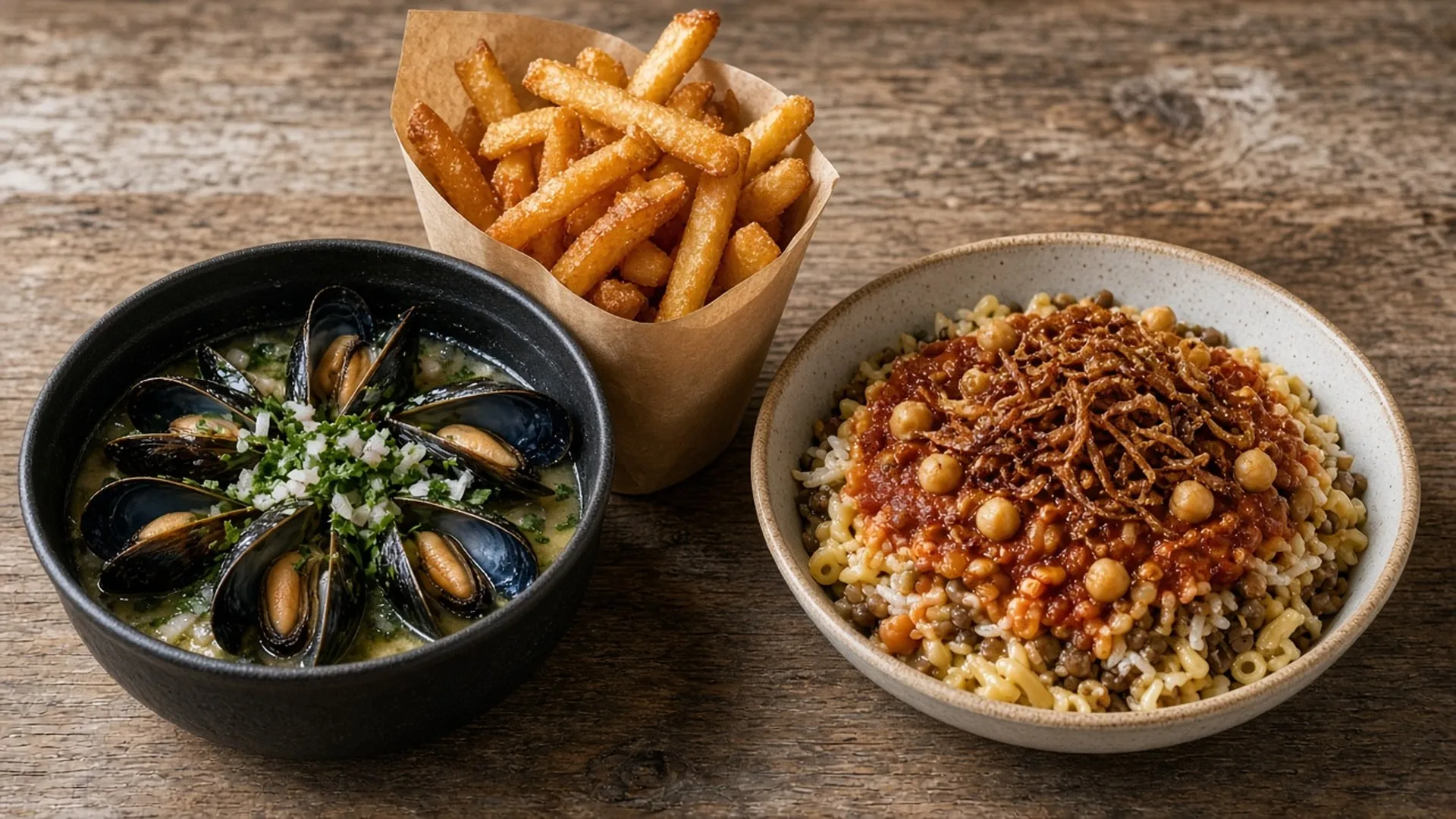
Moules-frites and koshari — two national dishes that prove a cheap ingredient list and abundance are not the same thing.
- Belgium: Moules-frites
- Egypt: Koshari
- Match: Group Stage · Seattle · June 15, 2026
There is a version of this conversation that goes: Belgium has one of the great culinary traditions in the world, and Egypt has rice and lentils in a bowl.
I am not having that conversation.
What Belgium has is the North Sea, an extraordinary mussel farming tradition, and the discipline to leave a great ingredient alone. What Egypt has is koshari — a bowl of rice, lentils, macaroni, chickpeas, fried onions, and tomato-vinegar sauce that has been feeding Cairo for well over a century and has never needed to be more than what it is.
Moules-frites is Belgium's answer to the question: what do you do when the ingredient is perfect? The answer is: steam it in white wine and shallots and serve it in the pot it cooked in, with fries on the side, and do not apologize for the simplicity because the simplicity is the point.
Koshari is Egypt's answer to a different question: what do you make when you have five cheap things and a city to feed? The answer is: a dish that has so many textural layers and flavors competing at once that it takes three bites to understand it and a hundred to stop eating it.
Both answers are correct.
The Belgian side — moules-frites.
Moules-frites is not a mussel recipe with fries on the side. It is a system. The mussels and the fries must arrive together — the pot, the cone, the beer — and they must be eaten simultaneously, the brine from the mussels occasionally borrowing a fry, the fry borrowing a mussel shell to use as a pincer for the next mussel. This is not an accident of presentation. It is the architecture of the dish.
The Belgian tradition is moules marinières — mussels steamed in white wine and shallots. There are variations: moules à la crème, moules au cidre, moules au Roquefort (this last one exists and I have had it and I will say only that it exists). The marinières version is the correct version. The wine deglazes the pot and becomes the broth. The shallots sweeten and soften. The mussels open and release their liquor into the steam, which they then absorb back as they cook. The whole system is self-basting.
The mussel is a filter feeder. It lives by drawing seawater through its body and extracting what it needs. This means the mussel you buy carries the quality of the water it lived in. The mussels on Belgian tables traditionally come from Zeeland, just across the border in the Netherlands. If you have access to live Zeeland mussels, use them. If not, the freshest mussels your fishmonger has today are the right mussels for tonight.
Buy them the day you cook them. This is not negotiable.
Serves: 4 · Time: 45 minutes (frites) + 15 minutes (mussels — the mussels are fast) · Active: 35 minutes
Ingredients
For the mussels:
- 2kg live mussels, scrubbed and debearded
- 30g unsalted butter
- 4 large shallots, finely sliced
- 3 cloves garlic, finely sliced
- 250ml dry white wine (Muscadet, Pinot Grigio, or any dry white you would actually drink)
- 4 sprigs fresh thyme
- 1 bay leaf
- handful of flat-leaf parsley, roughly chopped, to finish
- salt and black pepper
For the frites:
- 1kg floury potatoes (Maris Piper, Rooster, or Russet), peeled
- 2 litres neutral oil, for frying
- fine salt
To serve:
- bread, for the broth — not optional
Method
Frites first — they take longer and can be held briefly:
- Cut the potatoes into batons 1cm x 1cm x 8cm. Rinse in cold water until the water runs clear. Dry completely — thoroughly, obsessively — in a clean cloth. Moisture is the enemy of the crust. Wet potato = steam in the oil = no crust. Do this properly.
- Heat the oil to 140°C (284°F). This is the first fry — the blanch. Working in batches, fry the potato batons for 6 to 7 minutes until they are cooked through but still pale with no color. They should be soft when pierced. Remove, drain on a rack, and let them cool to room temperature. This is the double fry Belgian frites are known for. The first fry cooks the potato. The second fry builds the crust.
- When the mussels are nearly ready (step 6 below), raise the oil temperature to 180°C (356°F). Fry the blanched batons in batches for 3 to 4 minutes until deeply golden, with a proper crust that sounds crisp when you tap it. Drain on a rack, salt immediately while hot. Do not cover — covering traps steam and softens the crust you just built.
Mussels:
- First, sort the mussels. Discard any that are cracked or do not close when tapped firmly. Any mussel that is already open and stays open is dead. Do not use it. This sorting is not optional — a dead mussel in a pot can ruin everything around it.
- In a pot large enough to hold all the mussels with room above (they will expand as they open), melt the butter over medium heat. Add the shallots and cook gently for 4 minutes until soft and translucent. Add the garlic and cook 1 minute more. Add the thyme and bay leaf.
- Raise the heat to high. Add the wine and let it bubble for 30 seconds — you are boiling off the harshest alcohol. Add all the mussels in one go. Cover the pot tightly. Cook over high heat for 3 to 4 minutes, shaking the pot once halfway through. Open the lid: the mussels should be wide open and steaming. Any that have not opened after 5 minutes are to be discarded. Do not try to pry them. If a mussel will not open with heat, it was not alive when it went in.
- Scatter the parsley over the top. Taste the broth — it will be intensely savoury and slightly sweet. It needs almost no salt because the mussels have seasoned it. Grind black pepper generously.
- Bring the pot to the table. Bring the frites alongside in a bowl. Bring the bread. Put them all down at once.
The Egyptian side — koshari.
Koshari is Cairo's street food in the way that the hot dog is New York's street food and the baguette is Paris's breakfast — it is everywhere, it is cheap, it is made by people who have been making it for so long that the technique is in the hands before it reaches the mind, and it is exactly what it needs to be.
The dish is usually traced to the nineteenth century, though its exact origin is argued over — the most common account is Indian khichdi (rice and lentils) meeting Italian pasta, given an Egyptian tomato sauce, topped with fried onions, and finished with a sharp vinegar-garlic dressing called dakka. Every element is negotiable in the proportions. None of the elements is negotiable in the presence.
What makes koshari interesting is not any single component. It is the layering — the distinct textures and temperatures all arriving at once, the lentils earthying up the pasta, the chickpeas giving weight, the crispy onion giving something to chew against, the tomato sauce giving acid and sweet, the dakka cutting through all of it. Each layer is plain on its own. Together they create something that makes no particular sense until you eat it, at which point it makes complete sense.
The key technical point: the fried onions go in last, on top, and are never stirred in before serving. Their job is to stay crisp long enough for each person to have them while they are still crisp. Once they go into the bowl and absorb moisture from the lentils and sauce, they soften. They are better crisp. Serve immediately.
Serves: 4 · Time: 1 hour · Active: 40 minutes
Ingredients
For the base:
- 300g Egyptian short-grain rice (or any short-grain white rice), rinsed until water runs clear
- 200g brown lentils (not red — they must hold their shape)
- 150g elbow macaroni or ditalini (small tube pasta)
- 400g can chickpeas, drained and rinsed
- salt
For the tomato sauce:
- 3 tbsp olive oil
- 1 medium white onion, finely diced
- 4 cloves garlic, minced
- 400g can crushed tomatoes
- 2 tbsp white wine vinegar or apple cider vinegar
- 1 tsp ground cumin
- ½ tsp ground coriander
- ½ tsp cayenne
- salt to taste
For the dakka (vinegar-garlic sauce):
- 3 tbsp white wine vinegar
- 2 cloves garlic, minced to a paste with a pinch of salt
- 1 tsp ground cumin
- ½ tsp cayenne
- 3 tbsp water
For the crispy onions:
- 2 large white onions, very thinly sliced into half-moons
- 4 tbsp neutral oil
- salt
Method
- Start the lentils. Place the brown lentils in a pot with enough cold water to cover by 5cm. Bring to a boil, then simmer for 20 to 25 minutes until tender but still holding their shape. They should not be mushy. Drain, season with salt, and set aside.
- Make the tomato sauce. In a saucepan, warm the olive oil over medium heat. Add the onion and cook until soft and beginning to color, about 8 minutes. Add the garlic and cook 1 minute. Add the cumin, coriander, and cayenne, stir for 30 seconds. Add the crushed tomatoes and vinegar. Simmer uncovered for 15 minutes until the sauce has thickened and concentrated. Season with salt. The sauce should taste sharp and savory with real depth — not sweet. Keep warm.
- Make the dakka. Combine all ingredients in a small bowl. It should taste fiercely acidic and garlicky. This is correct. A small amount will go a long way.
- Cook the rice. In a medium pot, bring 600ml salted water to a boil. Add the rinsed rice. Reduce heat to the lowest setting, cover tightly, and cook for 15 minutes undisturbed. Remove from heat and leave covered for 5 minutes. Fluff with a fork.
- Cook the pasta in boiling salted water until al dente. Drain. Do not overcook — the pasta will soften further when it meets the warm lentils.
- Fry the onions. This is done last so they arrive crispy. Heat the oil in a wide pan over medium-high heat until shimmering. Add the onions in a single layer — or as close as your pan allows. Cook without stirring for 4 minutes until they begin to color. Then stir occasionally, adjusting heat as needed, until deeply golden and crisp, about 10 to 12 minutes total. Season with salt. Drain on a rack. They will crisp further as they cool slightly.
- Warm the chickpeas in a small pan with a splash of water and a pinch of cumin. Salt them.
- To assemble: layer the components in individual bowls or one large serving dish in this order — rice, then lentils, then pasta, then chickpeas. Spoon tomato sauce generously over the top. Add the crispy onions last, in a heap. Serve the dakka in a small dish on the side — people add it to taste.
Belgium left a great ingredient alone. Egypt made five cheap things into something irreducible. Both are right.
— Gusto
How to serve this.
The koshari can be assembled while the frites finish their second fry. Neither dish waits well — the mussels because they begin to close and toughen, the frites because they lose their crust, the koshari onions because they soften the moment they hit moisture.
Move fast. Set the table before you cook. Bring everything at once.
The mussel pot goes in the middle. The frites bowl alongside. The koshari at the other end, dakka in a small dish beside it, extra tomato sauce in a pot for those who want more. Beer for Belgium. Karkadeh (cold hibiscus tea) or a sparkling water for Egypt, if you want to go with the city.
Two dishes that feed nations — from opposite ends of the budget.
Moules-frites and koshari have nothing in common on paper. One requires a good fishmonger and a cold European sea. The other requires a pantry and a pot. One dish is built around a single outstanding ingredient. The other is built around five ordinary ones. But both of them answer the same question that every serious national dish answers: what feeds a lot of people, reliably, on a Tuesday, with what is actually available? Belgium answered with the North Sea and the potato. Egypt answered with rice, lentils, pasta, chickpeas, and an onion. Neither answer requires anything extraordinary. Both produce something you cannot stop eating. This is not a coincidence.
If you must vary it
- Moules à la crème — stir 100ml double cream into the broth for the last minute, once the mussels have opened. Rich, and correct. I allow it entirely.
- Koshari without the pasta. Some Egyptian versions skip it. The dish holds without it. I prefer it with — the different textures are the point.
- Koshari with vermicelli instead of macaroni. Traditional in many Cairo households. Slightly different texture, same logic.
Belgium's second table pairs Liège waffles with saffron tahdig in Belgium vs Iran. If the two-temperature frites appealed, the frying temperatures behind bitterballen and tonkatsu are explained in Netherlands vs Japan. The rest of the tournament pairings are gathered under Eat the Match.
Gusto / June 2026
Belgium has the North Sea. Egypt has a bowl that has been feeding Cairo for well over a century. At Lumen Field in Seattle tonight, they settle the football. The kitchen has already given its answer.