Belgium vs Iran: Liège Waffles and Tahdig
Belgium claims the chip. Iran perfected the crust on the rice pot. Both deserve your full attention.
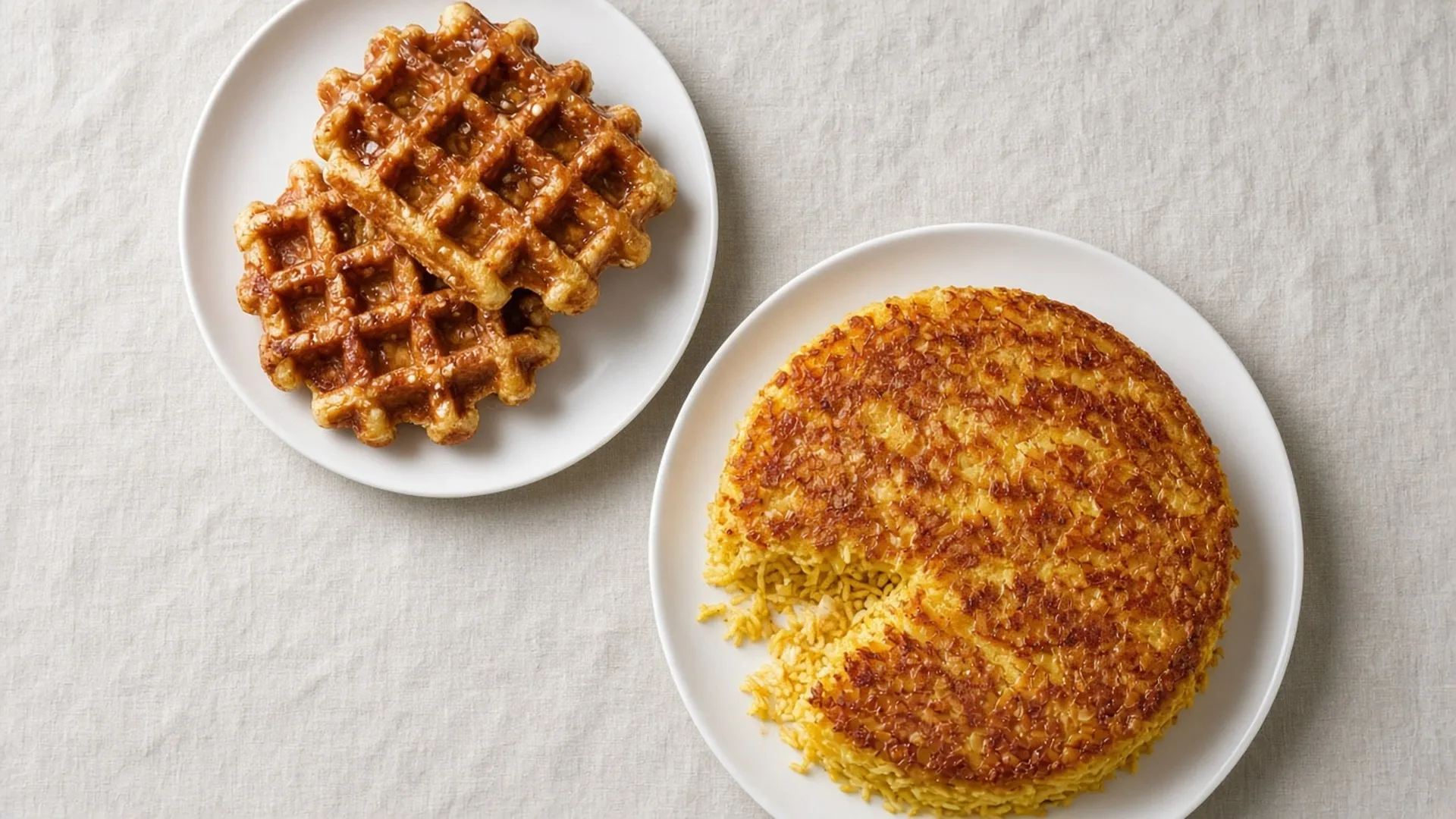
Belgium claims the chip. Iran perfected the crust on the rice pot. Both deserve your full attention.
- Belgium: Liège Waffles
- Iran: Tahdig
- Match: Group Stage · Los Angeles · June 21, 2026
Belgium's contribution to world cuisine is underestimated because it sounds modest: they gave us the waffle and, by their own account, the chip. What they actually gave us was the understanding that texture is not secondary to flavor — that the crisp exterior and the yielding interior are not a happy accident but the entire point of a dish, worth engineering deliberately.
Iran gave us tahdig, which operates on the same principle with rice. Tahdig is the crust that forms on the bottom of the rice pot — golden, shatteringly crisp on one side, still fluffy on the other. The rest of the rice cooks above it in fragrant steam. In Iran, the tahdig is the prize. The honored guest receives it. In my kitchen, whoever can get to it first.
Today we are making proper Belgian waffles — the Liège version, which uses pearl sugar and yeast and produces a waffle that is chewy in the center and caramelized in the pockets — alongside tahdig cooked with saffron and served with a simple herb kuku (Persian frittata). Both dishes are about what happens when something makes perfect contact with heat. Both require you to not interfere while they cook.
Liège waffles, saffron tahdig, and herb kuku.
Serves: 4-6 · Time: 2 hours (including waffle dough rest) · Active: 40 minutes
Ingredients
For the Liège waffles:
- 300g plain flour
- 7g instant yeast
- 100g unsalted butter, at room temperature
- 2 eggs
- 120ml warm milk
- 1 tbsp caster sugar
- ½ tsp salt
- 1 tsp vanilla extract
- 150g Belgian pearl sugar (available in specialty food shops — do not substitute regular sugar, it melts)
For the tahdig with saffron:
- 400g basmati rice, rinsed until water runs clear
- large pinch saffron, bloomed in 3 tbsp warm water
- 60g unsalted butter, plus 1 tbsp extra
- 2 tbsp neutral oil
- salt
For the herb kuku (Persian herb frittata):
- 6 eggs
- large bunch flat-leaf parsley, finely chopped
- large bunch coriander, finely chopped
- 4 spring onions, finely sliced
- 2 tbsp dried barberries (or currants)
- 1 tsp baking powder
- ½ tsp turmeric
- salt and black pepper
- 2 tbsp neutral oil
Method
- Make the waffle dough: combine flour, yeast, sugar, and salt. Add the warm milk, eggs, and vanilla. Mix until a shaggy dough forms. Add the softened butter in pieces and mix or knead until incorporated and smooth — 5-6 minutes. The dough will be sticky. Cover and rest 1 hour at room temperature until doubled.
- For the tahdig: bring a large pot of well-salted water to a boil. Add the rinsed rice and boil for exactly 7 minutes — the rice should be just barely tender at the outside but still raw at the center. Drain.
- In the pot, heat 60g butter and the oil over medium heat. Add 4 tablespoons of the bloomed saffron water. Add a 1cm layer of the parboiled rice. Flatten gently. Mix the remaining saffron water with 2 tablespoons of water and drizzle over the remaining rice. Pile the remaining rice on top in a loose mound. Make 5-6 holes in the rice with the handle of a wooden spoon — steam vents.
- Wrap the lid in a clean tea towel and place on the pot. Cook on medium heat for 10 minutes — you are establishing the crust — then reduce to low and cook 35 minutes. Do not lift the lid.
- For the kuku: whisk the eggs with baking powder, turmeric, salt, and pepper. Stir in the herbs, spring onions, and barberries. Heat oil in a medium skillet over medium heat. Pour in the egg mixture. Cook covered on medium-low for 8-10 minutes until the edges are set and the center is just barely wobbly. Flip onto a plate and slide back into the pan. Cook 3-4 minutes on the second side.
- Fold the pearl sugar into the rested waffle dough — it will seem like too much sugar and it is not. Divide into 8 pieces. Cook in a hot waffle iron according to your iron's instructions. The pearl sugar will caramelize against the iron — you will hear it. Let it. The caramelized pockets are the point.
- To serve the tahdig: run the pot briefly under cold water — 10 seconds — then invert onto a large plate in one confident motion. The crust should release as one golden disc. If it does not, a thin spatula around the edges before inverting helps.
- Serve the waffles hot from the iron. Serve the tahdig with the kuku alongside. Eat both at the table.
In Iran, the tahdig is the prize. The honored guest receives it. In my kitchen, whoever can get to it first.
— On the democratic tahdig
Why both dishes are about what happens at the bottom.
The Liège waffle and the tahdig are, beneath their obvious differences, the same culinary idea: deliberate caramelization at the contact surface, with a different texture maintained above it.
In the waffle iron, the pearl sugar in direct contact with the hot metal plate caramelizes. The batter above it rises and sets in steam. You get crunch below and chew above in every bite.
In the tahdig pot, the bottom layer of parboiled rice in contact with the butter and the hot metal of the pot undergoes the same surface caramelization — the starch browns, the moisture drives out, the crust forms. The rice above it steams gently in the moisture driven upward, remaining fluffy.
In both cases the technique requires patience and the refusal to interfere. Opening the waffle iron early breaks the crust before it sets. Opening the pot lid releases the steam and collapses the rice above. The cook's job is to wait.
If you must vary it
- Potato tahdig. Place thin-sliced potato in the butter at the bottom of the pot instead of the first rice layer. The potato becomes the crust — golden, shatteringly crisp, slightly richer than the plain rice version. This is my preferred variation and I am not ashamed of it.
- Brussels waffles instead of Liège. Brussels waffles use beaten egg whites for lift and no yeast, producing a lighter, crispier waffle with a more neutral flavor. Omit the pearl sugar, separate the eggs, fold beaten whites into the batter. Serve with cream and strawberries. Different waffle. Both are Belgian.
The bottom-crust idea behind tahdig returns in paella's socarrat: see Spain vs Saudi Arabia, where both rice dishes are cooked in braising liquid. Belgium's other menu, mussels with double-fried frites, is in Belgium vs Egypt, and all the match pairings live on the World Cup food page.
Gusto / June 2026
One motion. Invert with confidence. The tahdig is waiting.