Scotland vs Morocco: Cock-a-leekie and Lamb Tagine
Haggis won't travel but lamb tagine will, and one of these nations knows exactly what to do with a spice cabinet.
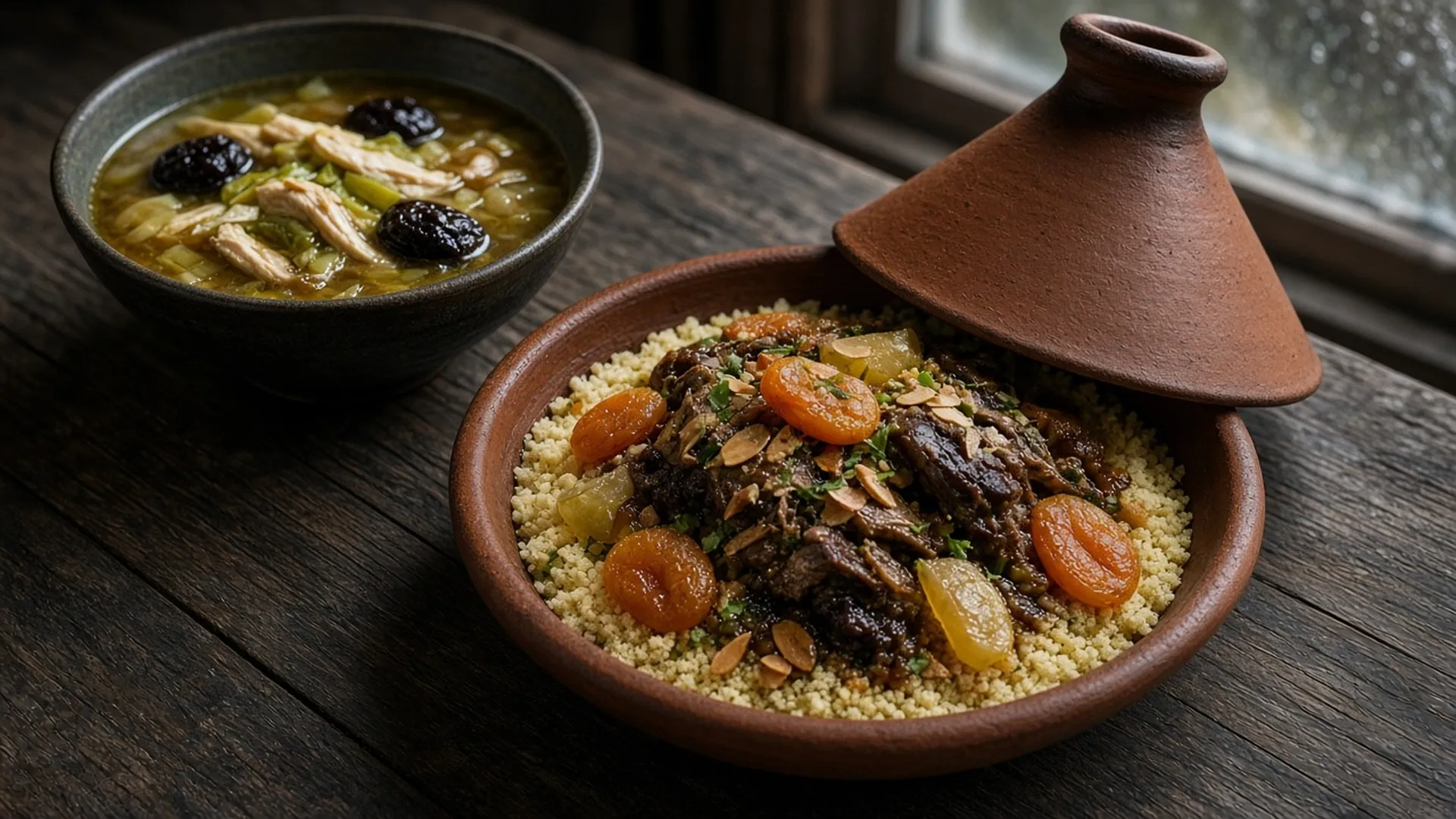
Haggis won't travel but lamb tagine will, and one of these nations knows exactly what to do with a spice cabinet.
- Scotland: Cock-a-leekie
- Morocco: Lamb Tagine
- Match: Group Stage · Boston · June 19, 2026
Scotland is a country of great courage and difficult weather that has produced, over centuries, a cuisine built entirely around the question of what you can do with things that are available when the sky is grey and the sea is cold. The answer, it turns out, is more than you'd expect. Cullen skink. Cranachan. A proper Scotch broth that takes you apart from the inside and puts you back together.
But haggis, which is the dish everyone wants to make for this match, requires a sheep's stomach and a level of commitment I will not ask of you on a Friday evening. We are making cock-a-leekie instead — Scotland's quiet masterpiece, a chicken and leek soup with prunes that has no business being as good as it is.
Morocco, meanwhile, does not have Scotland's problem. Morocco has saffron, preserved lemon, ras el hanout, and centuries of trade routes that deposited the world's spice cupboard at its doorstep. The lamb tagine I am giving you is not a quick dish — nothing worth making with lamb shoulder ever is — but the active work is twenty minutes. The rest is the oven doing what ovens are for.
Make both. Feed more people than you planned to. That is the correct approach to this match.
Moroccan lamb tagine and Scottish cock-a-leekie.
Serves: 4-6 · Time: 2 hours 30 minutes · Active: 25 minutes
Ingredients
For the lamb tagine:
- 1.2kg lamb shoulder, bone-in, cut into large pieces (ask your butcher)
- 2 white onions, roughly chopped
- 4 garlic cloves, minced
- 1 tbsp ras el hanout
- 1 tsp ground cumin
- 1 tsp ground coriander
- ½ tsp ground cinnamon
- ½ tsp ground ginger
- pinch of saffron, bloomed in 2 tbsp warm water
- 1 preserved lemon, pulp removed, rind finely sliced
- 400g tin chopped tomatoes
- 200ml lamb or chicken stock
- 100g dried apricots, halved
- handful of green olives, pitted
- salt and black pepper
- flat-leaf parsley and toasted almonds to finish
- couscous or flatbread to serve
For the cock-a-leekie (serves alongside):
- 1 whole chicken, jointed into 8 pieces
- 4 leeks, white and light green parts, cut into 3cm rounds
- 6 dried prunes, pitted and halved
- 1.5 litres good chicken stock
- 2 bay leaves
- salt and white pepper
- flat-leaf parsley to finish
Method
- Start the tagine first. Season the lamb aggressively with salt and pepper. In your heaviest pot or a proper tagine over a diffuser, heat oil until smoking. Brown the lamb in batches — do not crowd the pan, do not rush this, do not move the pieces until they release. Dark brown on at least two sides. This is where the flavor lives.
- Remove the lamb. In the same fat, cook the onions over medium heat for 10 minutes until soft and starting to color. Add the garlic and all the dry spices. Cook, stirring, for 2 minutes. The spices must cook in fat — they do not bloom in liquid.
- Add the saffron and its soaking water, the tomatoes, and the stock. Stir to lift every dark bit from the bottom of the pot — those bits are flavor. Return the lamb. Add the apricots and preserved lemon. Bring to a simmer, cover tightly, and transfer to the oven at 160°C / 320°F.
- Cook for 2 hours. Check at 90 minutes — the lamb should be beginning to fall from the bone. At 2 hours it should be fully surrendered. Add the olives for the final 15 minutes.
- While the tagine cooks, make the cock-a-leekie. Bring the stock to a simmer in a large pot. Add the chicken pieces and bay leaves. Simmer gently — not boil, simmer — for 25 minutes. Remove the chicken, shred the meat from the bones, return the meat to the pot.
- Add the leeks and prunes to the pot. Cook a further 15 minutes until the leeks are fully tender. Season with salt and white pepper. The prunes will have softened into the broth and this is correct and good.
- Finish the tagine with parsley and toasted almonds. Serve over couscous or with flatbread torn at the table. Serve the cock-a-leekie in deep bowls with the broth ladled generously over the meat and leeks.
The prunes will have softened into the broth and this is correct and good.
— On cock-a-leekie
Why shoulder and why two hours.
Lamb shoulder contains far more connective tissue than the leg — which most people consider the prize cut and which is, for this application, the wrong choice. Connective tissue is mostly collagen. At temperatures above 70°C sustained over time, collagen converts to gelatin: it dissolves, thickens the braising liquid, and coats every piece of meat in a glossy, clinging sauce. This is why a shoulder tagine after two hours has a sauce that coats the back of a spoon and a leg of lamb does not.
The fruity sweetness of the apricots is not a flourish. It is a calculated contrast to the fat of the lamb and the salt of the preserved lemon. Moroccan cooking is not sweet — it is balanced, and the balance here requires something to meet the savory weight of the shoulder.
Scotland's cock-a-leekie operates on similar counterintuition: the prunes are not dessert. They are the bitter-sweet depth that keeps the soup from tasting like chicken water.
If you must vary it
- Chicken instead of lamb. Chicken thighs work in the tagine — reduce cooking time to 45 minutes covered, 15 uncovered. The sauce will be lighter. This is acceptable for a weeknight. The occasion is irrelevant. The standard is not.
- No tagine pot. A Dutch oven with a tight lid does the same job. If you own a tagine and have never used it, today is the day.
Scotland's smoked haddock soup, Cullen skink, is on the table in Haiti vs Scotland, and Morocco's kefta with eggs in tomato-harissa sauce appears in Brazil vs Morocco. Why ground spices need fat is covered more fully in the spice drawer triage column.
Gusto / June 2026
Scotland brings heart. Morocco brings spice. Your table brings both.