Your kitchen isn't disorganized. It's organized for a kitchen you don't have.
Most kitchen organizing is sorting by category for a kitchen nobody has. Sort by frequency instead, keep the two feet beside the stove empty, and give every drawer one verb. By Sam.
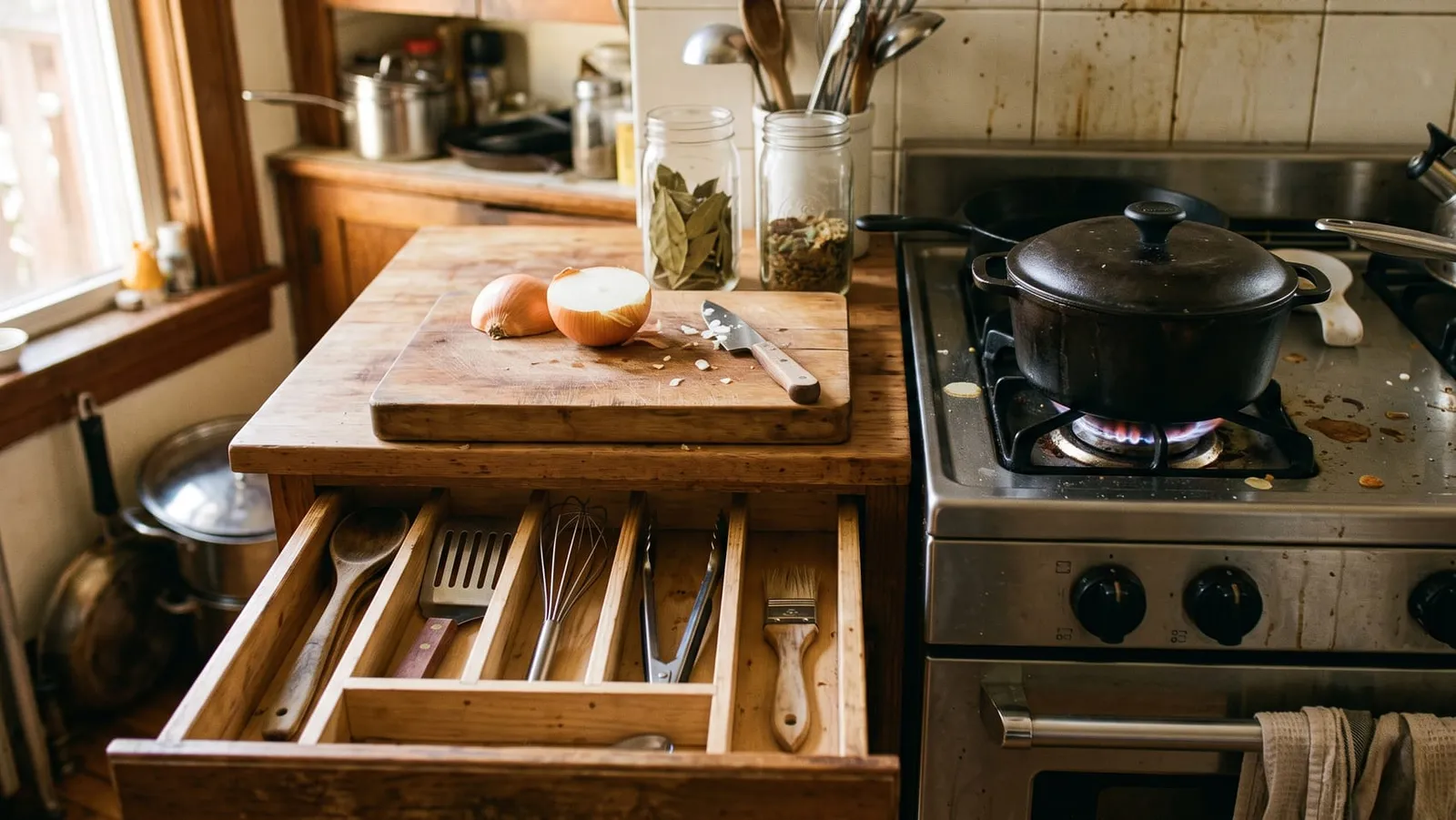
the organizing industry sells you containers. a container does not know what you cook.
- things most people reach for every single time they cook: 8
- empty bay you leave in every drawer — the maintenance budget: 1
- what the method costs before you buy a single divider: $0
- Updated: Aug '26
i once spent a saturday putting every baking item in one cabinet. flour, sugar, the good vanilla, three tins, a sifter i have used once, and an attachment for a stand mixer i do not own. it looked incredible. i took a photo of it.
then i cooked dinner, which is a thing i do most nights, and discovered that the salt was now in the baking cabinet, on the other side of the room, behind a sifter.
you don't shop in your kitchen. you cook in it — mostly the same eight things, mostly in the same forty minutes, mostly standing in the same square metre of floor.
so here's the alternative. four zones, sorted by how often you reach for something rather than by what shelf it belongs to philosophically. it takes an afternoon, it costs almost nothing, and the only thing you might buy is at the end.
00 / Before you buy a single container
Stand where you stand when you cook
don't tidy anything. don't move anything. the whole audit is four notes on a piece of paper, made from exactly the spot your feet already go.
the point is to find out what your kitchen is actually for, which is usually about eight objects and one square metre of floor — not what a cabinet layout says it's for.
- what you reach for every single time — for most people: salt, a fat, a board, a knife, one pan, one spoon. that list gets the prime real estate. (01)
- what's on the counter that you haven't used this week — that's the list that's currently stealing the real estate. (02)
- what you moved today to reach something else — anything you move to reach another thing is in the wrong place. permanently. by definition. (03)
- what's in the kitchen that isn't cooking — vases, batteries, the drawer. we'll come back to the drawer. (04)
Four zones, one afternoon
04 ZONES | HEAT, RUN, FREQUENCY, DRAWERS
Step 01 · Zone one | beside the heat
The two feet beside the stove. Kept empty.
the counter immediately next to the burners is the most valuable surface in the house, and almost everybody has a knife block, a fruit bowl and a stack of mail sitting on it.
clear it. permanently. that's landing space — for the hot pan, the plate, the thing you just took out of the oven with both hands full. when it's occupied you end up putting hot cookware somewhere it shouldn't go, which is how counters get scorched and how people get burned.
the only things allowed within arm's reach of the heat: salt, a cooking fat, and the two or three tools you use at the heat. everything else is a passenger.
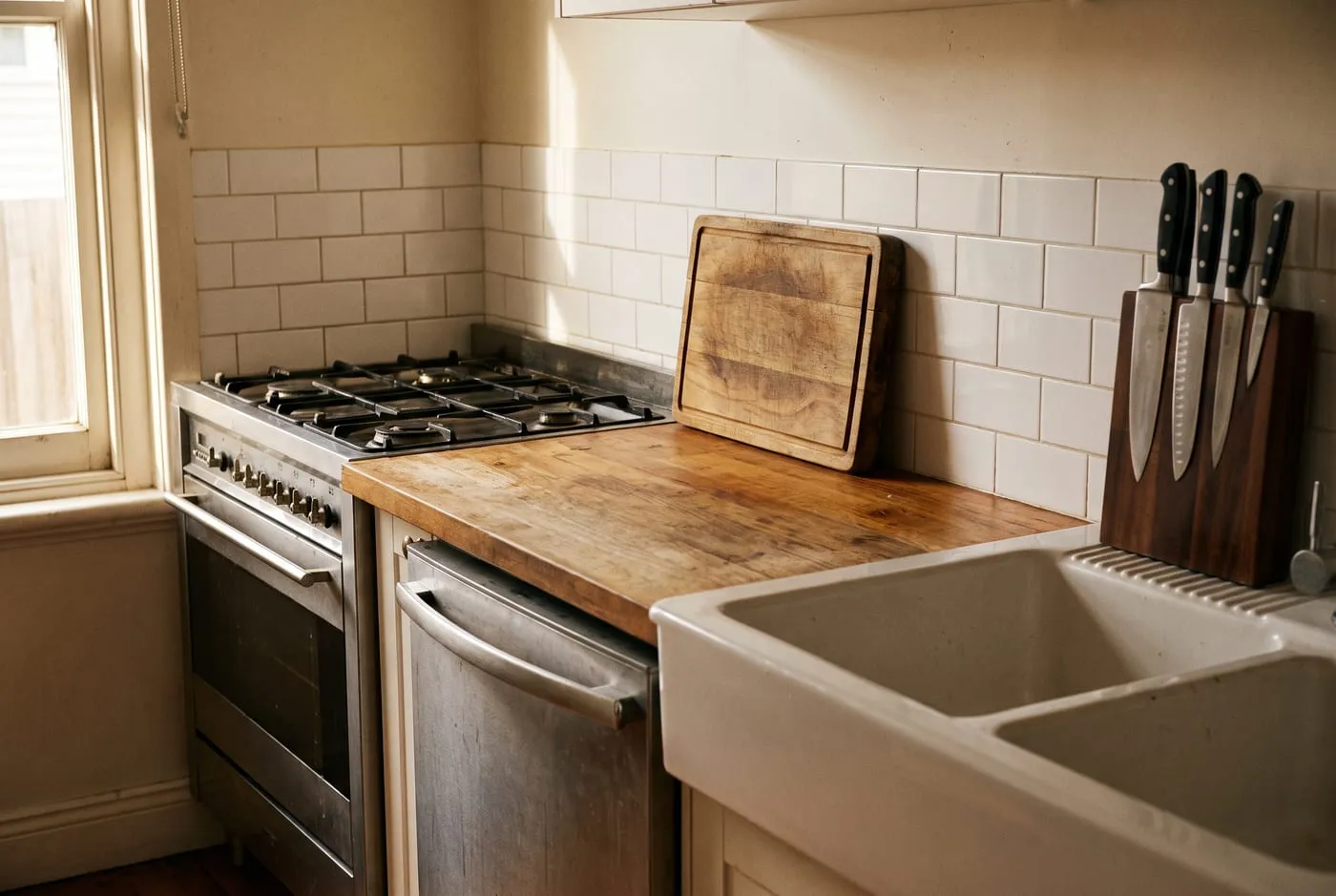
Step 02 · Zone two | the run
The run between the sink and the stove.
the work triangle is a lovely idea from an era of enormous kitchens. in a real one, prep happens on whatever counter sits between where you wash things and where you cook them. that's the run. protect it.
on it: a board, a knife within reach, a bowl for scraps. off it: the toaster, the kettle, the coffee setup, the appliance you use on sundays. those go to the far end, together, because they're a separate job that doesn't need to happen mid-prep.
if there's no counter at all between the sink and the stove — plenty of kitchens don't have one — then a board that sits over the sink is the single best thing you can buy for that room, and it costs about the same as lunch.
Step 03 · Zone three | the method
Sort by how often. Not by what it is.
this is the actual method, and it's the part that survives contact with a wednesday.
daily lives between hip and shoulder height, reachable with one hand, no bending and no stretch. that band is small. it should hold the eight things.
weekly lives directly above and below that band. bending is allowed. a step stool is not.
a few times a year goes to the top shelf, the back of the deep corner, or — and i mean this — out of the kitchen entirely. the roasting pan you use twice a year doesn't need to live in the room where you cook every day. put it in a closet. the kitchen is not a museum of your ambitions.
Step 04 · Zone four | drawers
One verb per drawer, and leave a bay empty.
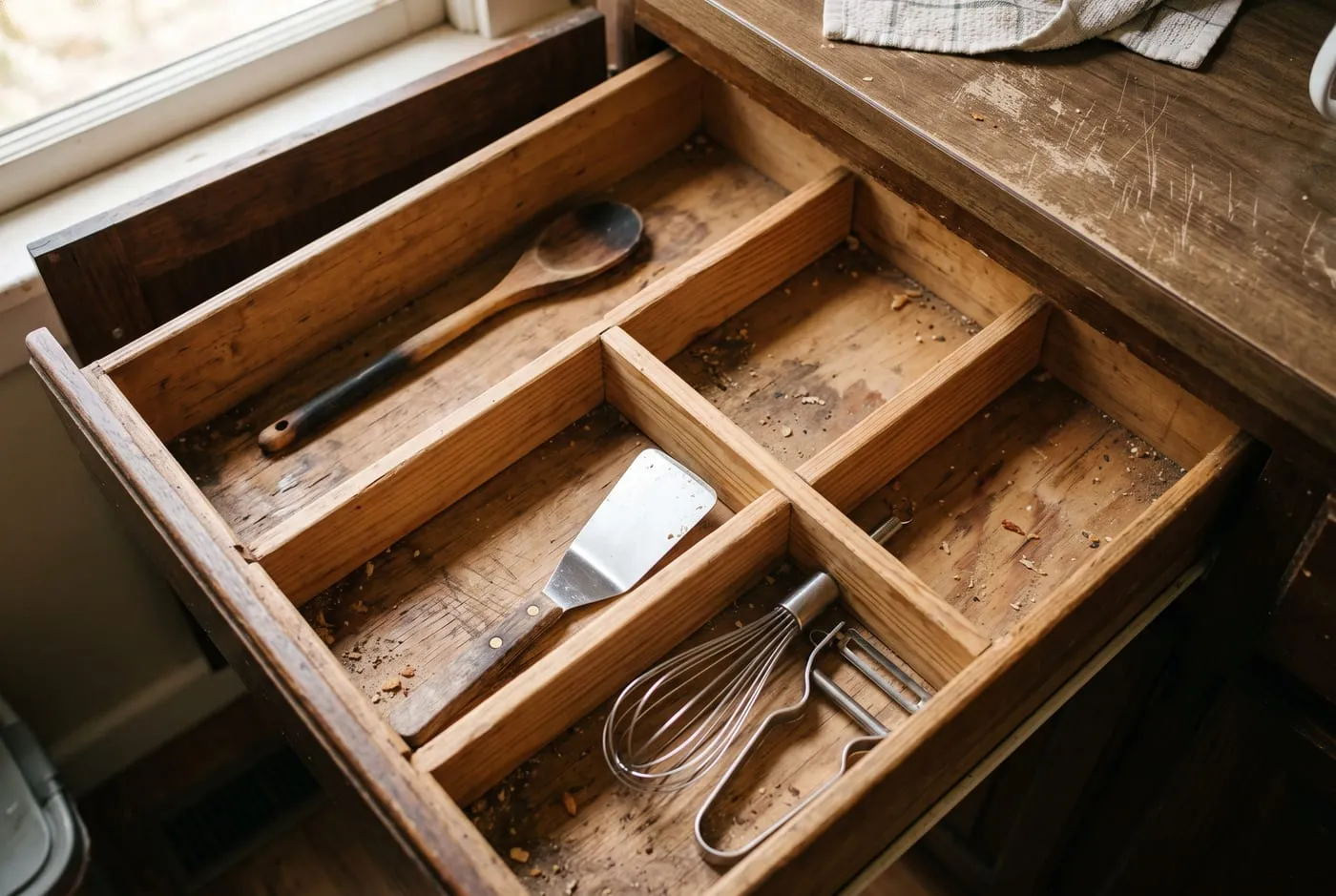
drawers fail because they hold nouns from four different jobs. give each one a verb instead.
cook — the tools you use standing at the stove, in the drawer next to the stove. it holds fewer things than you think; six good tools beat sixteen mediocre ones and you'll notice inside a week. eat — cutlery and serving spoons, near the table or near the dishwasher, whichever you unload from. fix — yes, the drawer. everybody has one, it's fine, i'm not going to pretend otherwise. what's not fine is a drawer with no dividers, because then it's a bin and you stop being able to find the tape you know is in there.
and then the rule almost nobody follows: leave one bay empty in every drawer. a system with no slack fails the first time you bring something new home, because there's nowhere for it to go except the counter. the empty bay isn't wasted space. it's the maintenance budget.
Sam's verdicts
Worth it, and not.
Worth it: adjustable drawer dividers
the cheapest thing on this list and the only one that stops the whole system sliding back inside a fortnight.
Worth it: a turntable in a deep corner cabinet
deep corners are where food goes to expire quietly. a turntable turns a cave into a shelf.
Worth it: one hook, in the right place
right place is wherever you already put that thing down. not wherever the wall looked empty.
Not worth it: decanting things you don't cook from
flour and sugar, genuinely useful — you scoop from them. pasta in a jar you have to funnel back out of is a photograph, not a system.
Not worth it: over-the-door racks that stop the door closing
you will hear it every day for a year.
measure the inside of the drawer first, then buy adjustable dividers that spring-fit the width — the sprung ones stop things migrating, which is the entire difference between an organized drawer and a drawer that was organized once.
kitchen cabinet organizers and drawer dividers →some links on this page are affiliate links — if you buy through one, we earn a commission at no extra cost to you.
Not a kitchen that photographs well. A kitchen that cooks on a Wednesday.
the goal is being able to make something ordinary without opening four doors. the salt goes next to the stove. that's the article, honestly.
two neighbours of this job while you are in there. the cabinet under the sink is where a slow drip hides behind the cleaning bottles, and a cheap leak sensor on its floor is covered in the no-subscription smart home guide. if that cabinet is already damp, what to do in the first sixty minutes is the order to work in. and the one hook in the right place still has to go into something solid — find the stud or use a real anchor.
— sam