Your AC doesn't break in August. It gives up.
Air conditioners rarely fail in August. They give up, after months of a dirty filter, a smothered outdoor coil and a drain line quietly filling with sludge. Three jobs, one afternoon. By Sam.
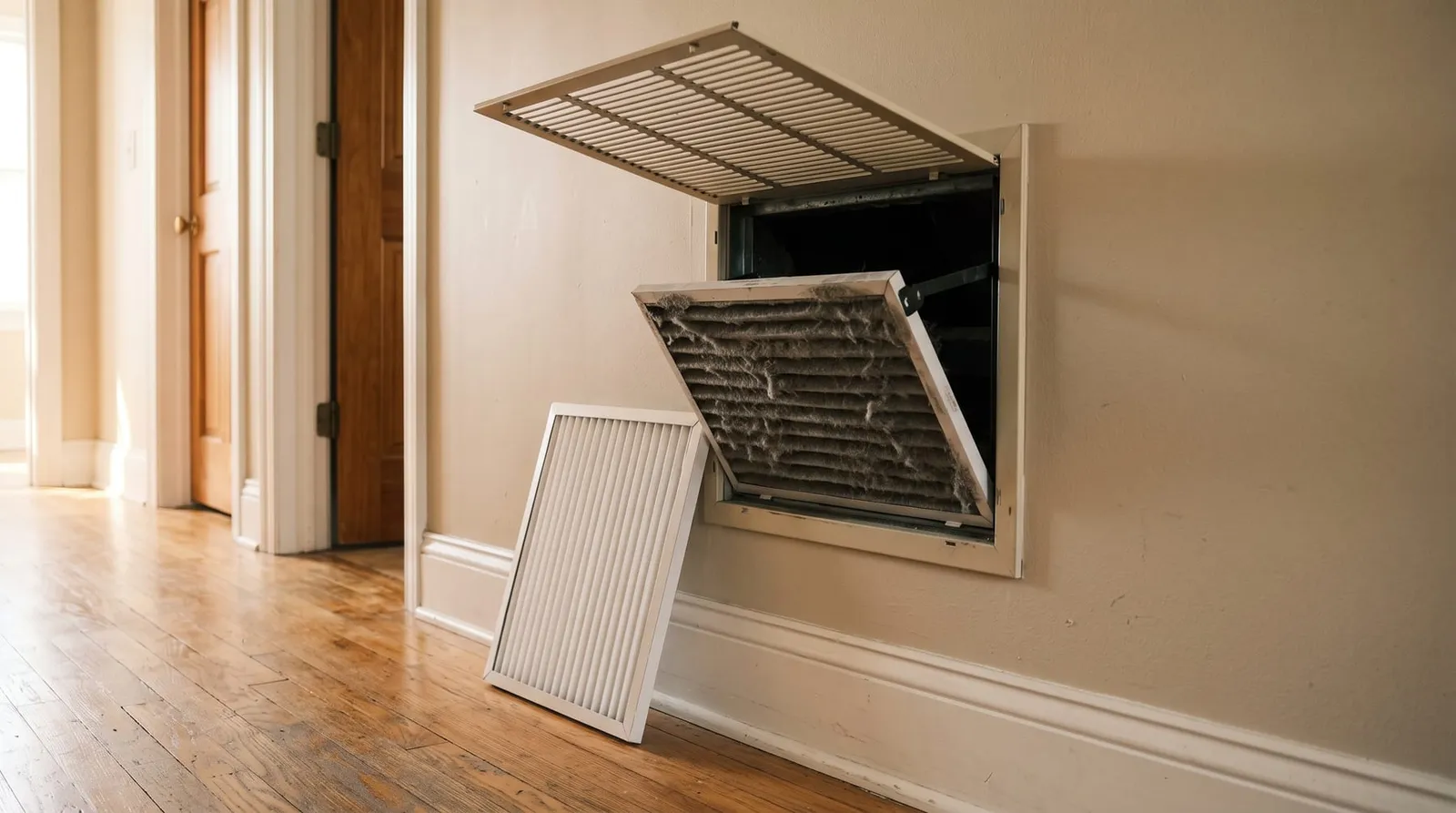
three jobs, one afternoon, and the one that saves a ceiling costs about eight dollars.
- jobs, all of them yours — none involve refrigerant or wiring: 3
- vinegar and a funnel, which is the one that saves a ceiling: ~$8
- of clear air the outdoor unit needs on every side: 2 ft
- Updated: Aug '26
nothing about an air conditioner fails suddenly in august. what happens is that it's been working slightly harder every week since may — through a filter that went in around march, past an outdoor coil wearing a coat of seed fluff, with a drain line quietly silting up — and then one afternoon it's ninety-five degrees and the system runs out of margin all at once.
it didn't break. it spent four months using up the room it had.
the good news: the three things carrying most of that load are all yours, they take an afternoon, and none of them involve refrigerant, wiring or a capacitor. those three belong to somebody with a license, and i'm not going to pretend otherwise.
One afternoon. Three jobs.
03 JOBS | FILTER, COIL, DRAIN LINE
Step 01 · Job one | the filter
The filter, fitted the right way round.
before you throw the old one out, read the size printed on the cardboard frame and put it in your phone. that's the single most reliable way to avoid standing in a store holding a tape measure and guessing.
then the bit that trips everybody: the new filter has a small arrow printed on its frame, and that arrow points the way the air travels — away from the room, toward the ducting and the blower. in backwards, and the filter's structure works against the airflow instead of with it. two-second detail, all-summer consequence.
on ratings, honestly: higher is not automatically better. a denser filter catches more and also resists more, and a system designed around a modest filter can end up starved behind a very fine one. if the manual or the old filter tells you what belongs there, follow that instead of the biggest number on the shelf.
Step 02 · Job two | the coil
The outdoor unit is probably wearing a coat.
the outdoor unit sheds heat through a fin pack, and that fin pack has spent all summer working as a very effective net for grass clippings, cottonwood, dandelion fluff and one particular leaf that will be there forever.
pull the debris out by hand, brush the fins with something soft, and cut back anything growing into it so there's roughly two feet of clear air on every side. a shrub that looks charming against the condenser is quietly reducing how much heat your house can get rid of.
rinse with a garden hose on a gentle spray, working from the inside of the fins outward so the debris goes back the way it came instead of deeper in. not a pressure washer. those fins are thin aluminium and a pressure washer folds them flat — which turns a dirty coil into a permanently restricted one, and a fifteen-minute job into a repair.
Step 03 · Job three | the $8 fix
The drain line decides whether this becomes a ceiling.
your air conditioner doesn't only cool the air, it pulls water out of it — and all of that water has to leave the house through a plastic pipe.
that pipe grows a biofilm over the season. slime, essentially, building up in a warm dark wet tube exactly the way you'd expect. when it finally blocks, one of two things happens: with a float switch, the system shuts itself off, which is annoying and is the good outcome. without one, the water backs up and arrives somewhere it wasn't invited — a pan, a closet floor, a ceiling.
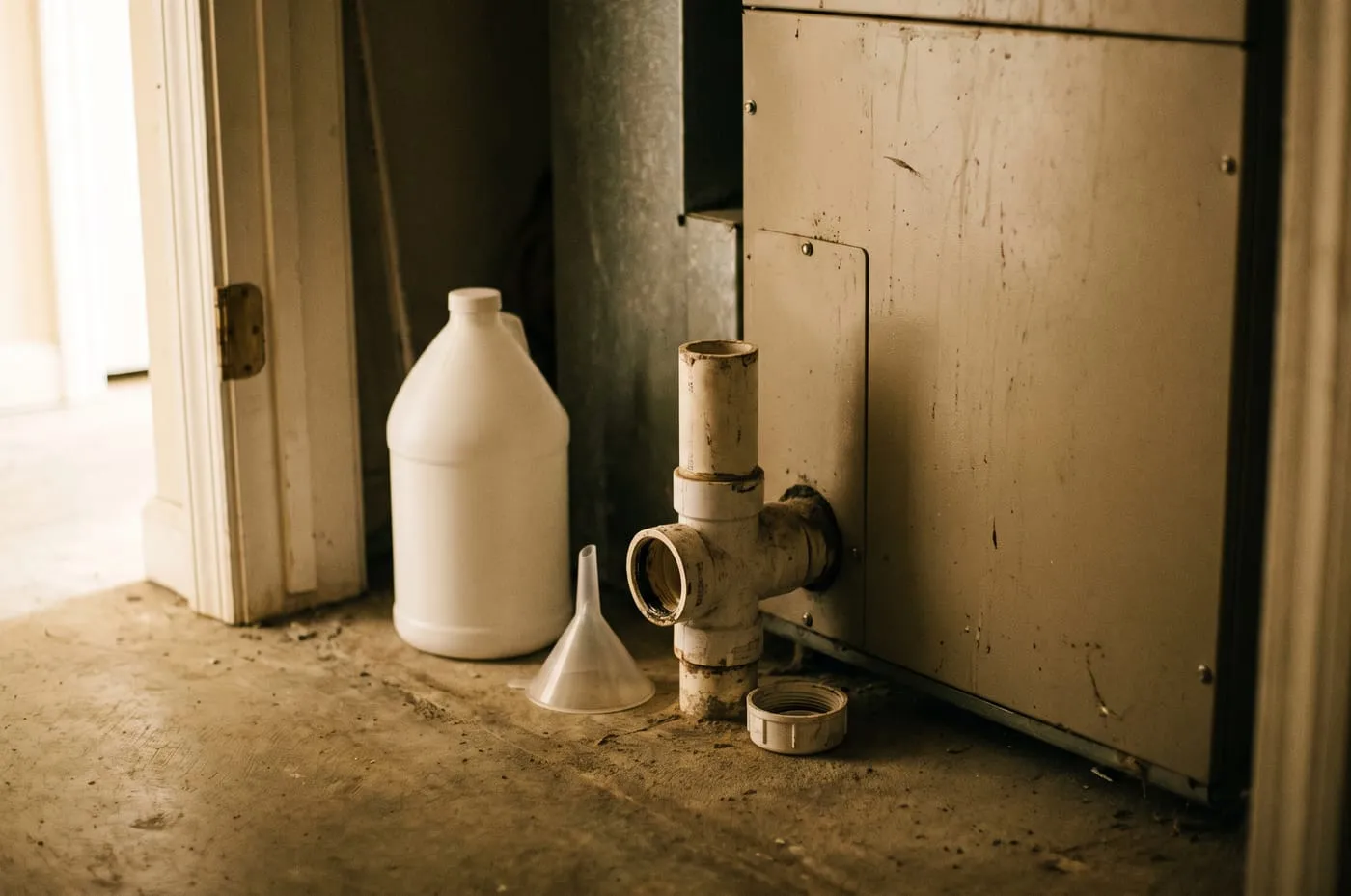
the fix is boring. find the T-shaped vent near the indoor air handler and pull its cap. at the open end of the line, draw the standing water and gunk out with a wet/dry vacuum. then pour a cup of plain white vinegar into the vent to break down whatever's regrowing, and put the cap back. a jug of vinegar and a funnel. every couple of months through the season, and the pipe never gets its chance.
Three things that belong to somebody licensed
Refrigerant. it's a closed system. if it's low, there's a leak — and topping it up without finding the leak is paying twice for the same afternoon.
The capacitor. it holds a charge after the power is off. that sentence is the whole reason not to touch it.
Anything at the panel. the disconnect and the breaker are switches you're allowed to use. the wiring behind them is not a saturday project.
if the drain line has already overflowed, the maintenance can wait: work through what to do in the first hour instead — shut off, extract, dry, photograph. and if you would rather hear about the next blockage from a beep than from a stain, a small leak sensor on the floor beside the indoor unit is a cheap early warning; the smart home that never bills you covers the kind with no monthly fee. more one-afternoon jobs for the house are on HowTo Home.
read the size off the old cardboard frame first, then buy a multi-pack in that exact size so the next three changes are already in the closet. this link opens on one of the common sizes — change it to yours. and the rating that belongs in your system is the one the manual asks for, not the highest one on the shelf.
pleated furnace and AC filters →some links on this page are affiliate links — if you buy through one, we earn a commission at no extra cost to you.
Filter, coil, drain line. Then it has margin again.
one afternoon in august, and the system spends the rest of the summer with room to spare instead of running on the last of it.
— sam