SPF Under Makeup, Without the Pilling
The grey threads that roll up under your fingers are not a bad sunscreen. They are a film problem — and films are a matter of timing, quantity and pressure.
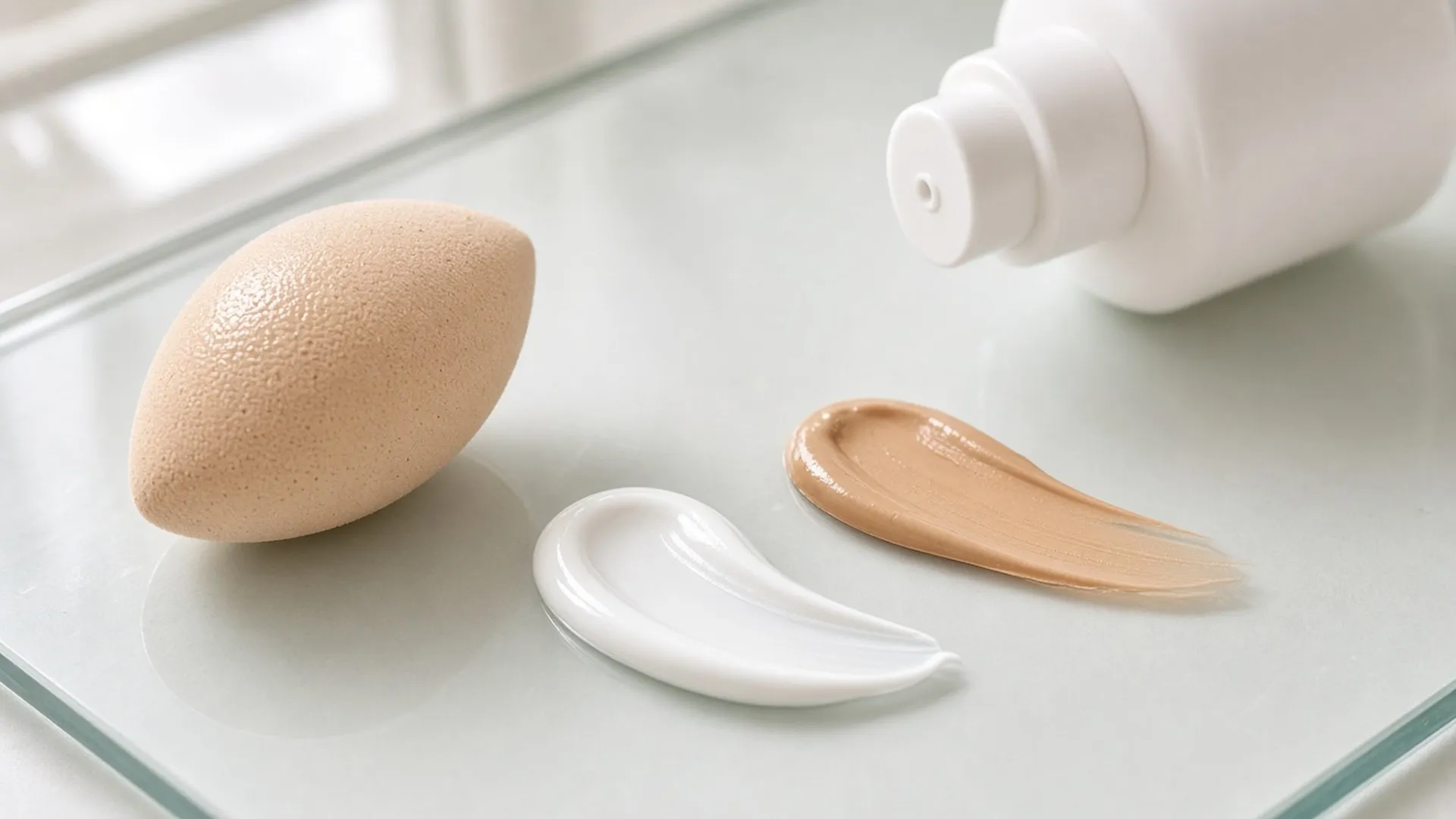
The grey threads that roll up under your fingers are not a bad sunscreen. They are a film problem — and films are a matter of timing, quantity and pressure.
You know the moment. Sunscreen on, foundation going over it, and somewhere around the cheekbone the surface starts to roll into little grey worms that collect at the edge of your sponge and refuse to leave. You blame the sunscreen. You buy a different one. It happens again, slightly less on Tuesday and slightly more on Thursday, and you begin to suspect your face personally.
It is not your face, and it is very rarely the sunscreen. Pilling is what happens when one film has not finished setting before the next one arrives, or when there are simply too many films stacked on top of each other and the friction of application peels the top one off the one beneath. Every layer you add is another surface that has to grip the one under it. Most mornings, the fix is fewer layers and more patience, not a better product.
What follows is the order I use, and it is mostly about waiting. That is the unglamorous answer. It is also the one that works with the sunscreen you already own, which matters, because the sunscreen you already own is the one you will actually wear.
Beginner · About 6 min, most of it waiting · Every morning · The sunscreen you already own, and fewer things under it
Pilling is not a product failure. It is a scheduling failure, and the schedule is yours.
One layer under, one layer over.
Step one · 60 seconds — One hydrating layer, and only one.
Choose either a light serum or a moisturiser for the morning. Not both, and certainly not a serum, an essence, a moisturiser and an eye cream, each of which leaves its own slip behind. If your skin is oily, a plain hydrating serum is often enough. If it is dry, a moisturiser and no serum. Use less than you think — a thin layer that sinks in, not a cushion that sits on the surface waiting to be disturbed.
Then leave it alone for a minute or two. Brush your teeth. Put the kettle on. The layer should feel settled and very slightly tacky, not wet, before anything goes on top. Sunscreen applied over a skincare layer that is still moving is sunscreen mixed into that layer, and the mixture is what rolls.
If your moisturiser already contains SPF, do not count it as your sunscreen unless you are using a full sunscreen-sized amount of it. Most people use a moisturiser amount, which is a good deal less.
Step two · 90 seconds — Sunscreen in sections, pressed on.
This is where most of the pilling is made. People dot sunscreen all over the face and then rub it in with brisk circles, which works it into the layer underneath and starts the rolling before foundation has even arrived. Do it in sections instead. Forehead, one cheek, the other cheek, nose and chin, then the neck. Spread each section with flat fingers in a few short strokes, then press it in with your palms rather than continuing to rub.
Quantity matters, and it is the one place I would not economise. Use a properly generous amount, SPF 30 or higher, and use the whole of it. Under-applying sunscreen to avoid pilling is solving the wrong problem; you end up with a face that looks fine and is barely protected. If you need the generous amount to sit well, the answer is to split it — half the face, a minute's pause, the second half of the amount pressed over the top — not to use less.
Pressing feels slower than rubbing. It is not, once you stop going back over the same patch four times because it does not feel absorbed yet.
Step three · Two minutes — The gap.
The two minutes between sunscreen and base are the whole method. A sunscreen film needs a little time to set into a continuous layer, and anything dragged across it before then breaks it up. I do my brows in this gap, or find my earrings, or stand at the window. If you do your base immediately, you are applying foundation to something that is still technically wet, and you will feel it catch.
How to tell it is ready: touch the side of your cheek lightly with a clean fingertip. It should feel smooth and faintly tacky, and your finger should not slide. If it still slides, give it another minute. If you have been waiting a while and it still slides, you have probably used too much under the sunscreen, not too much sunscreen.
A cool bathroom helps. A steamy one, straight out of the shower, keeps everything slippery for longer. Open the door.
Step four · 90 seconds — Base by pressing, never buffing.
Whatever you use — a skin tint, a light foundation, a concealer only where you need it — put it on by pressing or patting. A damp sponge, bounced — and a clean one, because a sponge past its date drags. Fingertips, tapped. A brush, if you must, stippled rather than swept. Buffing in circles is friction, and friction is the thing that lifts a film off the film beneath it. You can build coverage this way without moving the sunscreen at all.
Less base, also. Pilling scales with the number of layers and the amount in each. If you find yourself adding a primer to stop the pilling, then a setting spray to stop the primer moving, you have built a stack of four films to solve a problem caused by having three. Delete before you add.
If you set with powder, press it on with a puff and do not sweep. Sweeping is just buffing with a different tool.
Step five · Through the day — Reapplying without starting again.
If you are outdoors for a long stretch, sunscreen needs topping up, and nobody wants to take their face off at lunch to do it. Blot first with a tissue, pressing rather than wiping, then press a thin new layer over the top with your fingertips or a clean sponge. It will not be perfect. It does not need to be. A slightly less polished face that is protected is a better result than a perfect one that is not.
Do not forget the ears, the back of the neck, and the strip along the hairline. Nobody pills there, which is why nobody remembers them.
The shelf — what this actually needs
- One hydrating layer: a serum or a moisturiser, not both
- A sunscreen of SPF 30 or higher that you like enough to use generously
- Whatever base you already use, applied by pressing
- A damp sponge or clean fingertips
- Two minutes and something to do with them
Every layer you add is another surface that has to grip the one under it. The fewer surfaces, the fewer things can slide.
How to know it is working.
Check in daylight, by a window, not under the bathroom bulb. Pilling shows up at the edges of the face first, and the bathroom light is usually worst exactly there.
- Your sponge comes away with foundation on it and nothing else — no grey flecks gathered at the edge.
- The cheekbone and the side of the nose, which take the most friction, look the same as the forehead.
- By mid-afternoon the base has worn evenly rather than lifting in patches.
- You are using a generous amount of sunscreen and it is not causing the problem. That was the point.
- If it still pills with one layer under, sunscreen pressed on and a proper gap, try your sunscreen on bare skin for a morning. If it pills alone, that particular formula may not suit your skin, and it is fair to try another.
When it isn't going to plan.
It only pills when I use one particular foundation.
Some combinations simply do not get along — certain textures sit badly on certain others, and you will not find out which until you try them together. If one foundation pills over every sunscreen you own and the others do not, that foundation is the variable. Keep it for days without sunscreen under it, which in practice means evenings, or let it go.
Should I skip the moisturiser altogether?
If your skin is oily and your sunscreen is reasonably moisturising, you might, and that removes a layer. If your skin is dry, no — you will trade pilling for flaking, which is not an improvement. Try a smaller amount first, and a longer wait, before cutting it entirely.
Can I use less sunscreen if I am wearing foundation with SPF?
I would not. You would need far more foundation than anyone wears to get the protection on the label. Treat the SPF in your base as a small bonus and keep the sunscreen at its proper amount underneath.
My skin stings or goes red after sunscreen.
That is a different problem from pilling. Stop using that sunscreen and try a fragrance-free one, ideally a mineral formula, on a small patch first. If stinging, redness or a rash keeps happening whatever you use, see a GP or dermatologist rather than working through every bottle in the shop. There is more on calming a reactive face in the barrier rebuild week.
“I spent years looking for a sunscreen that did not pill. What I needed was two minutes and one fewer bottle.” — Nelly
This is the makeup end of the morning. The skincare queue that comes before it — rinse, vitamin C, a humectant, then the sunscreen last — is laid out in the ninety-second morning order, and more of the same desk is collected on HowTo Beauty.
Filed by Nelly, from the desk · Skin / Sun