The morning has an order, and it is not a preference.
Four products, ninety seconds, one sequence. Most morning routines fail on the queue, not the shelf.
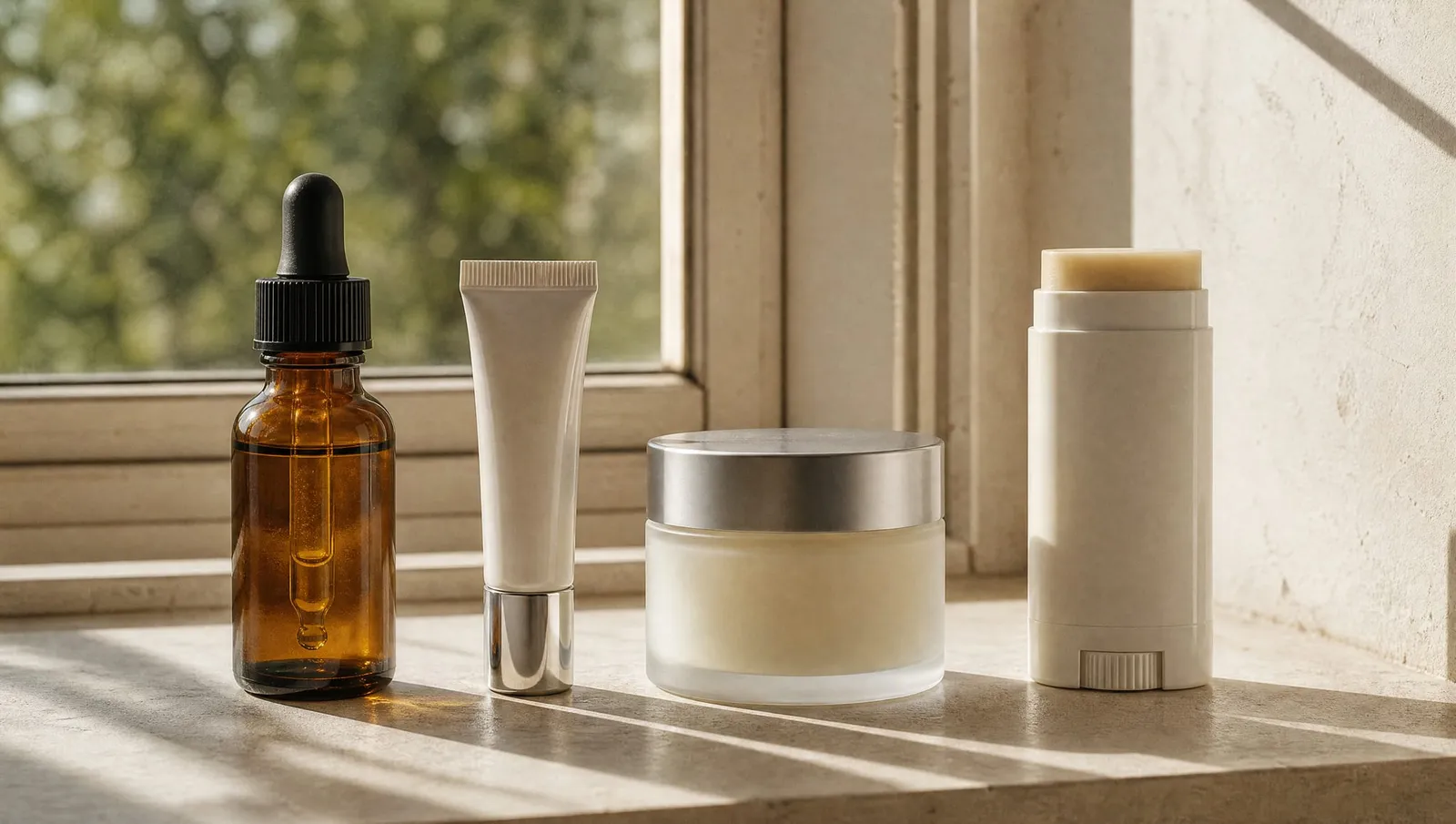
Four products, ninety seconds, one sequence. Most morning routines fail on the queue, not the shelf.
There is a version of this piece that lists four products and stops. That version is useless. I have watched people buy exactly the right four things, arrange them in exactly the wrong order for a year, and then conclude that vitamin C does nothing.
A morning routine is not a collection. It is a sequence, and the sequence is doing most of the work. Every layer you put on your face is, functionally, a lid on the one beneath it. Water-based things go under oil-based things because they cannot travel through them. Acidic things go first because they need contact with skin, not with a film of somebody else's emulsifier. Sunscreen goes last because it is the only product in the queue that is meant to sit on top and stay there.
What follows takes ninety seconds. I have timed it on mornings when I had four minutes in total and needed three of them for coffee. The order below is not my preference. It is what the chemistry allows.
Beginner · 90 sec · Every morning · ~€0 once the four are bought
What you can check much sooner is whether the sequence itself is behaving.
Ninety seconds, in order.
Step one · 10 seconds — Rinse. Do not cleanse.
In the morning your face is carrying last night's moisturiser and about eight hours of its own sebum. That is not dirt. A full surfactant cleanse at 7am strips a barrier that spent the night rebuilding itself, and a stripped face tends to feel tight and then shiny by noon — the exact problem most people are cleansing to prevent. Cool water, ten seconds, hands only. If you sleep in a heavy occlusive, or you genuinely wake up slick, use a low-foam gel and keep it under twenty seconds. Then pat until the skin is damp, not dry. Damp matters two steps from here.
If your morning cleanse leaves your face tight for more than a minute, it was too much cleanse. Tightness is not clean. It is a stripped barrier announcing itself.
Step two · 25 seconds — Vitamin C on bare skin, first or not at all.
L-ascorbic acid only gets into skin when it is formulated at a low pH — below 3.5 in the absorption study (Pinnell et al., Dermatologic Surgery, 2001) that set the template for these serums. Put anything on bare skin ahead of it — a hydrating toner, a mist, the residue of a rich cleanser — and you lift the surface pH and blunt the serum before it has done a thing. Four or five drops, pressed rather than rubbed, over the whole face including the sides of the nose, where most people stop. Then wait. You do not need the twenty-minute wait you will see recommended online. Sixty seconds, or until the layer stops looking wet.
If it stings past a minute, or the bottle smells faintly of hot dogs, the ascorbic acid has oxidised. That bottle is finished regardless of the date on the box.
Step three · 20 seconds — Hyaluronic acid on damp skin, then a lid.
Hyaluronic acid is a humectant. It pulls water toward itself and it does not care where the water comes from. On dry skin in a dry room there is little water for it to hold on to, which is why some people find it leaves them tighter rather than plumper. On damp skin it pulls from the film you have just left there. Three drops, onto skin still slightly wet from the serum before it, then something emollient over the top inside a minute. Without a lid you have a humectant with nowhere to put what it has collected.
In an aeroplane cabin, or any room with very dry air, skip the hyaluronic acid entirely and go straight to the emollient. There is no water in that air for it to hold.
Step four · 15 seconds — Eye cream, because the tissue is different.
The skin around the eye is noticeably thinner than the skin on your cheek, has far fewer oil glands, and moves every time you blink. That is not a marketing distinction. What it means in practice is that it dries faster, creases sooner, and that a face cream built to sit heavily on a cheek will migrate into the eye across a morning and hand you the puffiness you were trying to treat. Ring finger, three dots along the orbital bone — not the lid, not the lash line — tapped rather than dragged. Body heat moves it inward on its own.
The only eye products I have seen do visible work are the caffeine ones, and only on morning puffiness. Nothing topical has moved a hereditary hollow, mine included.
Step five · 20 seconds — SPF last, and more of it than you think.
Sunscreen is the only step here that is a physical layer rather than a delivery system, which is why it goes on top of everything and why nothing goes on top of it except makeup. The number on the bottle was measured with a thick, even layer — far more than most people use. Two fingers' length, squeezed along the index and middle finger, is a good working amount for the face. The SPF in your moisturiser is real chemistry, but it was rated at that same generous layer, and you are using a pea of moisturiser, so you are getting noticeably less protection than the label suggests. Mineral against chemical is a texture argument, not a protection one. Choose the one you will reapply without resenting it.
Give it two minutes before foundation. Applied over wet sunscreen the film breaks up and pills, and then everybody blames the foundation. The pilling problem has its own column.
The shelf — what this actually needs
- A stable vitamin C serum, in a small opaque bottle
- A hyaluronic acid serum
- A light eye cream
- A sunscreen you will reapply without resenting it
What’s in it
- L-ascorbic acid — The form of vitamin C most of the skin research is about, and the least stable of them. Buy small.
- Sodium hyaluronate — The lower-weight salt of hyaluronic acid. Sits better under sunscreen than the raw acid does.
- Zinc oxide — Mineral filter — broad, gentle, and it will leave a cast on deeper skin tones. That is a genuine trade, not a rumour.
- Caffeine — Constricts vessels, so it works on morning puffiness and nothing else. Wears off by lunch. Priced as though it doesn't.
The AM Skin Order, itemized — Four products, one sequence. The sequence is doing most of the work.
Skincare rarely fails at the shelf. It fails at the queue.
How to know the order is right.
Give it three weeks, not three days. Vitamin C works on pigment, and pigment moves at the speed of cell turnover, which takes weeks and slows down as you get older. What you can check much sooner is whether the sequence itself is behaving.
- By 11am your face is comfortable — neither tight nor slick. That means the cleanse was right-sized.
- Nothing pills under makeup. Pilling is almost always a wet layer going under a dry one, not a bad product.
- At week six the vitamin C is still pale straw-coloured. Colour is the honest expiry date.
- If you are shinier by lunch than you were before you started, cut the cleanse, not the moisturiser.
- If your eyes sting by mid-morning, the eye cream is sitting too close to the lash line or the sunscreen has migrated. Move both outward.
When the queue breaks.
Do I really have to wait between layers?
Sixty seconds, or until the layer stops looking wet. The one genuine wait is the two minutes between sunscreen and foundation.
Can I use vitamin C and niacinamide in the same morning?
Yes, for most people. If a particular combination flushes your skin, that is your skin talking — move the niacinamide to the evening and carry on.
My vitamin C serum has turned orange.
It has oxidised, and it is now doing nothing except staining your pillowcase. Buy the smaller bottle next time, keep it away from the window, and accept that an unopened one outlives an opened one by months.
Where do exfoliating acids go in the morning?
Ideally nowhere. Acids belong to the evening, where they are not sitting under sunscreen and daylight. If you insist, an acid replaces the vitamin C step entirely — it does not join it.
Is a separate eye cream honestly necessary?
Not necessary. Useful. If the choice is between an eye cream and enough sunscreen to matter, buy the sunscreen twice. Squinting into bright light is hard on that skin too, which is a hat-and-sunglasses problem before it is a cream problem.
“If you fix one thing this week, move the sunscreen to the end of the queue and double the amount. Everything else on this list is optimisation.” — Nelly
This is the skin part only. The rest of the morning around it — water, teeth while the sunscreen sets, brows, mascara, the balm by the door — is timed out in a morning that ends at the door.
Filed by Nelly, from the desk · 15 August · No. 09 · Skin / The AM Order