A starter shelf for forty dollars, counted.
Four products, $37.46, and $2.54 of change. Three minutes twice a day. Here is the arithmetic, and here is what forty dollars cannot buy you.
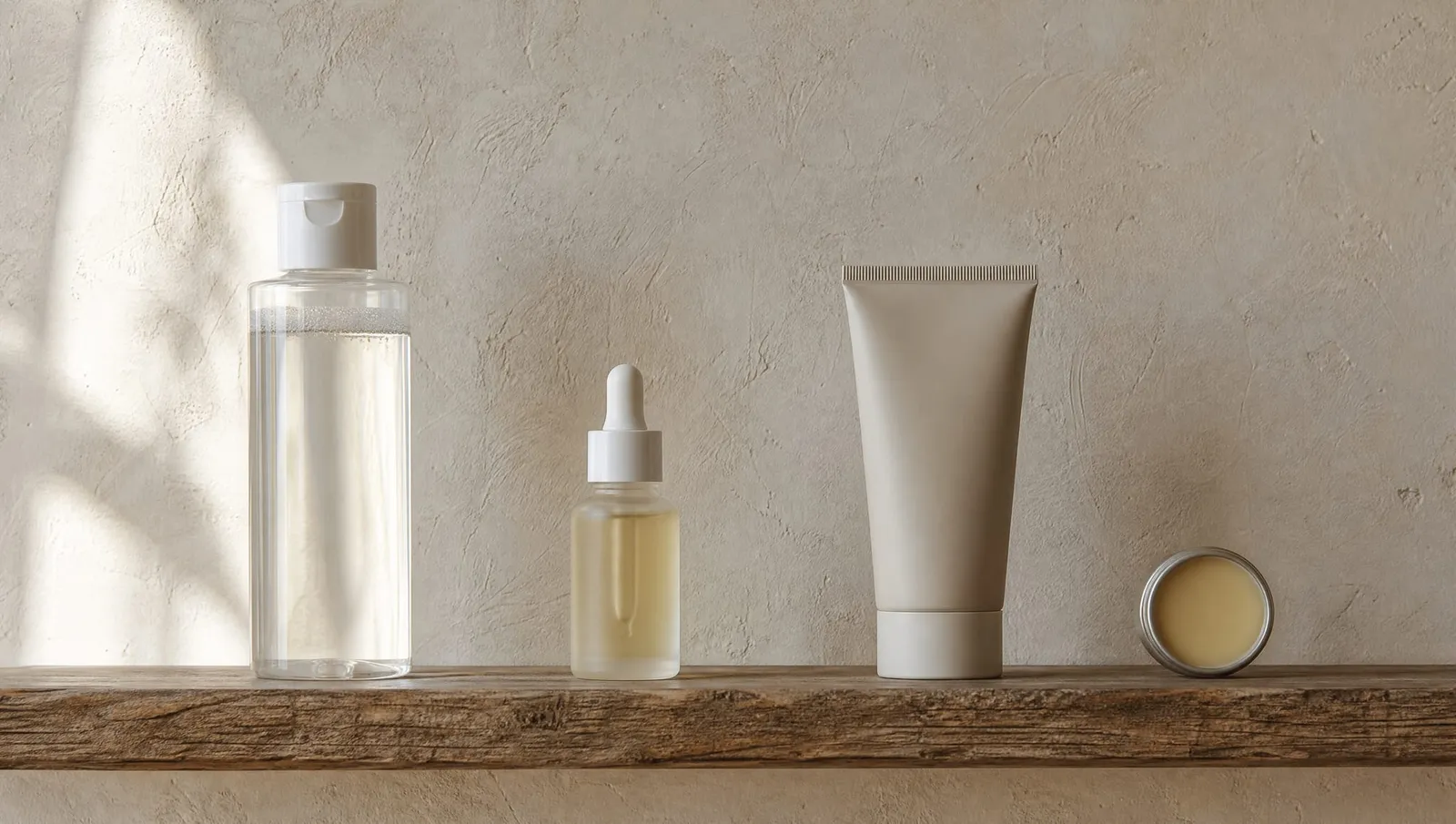
Four products, $37.46, and $2.54 of change. Three minutes twice a day. Here is the arithmetic, and here is what forty dollars cannot buy you.
Most starter routines are written by people who have not been broke recently. They begin at eighty dollars and describe that as an entry point. This one begins at the drugstore and ends with change, and it is the routine I would build for someone starting from an empty shelf tomorrow morning.
The arithmetic, so you can check it. Micellar water, 400ml, $8.99. A hyaluronic acid serum, 30ml, $9.49. A mineral SPF 30, 50ml, $14.99. A lip balm with SPF, $3.99. That is $37.46 and two dollars fifty-four left over, which is not enough for a fifth product and is exactly enough for a coffee, and I would take the coffee. Prices are drugstore, United States, as of writing, and they move — the shape of the shelf is the point, not the receipt.
What is not on it: a cleanser, a moisturiser, a toner, an eye cream, a retinoid, an exfoliant. Some of those absences are deliberate and permanent. One of them is a real compromise and I will name it in step one rather than bury it. When there is another fifteen dollars, I will tell you where it goes.
Beginner · 3 min · Twice daily, minus the SPF at night · $37.46
That works out at 37 cents, 22 cents, 19 cents and 7 cents — eighty-five cents a day, and the shelf empties in about six weeks, with the sunscreen and the micellar going first and together.
Three minutes, twice a day.
Step one · 60 seconds — Micellar water, twice, and why that's a compromise.
Micellar water works by suspending oil inside tiny surfactant spheres that lift off onto a pad rather than needing rinsing. It is genuinely good at makeup, city air and sweat, and it is the reason a shelf this cheap can skip a cleanser entirely. Here is the honest part. It is mediocre at removing mineral sunscreen, which is the one thing this shelf guarantees you will be wearing every day. Zinc oxide sits on the skin as a physical film and micelles do not much care for it. So you go twice: one pad to take the day off, a second pad that should come away nearly clean. If the second pad is still grey, go a third time. On a day with full makeup over sunscreen, this shelf is not enough, and no amount of technique makes it enough. That is what forty dollars costs you.
Reusable cotton rounds pay for themselves in about six weeks and are the only thing on this page I would buy before the coffee.
Step two · 30 seconds — Hyaluronic serum, on damp skin, or not at all.
Hyaluronic acid is a humectant. It does not add water to your face; it holds onto water that is already there, and if there is none there it will take some from wherever it can reach, which on a dry face in a dry room means the deeper layers of your own skin. This is not a theoretical risk. It is the reason people report that hyaluronic serums make them tighter, and they are describing something real. So: splash the face, do not dry it, and put three drops on while it is still visibly wet. Press, do not rub. Then leave it about a minute while you do something else.
In a heated flat in February, put a glass of water on the radiator. That sounds like folklore and it is not — a humectant in dry air behaves exactly as badly as everyone complains it does.
Step three · 60 seconds, morning only — Mineral SPF, after a full minute.
The serum needs a full minute to go tacky-dry before the sunscreen goes over it. Skip that minute and the mineral filter pills — it rolls into small grey threads under your fingers, you assume the sunscreen is bad, and you stop wearing sunscreen. That sequence has ruined more SPF habits than any product on the market. Once the face is tacky rather than wet: two fingers' length, squeezed along the index and middle finger, is the amount for a face and a neck. It is more than you think and it looks like more than you want. Press it on in sections rather than rubbing it around — mineral filters work by sitting evenly on top of the skin, and rubbing thins the film in exactly the places you have just tried to cover.
Mineral SPF is also doing the job of your missing moisturiser. Most zinc formulas are suspended in something emollient, which is why this shelf can skip a cream and still not feel tight by eleven.
Step four · 10 seconds — Balm, because the lip has no barrier.
The vermilion — the coloured part of the lip — has a stratum corneum a fraction of the thickness of the skin around it and essentially no sebaceous glands across the surface. It cannot moisturise itself and it cannot defend itself, which is why lips burn, split and age before anything else on a face does. Four dollars is not a compromise here; it is the correct price. Get one with SPF 15 or higher and apply it at the same moment you apply the face sunscreen, because that is the only way anyone remembers to do it.
If a balm makes you want to reapply every twenty minutes, it is doing the wrong thing — occlusive balms should be boring. A balm you crave is usually one that evaporates.
The shelf — what this actually needs
- Micellar water, 400ml — $8.99
- Hyaluronic acid serum, 30ml — $9.49
- Mineral SPF 30, 50ml — $14.99
- Lip balm with SPF 15 — $3.99
- Total — $37.46, with $2.54 left over
What’s in it
- Zinc oxide — The mineral filter. Sits on top of the skin as a physical film, which is why it must be pressed on evenly and why micellar water struggles to lift it off again.
- Sodium hyaluronate — The smaller, better-absorbed form of hyaluronic acid. A humectant — it holds water that is already present rather than supplying any.
- Poloxamer 184 — A common micelle-former. It suspends oil in tiny spheres so they lift onto a pad instead of needing to be rinsed away.
The $40 Starter Shelf, itemized — Four things, counted to the cent.
A shelf is not a collection. Four things that each do one job will beat eleven that overlap.
What it actually costs.
The purchase price is the least interesting number. The useful one is what the shelf costs to run, and how long it lasts before you are standing in the same aisle again. At two fingers of sunscreen a day, a 50ml tube is about 41 days. Micellar water at roughly 10ml a night is about 40 nights from a 400ml bottle. Three drops of serum twice a day is about 0.6ml, so 30ml is around 50 days. The balm runs about two months. That works out at 37 cents, 22 cents, 19 cents and 7 cents — eighty-five cents a day, and the shelf empties in about six weeks, with the sunscreen and the micellar going first and together.
- The sunscreen runs out in about six weeks. If yours lasts three months, you are not using enough of it, and that is the only genuinely alarming line on this page.
- By week three, your face does not feel tight at eleven in the morning. That is the serum and the SPF doing the moisturiser's job between them.
- The second micellar pad comes away nearly clean. If it does not, you are not removing your sunscreen, and everything above it is decoration.
- If the SPF pills into grey threads, you did not wait the full minute after the serum. This is a timing failure, not a product failure.
- If your skin feels tighter since adding the serum, you are applying it to a dry face. Wet the face first — the humectant has to have something to hold.
If something isn't working.
Where does the next fifteen dollars go?
A proper cleanser, and specifically a low-pH gel to use as a second step at night. It closes the one real hole in this shelf, which is that micellar water alone does not reliably clear mineral sunscreen. The long argument for that step is at on the second cleanse.
No moisturiser at all? Really.
Really, on this budget. A mineral sunscreen is suspended in emollients and does most of a light moisturiser's work during the day, and the hyaluronic serum on damp skin covers the night. If you are dry rather than merely un-oily, this shelf is the wrong forty dollars and I would drop the serum for a cream instead.
Can I use SPF 50 instead of 30?
Yes, and it will usually cost two or three dollars more, which this budget can absorb by dropping the serum to a smaller bottle. What matters far more than the number is the amount — SPF 50 applied thinly performs worse than SPF 30 applied properly, and almost everybody applies thinly.
Is chemical sunscreen cheaper?
Often, and it also removes more easily with micellar water, which would fix the compromise in step one. I have specified mineral because it is the safer default for skin whose reactivity you do not yet know. If you already know you tolerate chemical filters, buy those instead and save two dollars.
What about the eye area?
The serum and the sunscreen both go there. Eye cream is moisturiser in a smaller jar at four times the price per millilitre, and at forty dollars it is not a decision, it is arithmetic.
When does this shelf stop being enough?
When you start having a specific problem rather than a general one — texture, pigmentation, persistent congestion. A general shelf handles a general face. What I would buy after that is a longer conversation, and I have made my own list at the five products I'd re-buy tomorrow.
“Every cheap routine online quietly assumes you already own a cleanser. This one does not, which is why it is honest and why it has a hole in it that I have told you about.” — Nelly
Once this shelf feels routine, the order it follows in the morning is set out in more detail, with a vitamin C and an eye cream added, in the four-product morning order.
Filed by Nelly, from the desk · 9 August · No. 11 · Skin / Starting Out