The bag is the edit.
Five things that earn a slot, one bag deliberately too small, and the arithmetic that gets you there.
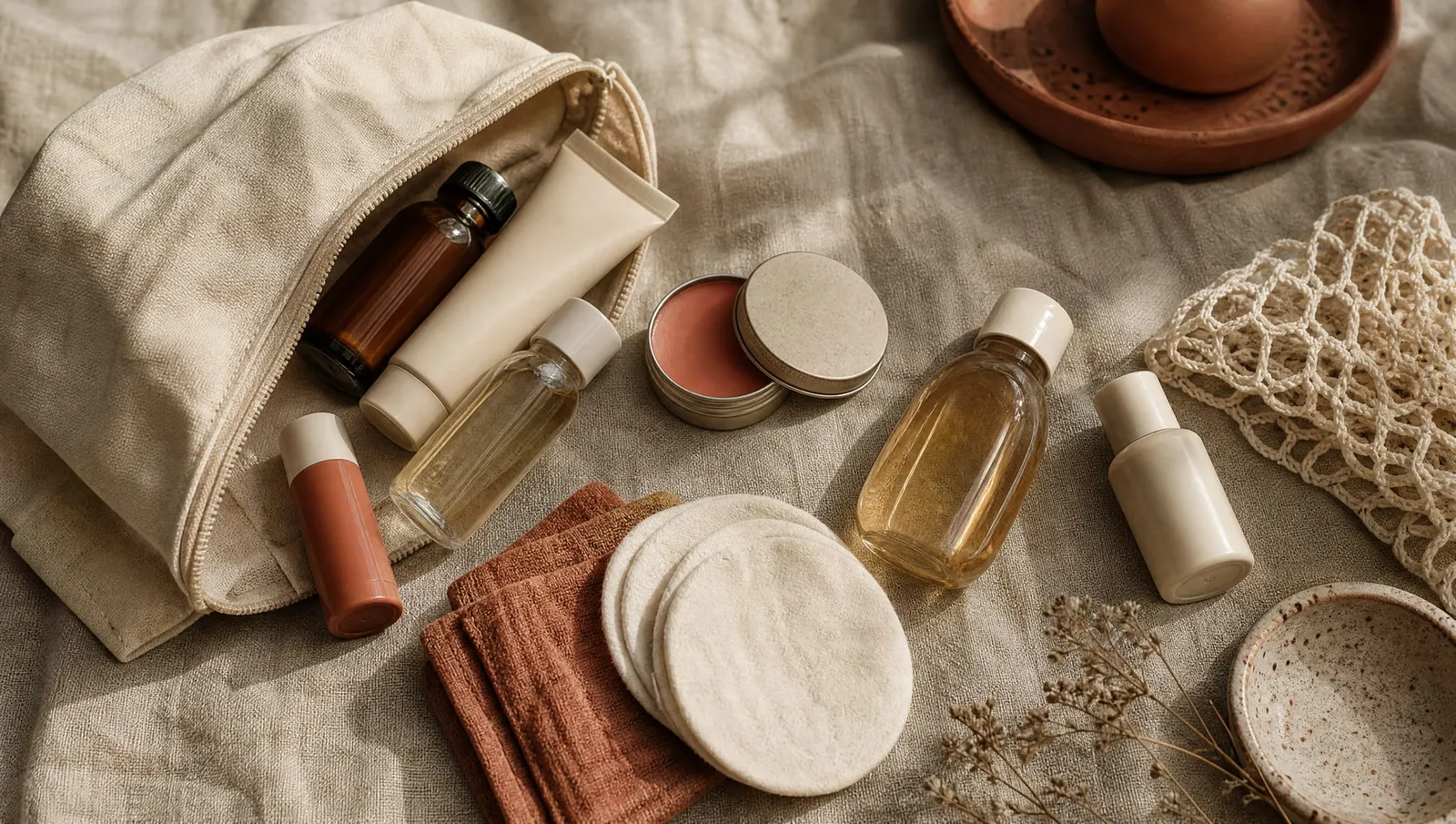
Five things that earn a slot, one bag deliberately too small, and the arithmetic that gets you there.
I have packed badly for fifteen years and well for about three, and the change was not a technique. It was a bag. A smaller one, chosen on purpose, which removed the option of taking everything and forced the only question worth asking: which of these do I use, as opposed to own.
This is the routine where the container is the method. A large washbag does not need an editor, so you never become one — you take the tinted moisturiser you have not opened since March and the sheet masks nobody has ever used in a hotel. A small bag makes every item argue for itself, and most items lose.
Five things below. They are not the five best products in my house. They are the five that keep earning the slot, which is a different and much less flattering list.
Beginner · 10 min to pack · Every trip · ~€0 once assembled
You are measuring what you touched.
What earns a slot.
Decision one · Before anything else — Choose the bag first, and make it too small.
Every packing problem is a container problem in disguise. Start with a bag that holds five to seven items and no more, and the editing does itself. Flat rather than deep, so you can see the whole contents at once — a deep bag hides things at the bottom, and anything you cannot see, you re-buy at an airport for four times the price. Mine is small enough that a full-size bottle of anything simply will not go in, which has settled more arguments with myself than any resolution ever did.
Pack the bag the night before, then carry it around the flat for ten minutes doing something else. Anything you take out in those ten minutes was never going to get used.
Decision two · The one that removes — One thing that takes it all off.
The single item I have never regretted packing. Travel is where routines collapse — you arrive at eleven at night, the bathroom light is unflattering in a way that feels personal, and the only step that genuinely has to happen is removal. Micellar water does it on dry skin without a rinse, which matters when the sink is the size of a dinner plate. Decant into a 100ml bottle rather than buying a travel size — travel sizes cost roughly three times as much per millilitre and run out on day four of a five-day trip, which is a design decision, not an accident. Pack six cotton pads, not the packet. The packet is air.
A hard-sided 100ml bottle, not a soft one. Cabin pressure pushes soft bottles open, and micellar water through a linen dress is a long evening.
Decision three · The one that goes everywhere — One thing that works on four places.
In a small bag, an item that does one job is expensive in a way that has nothing to do with price. A good balm is lips, cuticles, the dry patch beside the nose after four hours of cabin air, and — a fingertip's worth on the cheekbone — the only highlighter you need to carry. That is four slots collapsed into one, which is the whole logic of the bag. If you take one thing from this piece, make it the habit of asking every item how many jobs it does before it goes in.
A pot beats a stick in a bag this size — sticks warp against a hard base and never sit flush in the cap again. A pot means a finger, which is the one honest argument for the stick.
Decision four · The one that buys a day — One thing that buys you a day.
Dry shampoo is not a hair product on a trip. It is a scheduling tool. It converts a shower you do not have time for into twenty seconds at a mirror — the difference between arriving and arriving presentably. Spray from about twenty centimetres at the roots, then wait two full minutes before touching it — the starch needs time to absorb the oil, and every person who complains about a grey cast is brushing it out at thirty seconds. Then work it in with fingertips, not a brush. Powder versions travel better than aerosols and dodge the pressurised-container rules.
At home, dry shampoo does better on the evening before it is needed, which is the point of wash day, rescheduled. On a trip, it buys one day. Two is visible from across a room, and it will look like exactly what it is.
Decision five · The one that is not negotiable — One thing that is not up for debate.
Sunscreen is the only item here that does not have to justify its slot, and it is the one people leave out most often — on the reasoning that it is a beach product, or that the trip is only four days. UVA passes through cloud and through the window of every train you sit beside, which is why the left side of a long-haul driver's face measurably outpaces the right. Take enough for a quarter teaspoon a day plus a reapplication. Mineral is the sensible travel choice: active on contact, and it survives a hot bag.
Never decant sunscreen into a jar — it is an emulsion, and finger contact plus heat separates it faster than you would think. A squeeze tube, or the original.
Decision six · What stays — Everything else stays home.
The list of what I no longer pack is longer than the list of what I do, and more useful. Sheet masks: nobody has ever used one in a hotel, and the ones in my bag came back in my bag for six years running. A second lipstick in an adjacent shade: you will wear the first one. Tools that need a plug: hotel hairdryers are bad, and you will use them anyway. A full-size anything. Anything in its first two weeks of use — a reaction abroad is a miserable way to spend a Tuesday. And the tinted moisturiser you have been meaning to get on with — a trip is not the place where you finally get on with it.
The unpack is the audit. Anything that comes home unopened does not go in next time, and the bag gets more correct every trip until it is simply right.
The shelf — what this actually needs
- A small flat makeup bag with a structured base
- A hard-sided 100ml decant bottle
- Six cotton pads, not the packet
- A balm in a pot
- Powder dry shampoo, not aerosol
What’s in it
- Rice starch — The absorbent in most powder dry shampoos. It needs two minutes to take up the oil — the grey cast is impatience, not the product.
- Lanolin — Why a good balm works on lips, cuticles and a dry nose alike. It occludes rather than hydrates, which is right in cabin air.
- Zinc oxide — No waiting period, and it tolerates a hot bag better than most chemical filters.
- Poloxamer — The gentle surfactant in micellar water. Works on dry skin and does not require the sink to cooperate.
The Travel Bag, Solved, itemized — The bag is the routine. Five things earn a slot.
A travel bag is not a smaller version of your shelf. It is an argument about what you actually use.
How to know the edit held.
The verdict on a travel bag is delivered at the unpack, not at the pack. You are not measuring whether you felt prepared. You are measuring what you touched.
- Every item in the bag was opened at least once. That is the entire test.
- You bought nothing at a chemist mid-trip, which is where the real cost of a bad edit shows up.
- The bag closed without pressure, both directions. A bag you have to kneel on is over-packed, not well-packed.
- If two or more things came home unopened, take them out permanently instead of promising yourself next time.
- If you found yourself rummaging, the bag is too deep. Flat and visible beats large and organised.
When the bag fails.
Five items is not enough for a two-week trip.
It is the same five. Duration changes the volume you decant, not the number of items. Take a larger bottle of the remover and nothing else.
What about foundation and the rest of the makeup?
That is a second bag, and keeping them separate is the point. Skin and hair are what you need on the night you arrive at eleven; makeup is what you need the morning you have somewhere to be. Only one of the two is compulsory.
How do I stop things leaking?
Hard-sided bottles, filled to about 90% so there is air to compress. Most leaks are pressure, not defect.
The hotel provides shampoo — can I drop more things?
You can, and it is a fair trade for two nights. Beyond that, hotel shampoo is a high-surfactant formula built for one wash and it strips colour-treated hair visibly by day four.
“Buy the smaller bag. Everything I know about packing well came from running out of room, and none of it came from being disciplined.” — Nelly
Filed by Nelly, from the desk · 15 August · No. 12 · Kit / Travel