The blonde upkeep shelf.
Four products in the order they get used. The purple shampoo is the one I reach for least — every third or fourth wash, three minutes, no longer.
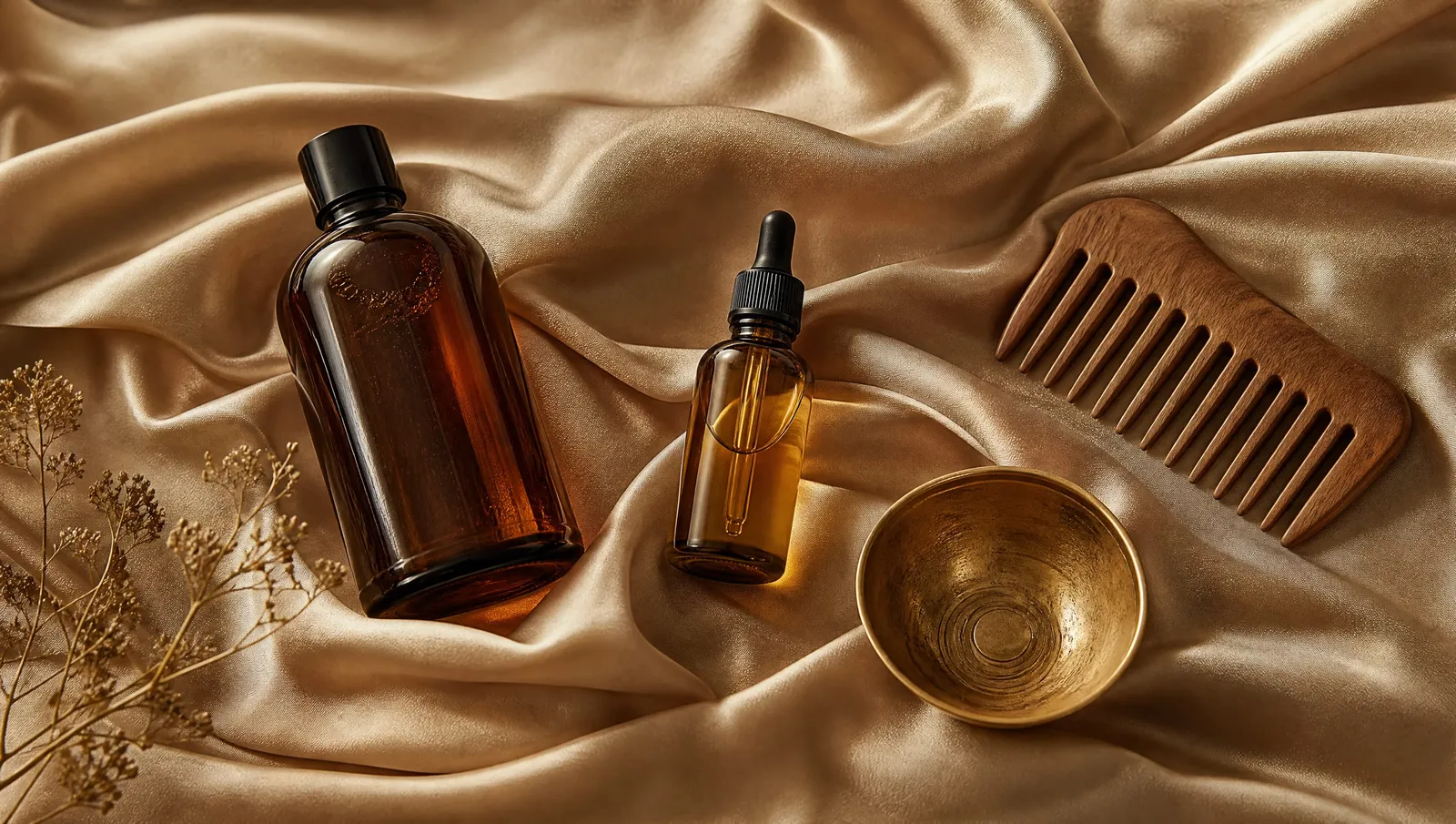
Four products, in the order they get used. The purple shampoo is on the shelf, and it is the one I reach for least — roughly every third or fourth wash, for three minutes, which is a fraction of what the bottle implies.
The first mistake I made with blonde was assuming the purple shampoo was the routine. It sat at the front of the shelf, it was the thing everyone recommended, and I used it every wash for about five months. My hair went from brassy to a flat, faintly grey nothing, particularly at the ends, and I could not work out why the thing that was supposed to be fixing the colour had left it looking like a photocopy of itself.
Purple sits opposite yellow on the colour wheel, which is the entire mechanism. It deposits violet pigment onto the surface of the hair to cancel the yellow showing through. It does not lift, it does not lighten, and it does not repair anything. On bleached hair — which is porous by definition, because that is what bleach does — the pigment goes in fast and it accumulates, so the ends grab more than the roots and hold it longer.
So the shelf has four things on it and they are used at four different rates. The gentle shampoo does most of the work and gets replaced most often. The purple is a correction, applied on one wash in three. The leave-in is the one preventing actual damage. And the last item is a pillowcase, which sounds like a stretch until you count the hours.
Beginner · Ten minutes a wash · Two washes a week, purple on one in three · Four products, replaced at different speeds
Take the same photograph in the same window on the same day of the week and compare those instead of trusting your memory.
Four products, in order.
Step one · The default wash — Sulfate-free is the everyday one.
Toner is demi-permanent. It is sitting on the outside of the hair and it leaves at a rate set largely by what you wash with, which is why a salon colour can look immaculate for a fortnight and tired by week five. Sulfates clean efficiently and take pigment with them; a sulfate-free formula cleans slightly less efficiently and takes noticeably less. Work it into the scalp with fingertips, let the run-off do the length, and accept the smaller lather, which is a formulation fact rather than a sign that nothing is happening.
Wash in cooler water than feels nice. Hot water swells the cuticle and an open cuticle releases toner faster than any shampoo does.
Step two · One wash in three — Purple, for three minutes.
On damp hair rather than soaking, because water dilutes the pigment and makes the timing unpredictable. Three minutes, four at the outside, and the ends go on last since they are the most porous part of the hair and will take up more pigment in less time. Rinse until the water runs clear. What you are correcting is yellow; if your brass is orange, purple will not touch it and you want a blue-toned product instead, which is the single most common reason people conclude their purple shampoo has stopped working.
Wear gloves if your blonde is very light and your ends are three years old. Stained fingers are recoverable. Lilac ends take about four washes to fade.
Step three · While it is wet — Leave-in first, comb second.
Bleached hair is porous and porous hair holds water, and hair full of water stretches further before it snaps. Detangling wet blonde with no slip in it is where most of the breakage you blame on the bleach actually happens. So: leave-in through the mid-lengths and ends while the hair is still wet, then a wide-tooth comb starting at the ends and working up in short sections. Never from the scalp down, which gathers every knot in your hair into one knot and then pulls it through the length.
If the comb stops, stop. Take the section apart with your fingers rather than forcing it — the snapping sound is not a metaphor.
Step four · Eight hours — The half of the day you are asleep for.
Cotton has a rougher weave than silk and it is absorbent, so it takes moisture out of the length and works against it every time you turn over. On virgin hair that is a frizz problem. On bleached hair, already missing a portion of its cuticle, it is a breakage problem — the damage shows up mid-shaft, where nobody looks for it, and gets attributed to the colourist. I have written the longer version of this elsewhere: the pillowcase is the cheapest thing on the shelf and it does the most consistent work.
A silk pillowcase does not repair anything. It stops you adding new damage for eight hours a night, which is a different and more achievable claim.
Step five · The variable nobody counts — Your water is part of the routine.
Iron and copper in hard water oxidise on light hair and read as brass, and chlorine does the same thing faster and greener. This is not a shampoo problem and no amount of purple will out-argue it, which is worth knowing before you buy a fourth bottle. Rinse with bottled or filtered water for the final thirty seconds if your water is very hard, wet your hair with clean water before swimming so it absorbs less of the pool, and use a chelating wash occasionally to lift the minerals that have already bound on.
If your kettle furs up in a month, this step is not optional for you, whatever your colourist has or has not mentioned.
The shelf — what this actually needs
- A sulfate-free shampoo — the everyday one
- A purple shampoo, used on one wash in three
- A leave-in conditioner, applied wet
- A wide-tooth comb
- A silk pillowcase
What’s in it
- Violet pigment — Cancels yellow, does nothing to orange, and deposits rather than lifts. That is the whole of it.
- Sulfates — Efficient cleansers that take toner with them. Not dangerous, simply expensive if you are paying for colour.
- Cationic conditioners — The slip in a leave-in. They bind to damaged, negatively charged hair, which is why porous blonde feels the difference most.
- Iron and copper — Hard-water minerals that oxidise on light hair and read as brass. A chelating wash lifts them; purple shampoo does not.
The Blonde Upkeep Shelf, itemized — Four products, and the purple one is used least.
Blonde is not maintained by the purple. It is maintained by the three washes between the purple ones.
How to know it is working.
Judge this at week four, which is roughly when an untended toner would have gone. Look at the hair in daylight, dry, against a neutral background — bathroom bulbs run warm and will show you brass that is not there, or hide brass that is. Take the same photograph in the same window on the same day of the week and compare those instead of trusting your memory.
- Week four: the colour has softened evenly rather than gone yellow at the ends and stayed cool at the roots.
- The ends are not noticeably darker or greyer than the mid-lengths, which means the purple is not accumulating.
- The wet comb-through takes under two minutes and you are not pulling hair out of the comb afterwards.
- If the hair looks dull and slightly grey in daylight, that is purple build-up. Stop it for three weeks — it fades, it does not have to be cut out.
- If the brass is orange rather than yellow, purple is the wrong tool. That is a blue-based product or a salon toner.
When it goes brassy anyway.
My purple shampoo stopped working. Do I need a stronger one?
Almost certainly not. Two things cause this: the brass has moved from yellow to orange, which purple cannot correct, or you have used it so consistently that the hair is saturated and you are reading build-up as dullness. Stop for three weeks and look again in daylight before buying anything.
How long should I leave it on? The bottle says up to ten minutes.
Three minutes on bleached hair. The instruction is written for every hair type at once, and porous blonde takes pigment several times faster than the highlighted brunette the timing was probably calibrated on. If you want more correction, use it more often rather than leaving it on longer — the second is much harder to undo.
Can I skip the leave-in if I use a rinse-out conditioner?
They do different jobs. The rinse-out conditions in the shower and most of it leaves with the water; the leave-in is there for the detangle, which is the moment the damage actually occurs. If you only keep one, keep the leave-in and comb carefully.
Is a satin pillowcase the same as silk?
Satin is a weave, silk is a fibre, and a polyester satin gives you most of the slip for a fraction of the price. It does not manage moisture the way silk does, so it is the better-than-cotton option rather than the equivalent one. Either is a substantial improvement on a cotton case you have had for six years.
How often should I actually be washing blonde hair?
Twice a week suits most people, and the reason is toner rather than cleanliness — every wash is a small withdrawal from a colour that was always going to fade. Dry shampoo covers the gap, and blonde hides it better than dark hair does, which is one of the few things about this that is easy.
“The purple shampoo is a cosmetic correction on a four-day clock. The pillowcase is maintenance on an eight-hour clock, every night, and it costs less.” — Nelly
Two related pieces. Wash day, rescheduled covers the clarifying wash for hard-water minerals and how to time the week so the good hair day lands where you need it. And the silk amendment goes further into satin against silk, including the hot-weather nights where they stop being equal.
Filed by Nelly, from the desk · 15 August · N. 13 · Hair / Colour