Heatless curls, from damp to morning.
Twelve minutes at night, two in the morning, and one piece of physics that decides whether it works. Most people fail at the water, not the wrapping.
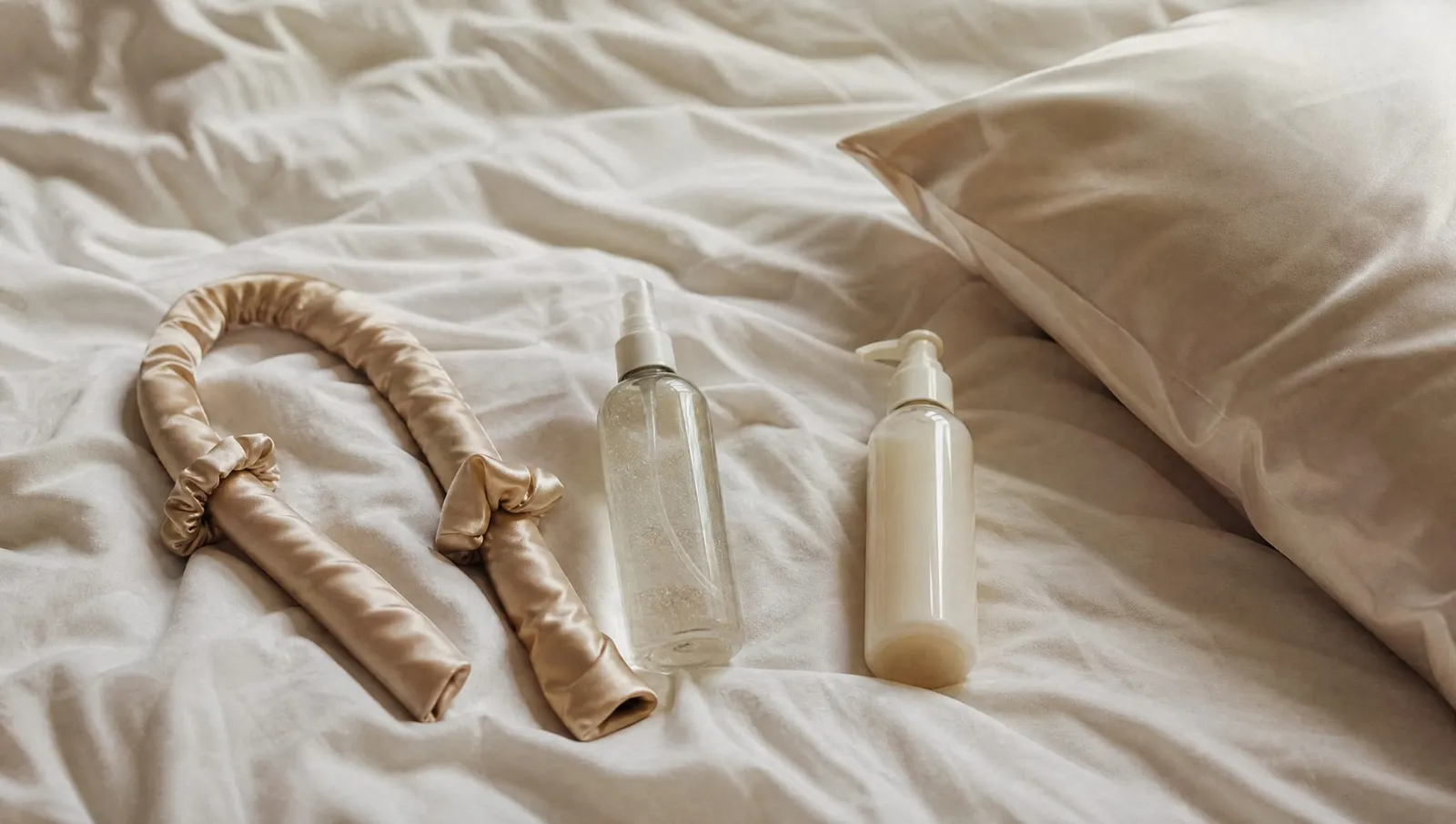
Twelve minutes at night, two in the morning, and one piece of physics that decides whether any of it works. Most people fail at the water, not the wrapping.
Hair holds a shape because of hydrogen bonds. They break when hair gets wet and reform as it dries, in whatever position the hair happens to be in at the time. That is the entire mechanism, and everything below is downstream of it. If your hair is dripping when you wrap it, the bonds will still be breaking at four in the morning and you will wake up with a damp head and no curl. If it is bone dry, there are no bonds to move and you have simply slept awkwardly for nothing.
So the number that matters is eighty percent. Damp, cool to the back of the hand, no longer cold to the touch. Everything else in this routine is either helping the set survive the night or stopping it looking like a set.
I should say what this is not, because the pictures lie. This does not produce the curl a hot iron produces. It produces a wave with a defined bend that starts somewhere around the ear and gets more serious toward the ends. On fine, short, very straight hair it holds about four hours and then it is a nice-looking Tuesday and nothing more. On anything with a little weight or wave already in it, it holds all day.
Intermediate · 12 min at night, 2 in the morning · Twice a week at most · Four things, one of them optional
Everything looks good at eight in the morning; the question this routine is answering is what your hair is doing at two in the afternoon.
Twelve minutes, the night before.
Step one · The part everyone skips — Dry to eighty percent first.
Wash, then wait. Rough-dry with a towel and leave it forty minutes, or use a dryer on cool. The test is the back of your hand against the mid-lengths: cool and slightly heavy is right, cold and slick is too wet, weightless is too dry. Wet hair cannot finish drying inside a wrap overnight — there is no airflow in there — and a wrap still damp at seven in the morning has set nothing at all. This is the step that decides the outcome, and the only one with no product attached to it, which is presumably why it gets skipped.
Thick hair: budget an hour of air-drying. Fine hair: twenty minutes and you have already overshot.
Step two · 2 minutes — Leave-in, on the ends only.
A leave-in conditioner does two things here that matter. It gives the cuticle enough slip that the hair can be wrapped without snagging, and it slows the drying down slightly, which gives the bonds more time to settle into the new shape rather than snapping into it. Rake it through the bottom two-thirds with your fingers, not a brush. Nothing above the ear. A leave-in near the root weighs down exactly the part of the curl that needs lift, and by morning you will have a flat crown and good ends, which is the worst possible combination.
Cream leave-ins, not sprays. A spray puts water back into hair you have just spent forty minutes drying.
Step three · 1 minute — Salt spray, at the mid-lengths.
Salt works by roughening the cuticle very slightly, which gives strands something to grip each other with — that grip is what keeps a heatless wave from falling out by lunchtime. It is also what makes hair feel like a beach towel if you use too much, and there is a genuinely narrow window between the two. Four to six sprays held about a foot away, aimed at the mid-lengths, scrunched in once with a cupped hand. Not at the roots, and not at the very ends — those are already the driest part of your head and salt will not improve their week.
Coloured or bleached hair: halve it, or skip it, and see the blonde upkeep shelf for why porous hair needs the slip more than the grip. Salt on porous hair is grip you did not need and dryness you will notice by Friday.
Step four · 6 minutes — Wrap, from the face backward.
Sit the ribbon or rod across the top of the head like a headband and let both tails hang. Take a section from the front — the piece that frames your face — and wrap it away from your face, over and around, then keep adding hair as you travel down, the way a French plait recruits as it goes. Away from the face is not decorative: wrapped toward the face, the front section falls forward all day and you spend Tuesday pushing it off your cheek. Work down one side, then the other, and tie off with something soft. Six minutes the first time, three by the fourth attempt.
Leave the last two inches out of the wrap on purpose. A fully wrapped end curls into a small tight hook that reads as a hot roller, and the whole point of this is that it should not.
Step five · The seven hours — Sleep on silk.
A wrap survives the first four hours regardless of what your pillow is made of. It is the last three that decide the morning, because by then the hair is dry, the set is holding, and the only thing left to damage it is friction. Cotton is a woven abrasive at three in the morning. Silk is not, and the difference shows up as frizz along the top of the head rather than anywhere obvious. The longer argument is at why your pillowcase is ruining your hair.
If you already wear a silk cap, the pillowcase is redundant. Keep whatever is on the bed.
Step six · 2 minutes — Unwind, then do nothing.
Untie and unwrap slowly, one section at a time, letting each piece fall rather than pulling it free. Then stop. Do not brush it, do not run your fingers through it, and do not touch the top of your head. The set is at its most fragile in the first ten minutes, and every pass of a hand through it costs you an hour of hold at the other end of the day. Give it ten minutes of being ignored, then tip your head forward, shake once from the roots, and separate two or three pieces at the front. That is the entire morning.
If you must add something: one pump of oil, rubbed between the palms, touched only to the ends. Anything aerosol puts moisture back into a set that has just finished drying.
The shelf — what this actually needs
- Forty minutes of air-drying, and no shortcut for it
- A cream leave-in conditioner, not a spray
- A sea salt spray — fine hair only
- A silk heatless curl set, ribbon or rod
- A silk pillowcase, for the last three hours
What’s in it
- Magnesium sulfate — The salt doing the work in most sea salt sprays. It roughens the cuticle just enough for strands to grip each other. Too much and you have a beach towel.
- Cetearyl alcohol — The fatty alcohol giving a cream leave-in its slip. It is not the drying kind of alcohol, whatever the internet has told you.
- Hydrogen bonds — Not an ingredient. The actual mechanism — they break when hair is wet and reform as it dries, in whatever shape the hair is held in.
Heatless Curls, Start to Finish, itemized — A decision made at 10pm about how Tuesday will look.
Heatless curling is not a technique. It is a decision made at ten at night about how Tuesday is going to look.
How to know it's working.
Check at hour six, not at hour one. Everything looks good at eight in the morning; the question this routine is answering is what your hair is doing at two in the afternoon.
- At 2pm the bend is still visible from the ear down, even if the very ends have relaxed.
- The front sections are sitting away from your face rather than falling into it.
- The top of your head is smooth. Frizz there is a pillowcase problem, not a wrapping problem.
- If your hair is still slightly damp when you unwrap, you started too wet. Add twenty minutes of drying before the wrap, not after.
- If the wave is gone by eleven, either there was no salt spray or the hair was dry rather than damp when it went on. Those two failures look identical and have different fixes.
If something isn't working.
I wake up with a kink instead of a curl.
The section was too thick, or it was wrapped too loosely, or both. A wrap that can be slid along the rod with one finger is not holding a shape, it is holding a fold. Take thinner sections and pull each one snug against the rod before adding the next.
The roots are completely flat.
Leave-in went too high. It belongs on the bottom two-thirds and nowhere near the crown. If the crown is still flat with the product correct, wrap the top section in the opposite direction to the one underneath it — the two fighting each other creates the lift.
It falls out by lunchtime.
Three candidates, in order of likelihood. You touched it in the first ten minutes. The hair was too dry going in. Or the humidity is above roughly seventy percent, in which case nothing you do at ten at night is going to survive one at noon, and I would rather tell you that than sell you a product for it.
Can I do this every night?
You can, and you will regret it by the second week. The wrap puts sustained tension on the same sections in the same places, and hair that is being tensioned nightly starts breaking where the ribbon sits. Twice a week, and move the parting between attempts.
Do I need the salt spray, honestly?
On thick or wavy hair, no — you have enough grip already and the salt only costs you moisture. On fine, straight, freshly washed hair it is the difference between a wave that lasts four hours and one that lasts nine. It is the most optional item here and the one that fine hair cannot skip.
“Everybody films the wrapping. Nobody films the forty minutes of waiting for hair to reach eighty percent dry, which is the only part that decides anything.” — Nelly
If you would rather use heat on the days you have time, the round-brush blow dry starts from the same damp-not-wet rule. And for working out which night to wash so the set lands on the right morning, see wash day moved to Thursday.
Filed by Nelly, from the desk · 7 August · No. 10 · Hair / Styling