The evening is for removing things.
Five steps, about six minutes, and only one of them puts anything back on your face.
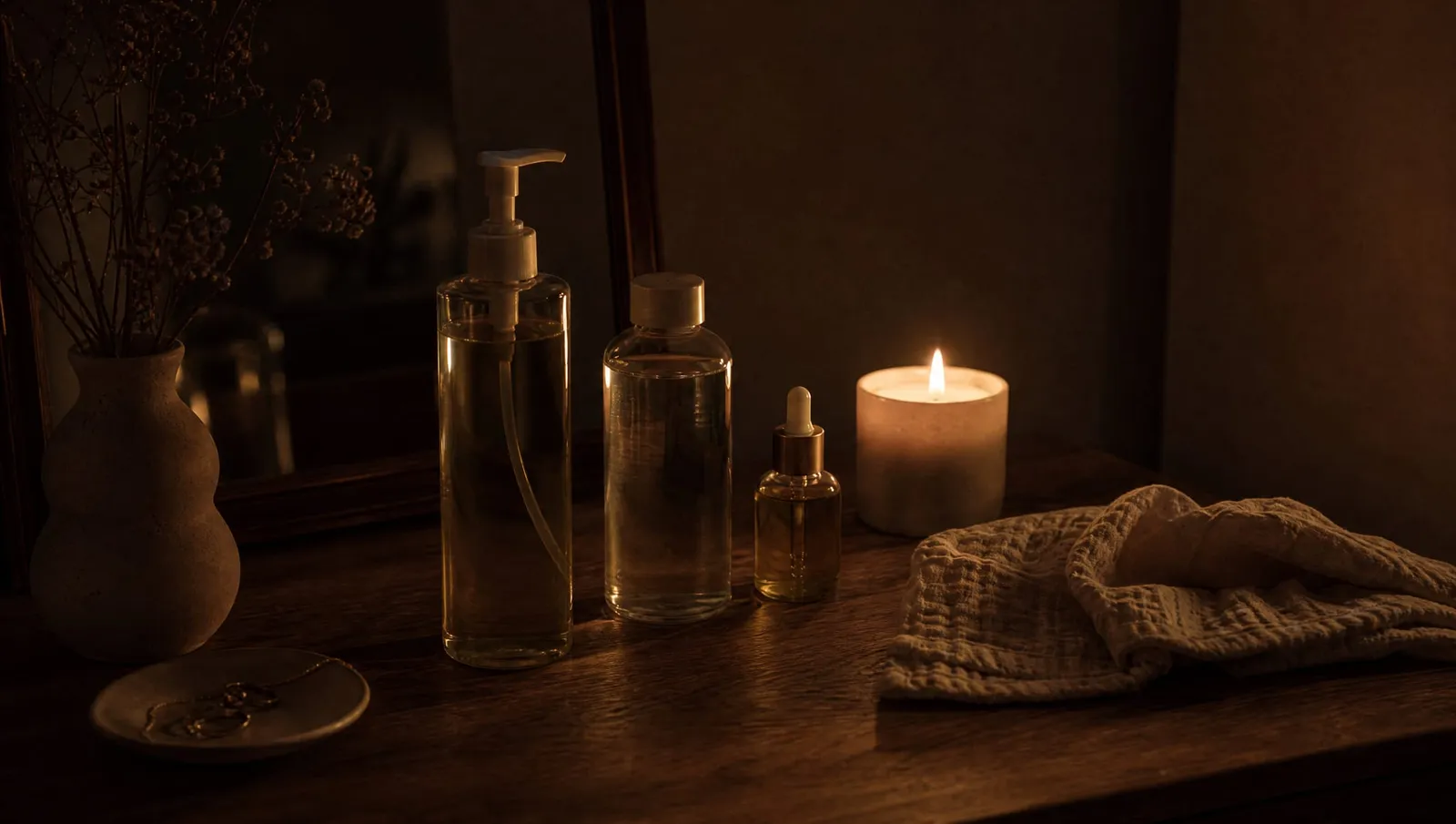
Five steps, about six minutes, and only one of them puts anything back on your face.
The evening routine has been oversold to us as the treatment routine — the one where the actives go, where the repair happens, where you earn something back. That framing is why most people's nights are crowded. Six products, three of them arguing with each other, and a barrier that never gets an hour to itself.
I think about the evening as subtraction. The day put things on your face: sunscreen, which is designed to be difficult to remove; makeup, which is designed to stay; sebum, which by 9pm has been sitting in the pores for fourteen hours oxidising; and whatever the city contributed. The single most useful thing you can do at night is take all of that off properly and then leave your skin substantially alone.
What follows is five steps and about six minutes, and only one of them adds anything. If you do it in a hurry, do the first two and go to bed.
Beginner · 6 min · Every night · ~€0 once the four are bought
Removal routines pay out slowly and quietly, and the evidence shows up as things that stopped happening rather than things that started.
Six minutes, and one of them adds.
Step one · 60 seconds — Micellar water, on dry skin.
Micelles are tiny spheres of surfactant with an oil-loving inside and a water-loving outside. On dry skin they can get at sunscreen, foundation and the day's sebum directly. Wet the skin first and you have diluted the mechanism before it starts, which is why so many people conclude micellar water does not work on sunscreen. Saturate the pad properly — a stingy pad is what makes this step feel like sanding. Hold it against the eye for ten seconds before you move it; mascara dissolves, it does not scrub off. Two pads for a full face of makeup, one on a bare day.
If the second pad comes away with as much colour as the first, the first pad was too dry, not the makeup too stubborn.
Step two · 60 seconds — The second cleanse, which is the actual cleanse.
The first pass took off what was sitting on top. The second one cleans the skin itself, and it is the step people skip on the theory that they have already washed their face. They have not. I have written the long version of this argument in On the Second Cleanse, and it is the one piece of my own advice I have never once talked myself out of. A salicylic cleanser is the useful choice here because salicylic acid is oil-soluble — it will go down into a pore where a water-based cleanser stops at the opening. Sixty seconds of contact time, worked with fingertips, then rinsed with tepid water. Not hot. Hot water is the fastest way to a red, tight face at eleven at night.
Salicylic every night is more than most faces want. Three nights a week, and a plain gel cleanser on the others, gets you the same result without the flaking at week three.
Step three · 60 seconds — Do nothing, on purpose.
Pat with a towel until the skin is damp rather than dry, then leave it for a minute. This is not a wellness instruction and I am not asking you to be present with your face. It is a practical window: everything from here on works better on skin that still holds a film of water, and the minute also tells you something. A face that goes from damp to tight in under sixty seconds has been over-cleansed, and the fix is fewer surfactant nights, not more oil afterwards.
A clean towel twice a week costs nothing and does more for congestion along the jaw than most of what you would buy to treat it.
Step four · 60 seconds — Facial oil — the only thing you add.
An oil is an occlusive and an emollient, not a moisturiser. It does not hydrate the skin; it slows down how fast the water already in there leaves, which overnight is the difference between waking up comfortable and waking up creased. Three to four drops in the palms, warmed for a moment, then pressed onto damp skin rather than massaged in. On genuinely dry skin, a cream first and the oil over it as a lid. On oily skin the oil alone is often enough, and squalane will not sit on the face like an argument the way an argan-heavy blend can.
If you are using a retinoid, it goes on dry skin before the oil, not after. Oil first means you have made your own slow-release retinoid, which is a good way to spend a week peeling.
Step five · 20 seconds — The pillowcase, which does the other eight hours.
You have just spent five minutes on your face and you are about to press it into a fabric for a third of the day. Cotton catches — on hair, and on skin, and on the film of oil you have just applied, most of which ends up in the weave rather than on you. Satin or silk holds far less product and drags far less across the cheek that you sleep on, which is reliably the side that creases first. Turn the case at least twice a week.
If you sleep on one side, that cheek will show it before the other does. It is not asymmetry in your face. It is the pillow keeping a record.
The shelf — what this actually needs
- Micellar water and two cotton pads
- A salicylic cleanser, for three nights a week
- A clean towel, changed twice a week
- A light facial oil
- A satin or silk pillowcase
What’s in it
- Salicylic acid — Oil-soluble, so it travels into the pore rather than stopping at the opening. Three nights a week, not seven.
- Squalane — The oil that behaves. Light, stable, and it does not oxidise into that faintly stale smell by month four.
- Glycerin — The unglamorous humectant in almost every cleanser worth using. It is why some cleansers leave skin comfortable and others leave it squeaking.
- Poloxamer — A common surfactant in micellar waters. Gentle, and it rinses cleanly, which is why the no-rinse claim mostly holds.
The PM Wind-Down, itemized — The evening is subtraction. Only one step adds anything.
A night routine that adds more than it removes is a night routine doing the wrong job.
How to know it's working.
Judge this at the fourteenth morning, not the third. Removal routines pay out slowly and quietly, and the evidence shows up as things that stopped happening rather than things that started.
- You wake up without a film — the face feels like skin, not like last night's product.
- The small congestion along the jaw and hairline, which is usually sunscreen that never came off, has thinned out.
- The sleep crease on your usual side is gone by the time you have finished coffee, rather than lasting until lunch.
- If your face is tight within a minute of towelling, drop the salicylic to three nights a week before you add anything.
- If you wake up slick, you are using too much oil, not the wrong oil. Go to two drops.
If the evening isn't landing.
Is the second cleanse honestly necessary if I don't wear makeup?
If you wear sunscreen, yes — sunscreen is engineered to resist water and sweat, and one pass of anything rarely takes all of it. If you wear neither makeup nor sunscreen, one thorough cleanse is fine, and I would gently ask why there is no sunscreen.
Can I use a cleansing balm instead of micellar water?
Yes, and on a heavy makeup day a balm is better. Micellar water wins on speed and on nights you are already half asleep, which is most nights. The step matters more than the format.
Where does retinol fit into this?
After step three, on dry skin, and then the oil over it. Start twice a week, on named nights rather than numbered ones. Going slowly is the whole trick with retinoids: a little, a few nights a week, building up only once your skin stops flaking. Most of us rush the first month anyway and then regret it.
My skin is oily. Do I really want to put oil on it?
Squalane, yes — it is light, it does not oxidise the way a heavy botanical blend does, and oily skin can still be short of water. If any oil makes you break out along the same three spots within a week, that is a comedogenicity answer and you should stop.
Six minutes is more than I have at midnight.
Then do steps one and two and go to bed. Removal is the part that matters. The oil is a comfort; the pillowcase does its work whether or not you were diligent.
“If you only take one thing from this: the second cleanse is the step, and everything after it is comfort. I have written eight hundred words elsewhere about why, and I still do it on nights I do nothing else.” — Nelly
Filed by Nelly, from the desk · 15 August · No. 10 · Skin / The Evening