How to Know When to Slab a Card
Most cards sent to graders lose money. Run my break-even math on fees, comps, and gem odds before you slab, and grade the right cards for the right reasons.

Grading is a math problem wearing a hobby costume. Here's the math.
I've talked more people out of grading than into it, and I say that as the guy with a PSA case within arm's reach right now. The single most expensive mistake I see is slabbing cards that had no business in a slab. Grading is a math problem wearing a hobby costume. Here's the math.
THE MATH, IN ORDER
- 01 Start with the fee
- 02 Pull the comps
- 03 Grade your own card honestly
- 04 Run the expected-value math
- 05 Protection + provenance
- 06 Check the population
- 07 No mercy grades
PHASE A
The inputs
FEE → COMPS → HONEST GRADE
1. Start with the fee, not the card
Look up the grader's current price for its cheapest open tier — prices and available tiers change, so check the submission page rather than a forum post — then add shipping and insurance both ways. That all-in cost per card is your floor. If the card can't clear that floor with a realistic grade, the conversation is over before it starts.
If a $10 raw card becomes a $30 slab at a 9 after a $30 all-in fee, it didn't make you money. It made you a break-even receipt and a three-month wait.
2. Pull the comps for every likely grade
Never grade on the raw price. Look up sold comps — actual completed sales, not listed prices — for the card at a 10, a 9, and an 8. Write down all three numbers. That's your outcome table.
Say a modern Lorcana enchanted rare shows raw sales at $80, a 10 at $220, a 9 at $110, an 8 at $70. Now the decision has shape. A 10 is a clear win. A 9 roughly breaks even after fees. An 8 loses money versus just selling it raw. Your whole decision now rides on one question: what are the odds this card gems?
3. Grade your own card honestly before a grader does
This is where collectors lie to themselves. Under a bright light and a loupe, check four things: centering, corners, edges, surface. Measure centering against the borders and compare it with the centering your grader publishes for a 10. One soft corner under magnification usually means 9 ceiling. A surface scratch across the holo, visible when you tilt it, means 8 territory no matter how pretty the corners are.
Pack-fresh does not mean gem. Modern print quality varies wildly; some sports card products gem at high rates, while certain vintage and Japanese-to-English print runs produce 10s only a few percent of the time. If your card has a visible flaw, assume the grader sees it too. They look at cards for a living. You look at your cards with hope.
+ STEP 04 · THE NINETY-SECOND CALCULATION
Run the expected-value math
I do this on the back of a show flyer in about ninety seconds. It's not financial advice, it's arithmetic, and it's the difference between collectors who grade smart and collectors who fund the grading companies.
Now combine steps 2 and 3. Say you honestly assess your Magic card at 40% odds of a 10, 45% of a 9, 15% of an 8. Multiply each grade's comp by its odds, add them up, subtract your all-in fee, and compare against the raw comp. If the number beats selling raw by a comfortable margin, grade it. If it beats raw by five bucks, that's not a margin, that's noise plus three months of waiting.
YOUR HONEST ODDS
Grade 10
YOUR HONEST ODDS
Grade 9
YOUR HONEST ODDS
Grade 8
COMP × ODDS · ADD THEM UP · SUBTRACT THE FEE · COMPARE AGAINST RAW
PHASE B
The judgment calls
WHEN MATH ISN'T THE WHOLE STORY
5. Grade for protection and provenance, not just price
Money isn't the only reason to slab. Three non-math cases where I grade without hesitating: a card I plan to keep for decades and want sealed against handling; a vintage card where authentication itself is the value, because a slab converts "trust me it's real" into a certification number anyone can verify; and a card with real sentimental weight, like the first chase card my nephew ever pulled. That one's a PSA 7 and worth more to him than any 10 in my case.
6. Check the population before you submit
A quick look at the population report changes decisions. If a modern card already has four thousand 10s, your gem joins a crowd, and crowds push prices down over time. If a card has a low population because nobody submits it, ask why nobody submits it. I've written a whole separate guide on reading pop reports without lying to yourself, because that skill deserves more than a paragraph.
7. Never grade damaged cards hoping for mercy
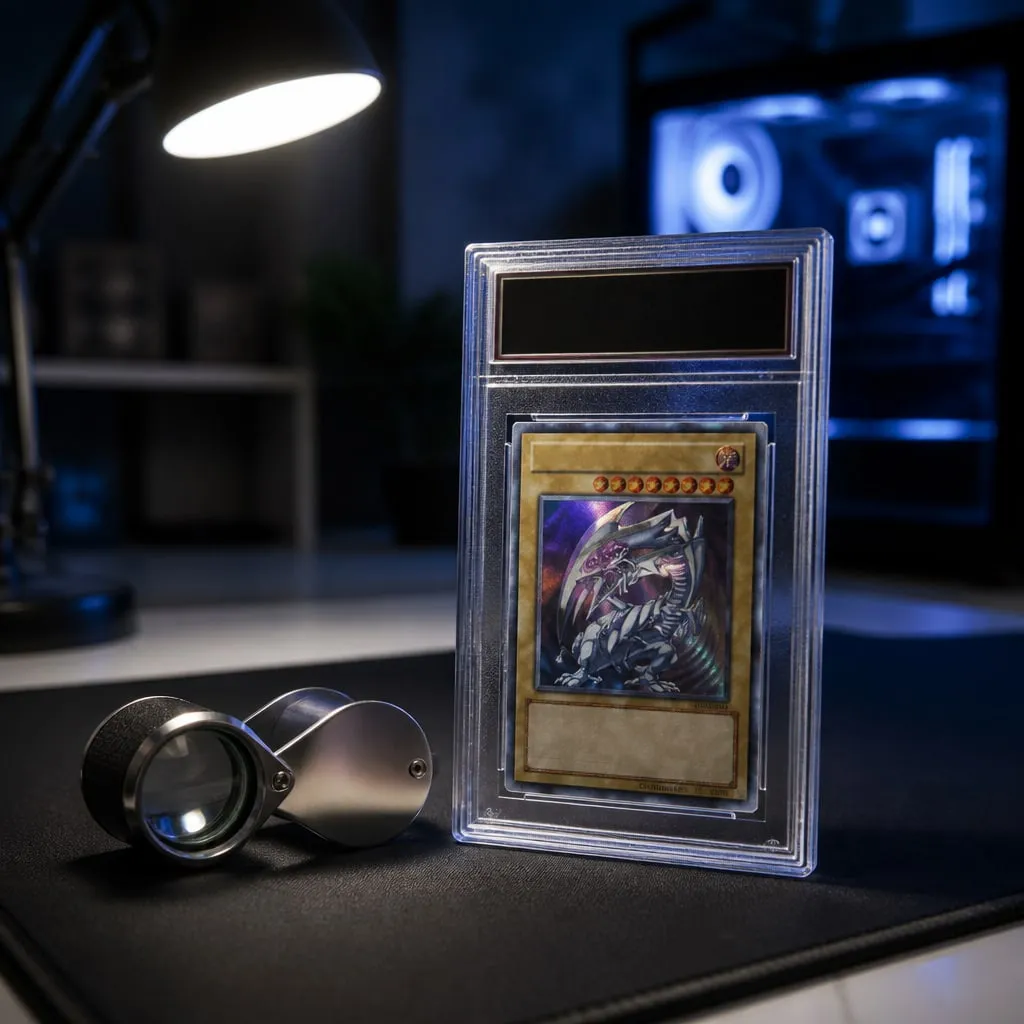
Graders don't do mercy. A crease is a crease, and a creased card comes back numbered somewhere that makes everyone sad, in a case you paid for. The exception is genuinely rare vintage, where even a 3 carries value and the authentication matters. A heavily played Yu-Gi-Oh starter deck Blue-Eyes from 2002 might be worth slabbing at any grade. Your binder rare from last year is not.
CASE FILE · HONEST EYES
They look at cards for a living. You look at your cards with hope.
SPEC · AN EXAMPLE OUTCOME TABLE
raw: $80
at a 10: $220
at a 9: $110
at an 8: $70
+ THE KIT
The pre-grading bench
You cannot pre-grade without magnification.
- Jeweler's loupe, 10x — you cannot pre-grade without magnification · <$15
- A bright, adjustable LED desk lamp — for surface and tilt inspection · ANY
- Ultra Pro penny sleeves — 100 for about $2 — every submission card gets one · ~$2
- Card Saver 1 semi-rigid holders — about $10 for 50 — the standard for grading submissions; graders prefer them over toploaders · ~$10
- Centering tool — or a simple printed centering overlay · <$10
- Painter's tape — for team bags and packaging — never regular tape near a submission · ANY
SOME LINKS EARN IAN A COMMISSION. IT FUNDS THE REFERENCE BINDER.
The grading section breaks this decision into smaller pieces: a break-even you can run in two minutes, a pre-flight check of corners, edges and surface, and a budget for the whole box instead of one card. They are collected under card grading.
Quick Answers
Is a 9 ever worth grading for?
Sometimes. On high-value vintage, the gap between raw and a 9 can be enormous, so a 9 is a fine outcome. On modern cards, a 9 usually sells near raw price, which means you paid a fee to break even. Know which situation you're in before you submit.
Which grading company should I use?
The one whose slabs sell best for your specific card type — check sold comps in the exact slab. PSA typically leads on sports and Pokémon resale; CGC has strong pricing on some TCG niches. Comps answer this question better than brand loyalty does.
How long does grading actually take?
Economy tiers can take months depending on backlog, whatever the estimate says at checkout, and graders sometimes pause their cheapest tiers altogether. Faster tiers exist at a much higher price. Build the wait into your math, because a market can move while your card sits in a queue.
Slab the winners, sleeve the rest, and let the math make the call — that's how you respect the hobby and your wallet at the same time.
— IAN + CASE 02 CLOSED