The case for a single candle
Not a shelf of them. One. On ritual, restraint, and the difference between a scented room and a room that smells of trying too hard.
Not a shelf of them. One. On ritual, restraint, and the difference between a scented room and a room that smells of trying too hard.
I have been in flats where every flat surface held a candle. The bathroom, the bookshelf, the windowsill, the little table in the hall. Each one a different scent, some lit, some merely displayed. By the time you have taken your coat off you have been told about fig, amber, sea salt, cashmere, and something that claims to be a library. It is a great deal of information for a hallway.
I own one candle. I light it in the evening, when the laptop closes and the day is officially over. It smells of very little: something a bit like woodsmoke and a bit like clean linen, which is to say it smells like a room someone lives in rather than a room someone is trying to sell you. When it runs out I buy the same one again, or something close to it. That is the entire system.
I am aware that this is a very small hill to stand on. I am standing on it anyway.
A scented room should smell faintly of something. A room with six candles smells of trying.
Why one.
The case for one candle is mostly the case I make about everything else: edit, don't add. Scents in the same room do not politely take turns. They pile up. Two good candles can make a room that smells of neither, and three will give you a faint headache and a vague sense of being in a department store at Christmas. I have written about the same problem with fragrance on the skin in the layering column. It is a volume problem, not a quality problem.
One candle also means you notice it. A scent you meet every evening becomes a signal, a small cue that says the working part of the day is over. That cue is more useful to me than any amount of variety. Variety is what you want from dinner. From a ritual, you want repetition.
Choosing the one.
I look for something that smells like a place rather than a dessert. Wood, smoke, herbs, tea, linen, a little resin. Nothing that reminds me of a cake shop. Nothing so strong that I can smell it from the street outside my door. If you can smell an unlit candle from across the room, it will be too much lit.
Smell it more than once, on different days, before you commit. A scent that delights you in the shop at noon can be exhausting by the second evening at home. Unscented is a perfectly respectable choice, by the way. Sometimes what you want from a candle is the light and not the perfume.
The ritual, briefly.
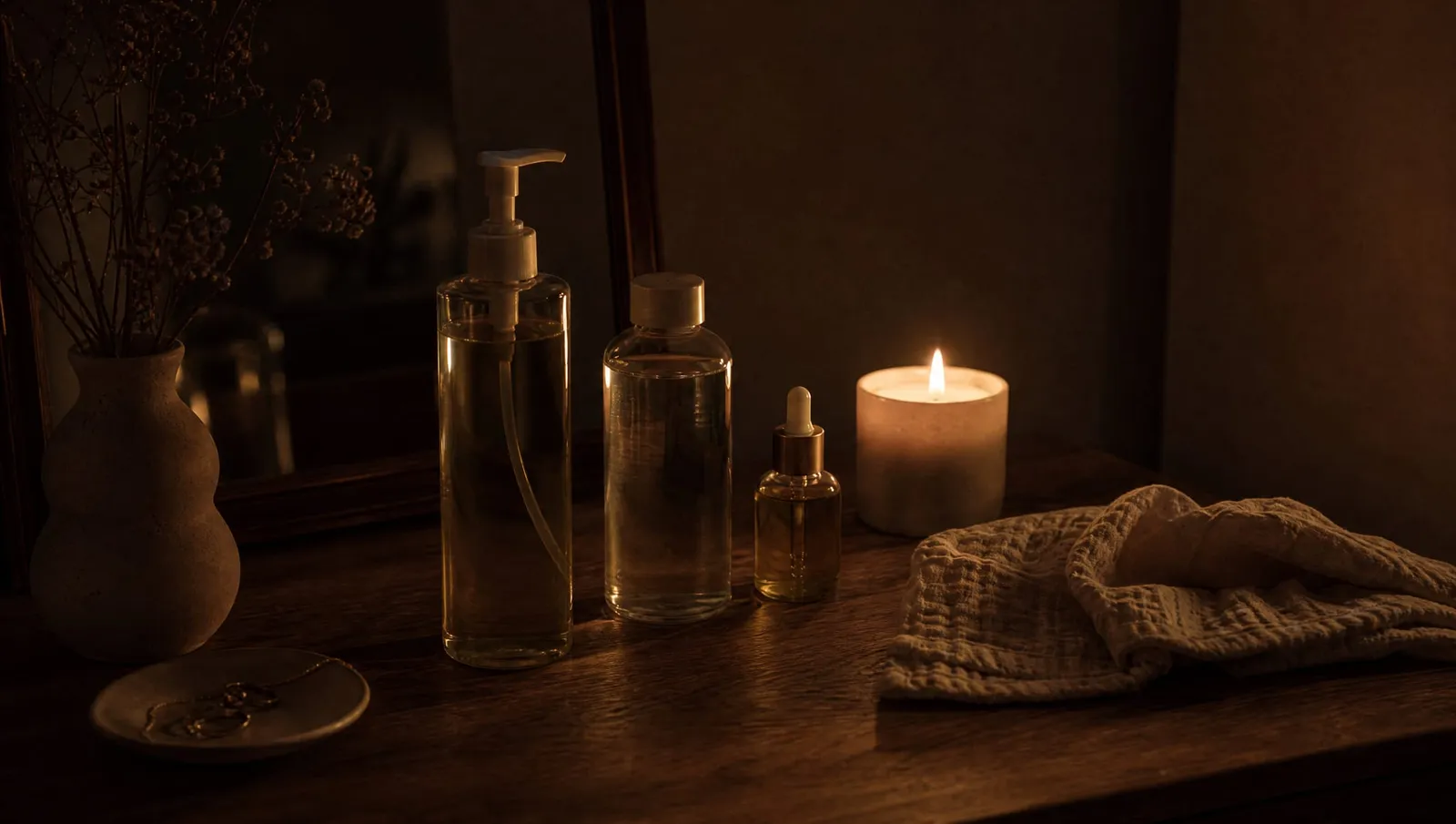
Lights down, or at least a lamp instead of the overhead. Phone in another room, which is the hardest part. Candle lit on the same spot on the same table. A cup of something. A book, or nothing. I keep it to an hour or so and then put it out before I go to bed, every time.
The first time you light a new candle, let it burn until the melted wax reaches the edges of the container, so it does not tunnel down the middle and waste the rest. That means only lighting it first on an evening when you will be in the room for a while. A candle is not something to rush.
The boring part, which is the important part.
A candle is an open flame in your home. I like the ritual very much, and I like my flat more. These are the rules I do not bend.
- Never leave it unattended. Not to run a bath, not to pop to the shop, not to fall asleep on the sofa. If you are leaving the room for more than a moment, put it out.
- Trim the wick short before every lighting. A long wick gives a tall, smoky, flickering flame and blackens the glass.
- Mind what is near it. Keep it well away from curtains, blinds, books, plants, shelves above, and anything that could fall or blow onto it. Keep it out of draughts.
- Keep it out of reach of children and pets. A cat's tail is a very efficient way to discover this rule.
- Use a stable, heat-resistant surface. A plate or coaster under the container is sensible; the base can get hot.
- Ventilate. Open a window for a while afterwards, and do not burn it for hours on end in a small closed room.
- Put it out properly. A snuffer or the lid is calmer than blowing, which scatters wax and smoke. Make sure it is fully out before you leave it.
- Stop near the end. When only a little wax remains at the bottom, retire it. The container can overheat when it is nearly empty.
If scented candles give you a headache, irritate your eyes, or make breathing uncomfortable, put it out, open a window, and switch to unscented or none at all. If you have asthma or another breathing condition and are unsure, ask your doctor rather than persevering.
One flame, watched. That is the whole luxury. Anything more is decoration.
The candle is a supporting part in a longer evening, too: the Sunday column keeps one on the shelf, in a sturdy holder, during the one slow night of the week.
Filed by Nelly, from the desk · Home / Ritual