The case against the ten-step routine
Ten steps is not a routine. It is a to-do list someone sold you. Here is what I kept, and the eight things I quietly put down.
Ten steps is not a routine. It is a to-do list someone sold you. Here is what I kept, and the eight things I quietly put down.
I did the ten steps. I want that on the record before anyone accuses me of criticising something I have not tried. For most of a year in my twenties, I stood in a small bathroom every night with ten things lined up along the edge of the sink in order, like an altar, and I worked through them. Oil cleanser, foaming cleanser, exfoliating toner, essence, ampoule, sheet mask, eye cream, spot treatment, facial mist, sleeping mask. It took about twenty-five minutes. I timed it, because I am the sort of person who times things.
My skin was not better that year. It was not dramatically worse, either. It was busy. It was a face that was always mid-way through something, always slightly tacky, always being asked to absorb the next layer before it had finished with the last. I looked like someone who had a skincare routine. I did not look like someone who had good skin.
A routine, as far as I can tell, is something you do without having to decide to. Ten steps is the opposite. Ten steps is a list of decisions, every night, dressed up as calm.
I looked like someone who had a skincare routine. I did not look like someone who had good skin.
What I kept.
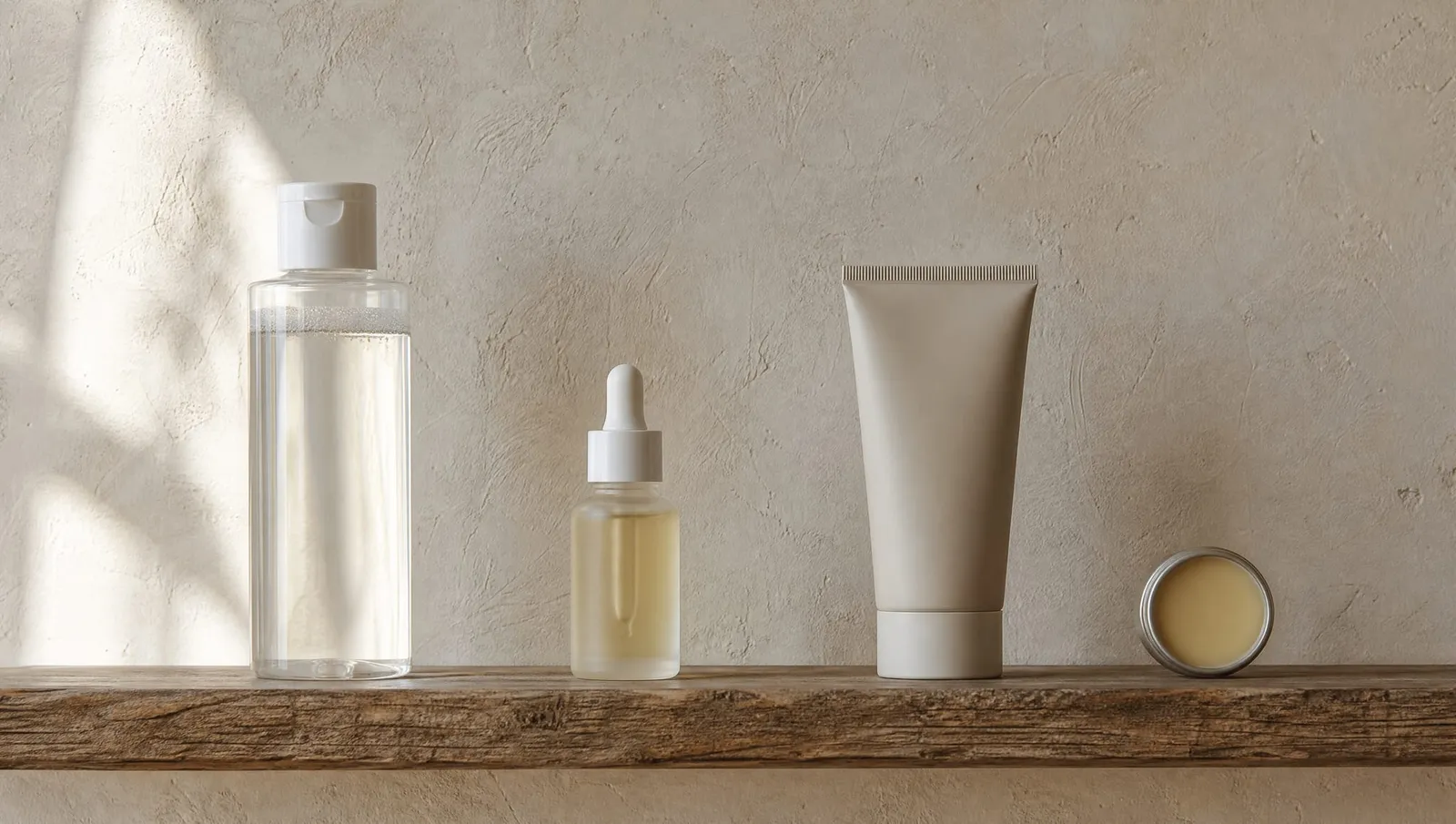
Two steps. They are the first two, which tells you something about how the list was built: the useful parts at the front, the selling parts after.
The first cleanse.
Oil, or a balm, onto a dry face, to take off the sunscreen and whatever the day put on top of it. This one survived because it does a job nothing else on the list could do. Oil lifts oil. Everything that came after it in the ten was working on a face that this step had made available.
The second cleanse.
A gentle gel, on the nights with sunscreen or makeup, for about a minute. I swapped the foaming cleanser for something milder years ago, but the step is the same step, and it is the one I would defend longest. The full argument is in on the second cleanse.
You will notice there is a moisturiser on my shelf, and a sunscreen, and a serum in the morning. None of them were in the ten. The ten was an evening list and sunscreen was not on it, which I now think is the single most telling thing about it. The jar I use at night arrived later, to do plainly what the sleeping mask had been doing expensively.
The eight I put down.
I did not throw them out dramatically. I stopped reaching for them, one at a time, and waited to see whether my face noticed. Mostly, it did not. That was the experiment.
The exfoliating toner.
Every night was too often, and I did not know that, because nobody selling a nightly step tells you to do it weekly. My skin got calmer within a few weeks of stopping. Exfoliating is now an occasional thing, on one evening a week, and it does more good there than it ever did as a habit.
The essence and the ampoule.
I have put these together because I could never explain the difference between them, and neither could the person who sold them to me. Thin, watery, pleasant, and doing roughly what a splash of water and a decent moisturiser do between them. I do not miss either.
The sheet mask.
Twenty minutes of lying still with a cold wet thing on my face, which I enjoyed, and which produced a glow that lasted until roughly the end of the evening. That is a nice thing to do occasionally. It is not a step.
The eye cream.
I have said elsewhere that most eye creams are optimistic fiction in very small containers. My eye area now gets the same moisturiser as the rest of my face, from a smaller pot. It has not complained.
The spot treatment.
A drying dab on every blemish, which mostly gave me a flaky patch around a spot that would have gone on its own. When I stopped attacking things, fewer things appeared. If you have acne that does not settle, that is a different conversation, and a dermatologist or your GP is a better person to have it with than a tenth step.
The facial mist.
Nice in a hot train carriage. Pointless in a bathroom, where a mist that evaporates off the face can leave it feeling drier than before. I have a bottle in a drawer somewhere for summer.
The sleeping mask.
A thick layer of something rich and scented that I was meant to sleep in. I replaced it with the jar, which is not scented, and which I put on more thinly. My pillowcase is grateful.
What the eight cost.
Not the money, although there was a great deal of that. The real cost was attention. Twenty-five minutes every night is the better part of three hours a week spent managing a face that would have been fine with ten minutes. More than that, it was the habit of thinking that skin is a project, that more care means more products, that every problem has a step waiting to be bought.
The two steps I kept take a few minutes, and on the nights without sunscreen it is fewer. I add something plain on top and go to bed. My skin is calmer than it was in the year of ten, and I think about it far less, which I have come to believe is the real measure.
If you are doing ten steps and your skin is happy and you enjoy it, carry on. I mean that. This is not about rules. It is about noticing whether the list is serving your face or your face is serving the list. Put one thing down for a fortnight. See if anything happens. If nothing does, you have your answer.
Put one thing down for a fortnight. If nothing happens, you have your answer.
Filed by Nelly, from the desk · Skin / Routine