How to Fold and Drape a Throw Blanket
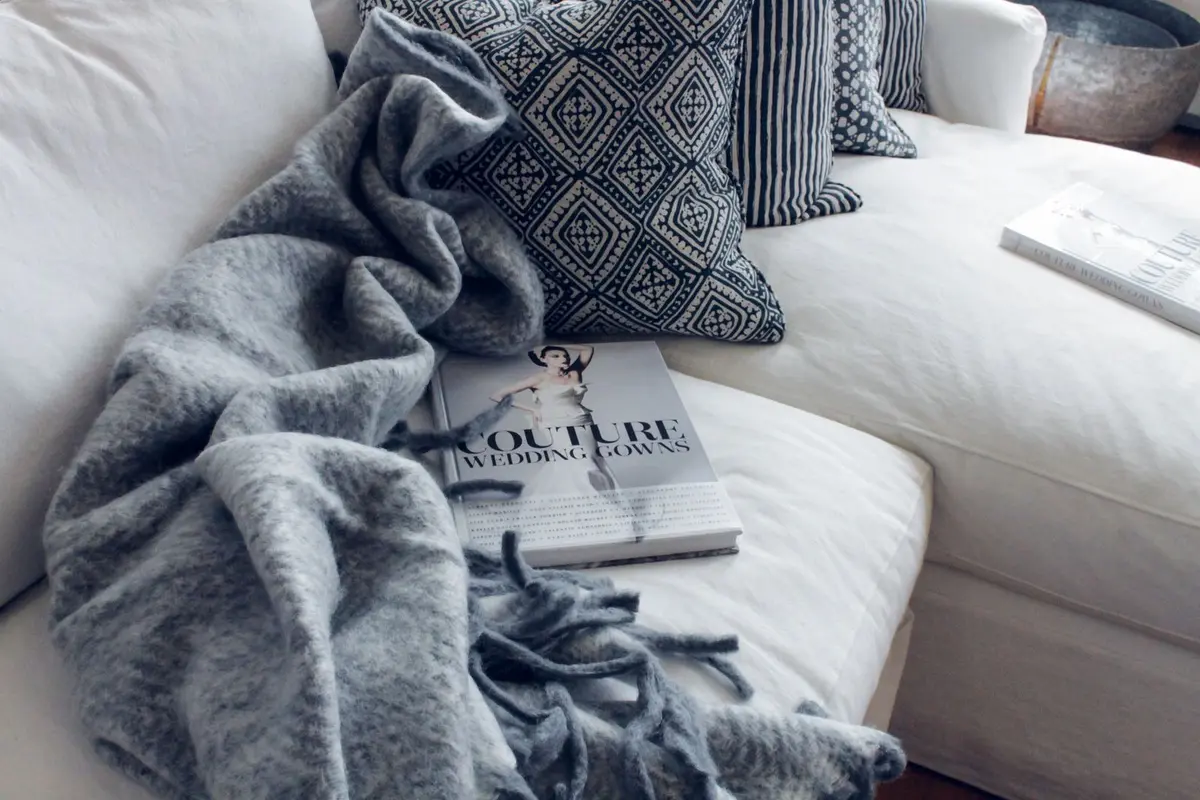
A throw blanket looks intentional when folded into thirds lengthwise, then draped over the arm or back of a sofa with the fold facing outward. The key is consistent thirds and leaving enough length to cascade naturally.
- Difficulty
- Beginner
- Time
- 10-15 minutes
- Cost
- $0 (uses existing throw)
- Tools
- None
- Permit required
- No
- Contractor recommended
- No
- You will need
- Throw blanket (50x60 to 70x90 inches), Clean bed or large flat table, Smooth, clear work surface (free of clutter), Your sofa or chair, Ten minutes and good lighting
Materials
- 1 Throw blanket (wool, cotton, linen, or acrylic blend) (Any size from 50x60 inches to 70x90 inches works. Heavier blankets hold folds better; lightweight ones cascade more fluidly. Choose based on your climate and the look you want.) — $20 — $120
Step by step
Orient Grain First
Spread the throw completely flat on a clean bed or large table. Look at how the weave or nap runs. If it's a knit, notice which direction feels smoothest when you run your hand over it. This isn't essential for folding, but it helps you position the blanket so its best side faces out when draped. Smooth any wrinkles as you lay it down.
Tip: If the blanket has a directional print or texture that looks better one way, orient it now so the finished fold shows that direction.Find the Midline
Imagine a line running down the middle of the blanket from top to bottom, dividing it in half. You're about to fold the blanket into thirds along its length, not its width. This matters. You'll be folding the long sides toward that imaginary center line, not folding the blanket in half. The result is a long, narrow rectangle that's one-third the blanket's original width.
Tip: If your blanket is slightly uneven or irregular, fold toward the center from both sides rather than anchoring one edge—it'll stay more balanced.Fold First Edge Inward
Starting at the top, lift one long edge of the blanket and fold it inward, stopping at approximately the one-third mark from that edge. The fold line should run parallel to the length of the blanket. Smooth it down as you go, working from top to bottom. Use both hands to keep tension even. You should see the fold create a clean line running the blanket's full length.
Tip: Work in sections if the blanket is large—fold a few feet, smooth it, then continue rather than trying to fold the entire length at once.Fold Second Edge Over
From the other long edge, fold inward toward that same imaginary center line, overlapping slightly with the first fold you made. Smooth this down as well, working the entire length. You now have a long rectangle that's roughly one-third the blanket's original width. The blanket should feel compact but not creased severely—think of firm, clean folds rather than sharp creases.
Tip: The two folds don't need to meet exactly at center—slight overlap is fine and actually looks more natural when draped.Halve the Length
Take your long narrow rectangle and fold it in half across its width, bringing one short end to meet the other. This creates a compact, manageable bundle about half the length you just created. Smooth this fold down. You now have a compact rectangle roughly one-third the blanket's width and one-half its original length.
Tip: For storage or transport, you can stop here. For draping, pick it up and move to your sofa.Lay Fold on Sofa
Carry the folded blanket to your sofa. Unfold it once—back to the long rectangle from step 4—so you're holding it in thirds lengthwise, folded in half widthwise. Lay this bundle across the arm of the sofa or the back, with the folded edges facing outward (toward the room) and the open edges facing the sofa or hidden. The fold creates a finished visual line. Position it so roughly one-third of the blanket's length drapes down the side or back of the sofa, and two-thirds extends horizontally across the arm or back.
Tip: If the blanket keeps sliding, fold the corner of the bottom layer under itself slightly where it meets the sofa—this creates friction without being visible.Balance the Fall
Step back and look at the blanket as it hangs or lies. The draped portion should look natural, not stiff. Gently pull or shift the blanket so the cascade—the hanging section—is even and flows with the furniture's lines. If you're draping over the back of a sofa, the blanket should reach about halfway to the seat. If it's over an arm, it should fall gracefully to within a few inches of the floor. There's no exact rule; it's about visual balance relative to your sofa's size.
Tip: Slightly uneven cascades often look more intentional and lived-in than perfectly symmetrical ones.Ruffle the Line
The clean fold you created shouldn't look rigid. Use your fingers to gently ruffle or separate the layers slightly where the fold meets the arm or back. Break up the line just enough so it feels organic rather than origami-precise. Think of it as suggesting the fold, not announcing it. A tiny amount of looseness at the fold's edge makes the entire drape look more natural.
Tip: This is the step people skip, and it's the difference between 'decorated' and 'looks nice'—spend ten seconds on it.Step Back and Assess
Walk around your sofa and view the blanket from different angles. From the side, it should look like it's casually placed, not positioned with military precision. From the front, the folds should be visible but not overwhelming. The blanket should complement the sofa's proportions, not dominate or disappear. Make any final micro-adjustments—a small shift here, a gentle ruffle there—until it feels right to your eye.
Tip: If you have multiple throws in the room, they should vary in folding method or position so they read as decorative choices, not a matched set.
Questions people ask
Should a throw blanket always be folded the same way?
No. Vary the method depending on your throw's weight, texture, and your sofa's style. A chunky knit wants loose, generous folds and a heavier cascade. A delicate linen wants tighter, more precise folds. The rule is: let the blanket's qualities guide how you fold it, not the other way around.
What if my throw is a weird shape or doesn't fold evenly?
Most throws are rectangular, but some hand-woven or artisanal ones aren't perfectly symmetrical. Fold it the best you can toward an approximate center, and let the imperfection show—it often looks more authentic. Asymmetrical folds read as handmade rather than sloppy.
How often should I refold my throw blanket?
Once or twice a week if you use it regularly. Folds soften and wrinkles set in from casual use and sitting. A quick refold takes two minutes and keeps it looking intentional. If it's purely decorative, weekly is fine. If it's also functional, refold whenever it starts to look rumpled.
Can I drape a throw on a chair the same way as a sofa?
Yes, but adjust the proportions. On a chair, a longer cascade can look better because there's less visual weight overall. You might fold the same way but position it so more of the blanket drapes down the side. Step back and adjust for the chair's size and your room's scale.
What's the best throw blanket material for draping?
Cotton and linen hold folds cleanly and cascade gracefully. Wool is heavier and wants a looser, more generous drape. Acrylic blends vary widely. Avoid materials that are too slippery (satin, silk-like synthetics) unless you're comfortable with it sliding around, or synthetic fleece that doesn't crease well. Feel the blanket first.
Variations
- Drape diagonally across the back and one arm for an asymmetrical look that reads as more relaxed
- Fold into quarters and drape over one corner of the sofa for a minimal, sculptural effect
- Use two throws of different weights or colors—fold one tightly, let the other drape more loosely for visual contrast
- Fold the trifold method but leave the end unfolded so it cascades all the way to the floor for a more dramatic, layered appearance
- Fold lengthwise in halves (not thirds) for a narrower, more delicate drape on smaller sofas or accent chairs
Troubleshooting
The blanket keeps sliding off the sofa arm
Fold a small corner of the underlayer under itself where it contacts the sofa to create friction, or position the blanket so more of its weight sits on the sofa itself rather than draping freely.
The folds look sloppy or wrinkled
Refold the blanket on a flat surface rather than adjusting it in place. Wrinkles set in when you fold on furniture. Smooth each layer completely before moving to the next fold.
The blanket looks too stiff or staged
Soften the fold edges more aggressively. Ruffle the layers at the fold line and let the cascade fall more loosely. The goal is 'casual' not 'perfect.'
The cascade is too long and puddles on the floor
Fold the blanket in thirds lengthwise but fold it into thirds widthwise instead of halves—this shortens the overall length. Or drape it further back on the sofa.
The blanket looks too bulky on a small sofa
Use a lighter-weight throw or fold it into narrower thirds. A chunky blanket on a compact sofa reads as overwhelming. Consider draping it over just one arm rather than across the back.
One corner of the fold keeps flipping or unfolding
The fold wasn't sharp enough initially. Refold on a flat surface and use both hands to create a crisp, defined line. The sharper the initial fold, the longer it holds.
More for the living room: living room decorating, how to create a listening corner and refinish a thrifted chair.