Four of your five cameras are watching a fence.
Most home cameras are pointed at a fence. The five placements that actually produce usable footage — the approach, the driveway, the quiet door, the interior choke point, and whatever's dark. By Sam.
the number of cameras is not the thing. what each one is pointed at is the entire thing.
- jobs to cover — which is not the same as five cameras: 5
- mounting height that records faces instead of scalps: 8–9 ft
- well-aimed cameras that beat six aimed at scenery: 3
- Updated: Aug '26
a neighbour of mine had a package taken and four cameras running. we sat and watched all four clips. camera one: a very good recording of a hedge. camera two: the top of a baseball cap, for a second and a half. camera three: a driveway at such a steep angle that a human being read as a moving shadow. camera four: the side of the house nobody has ever walked past, filmed beautifully, in high definition, for two years.
cameras got cheap and good very fast. aiming them did not.
so: five spots. not five cameras — you can do most of this with three. five jobs, in the order i'd cover them.
Five jobs. Three cameras will do it.
05 SPOTS | APPROACH, DRIVE, QUIET DOOR, CORRIDOR, DARK
Step 01 · Spot one | the approach
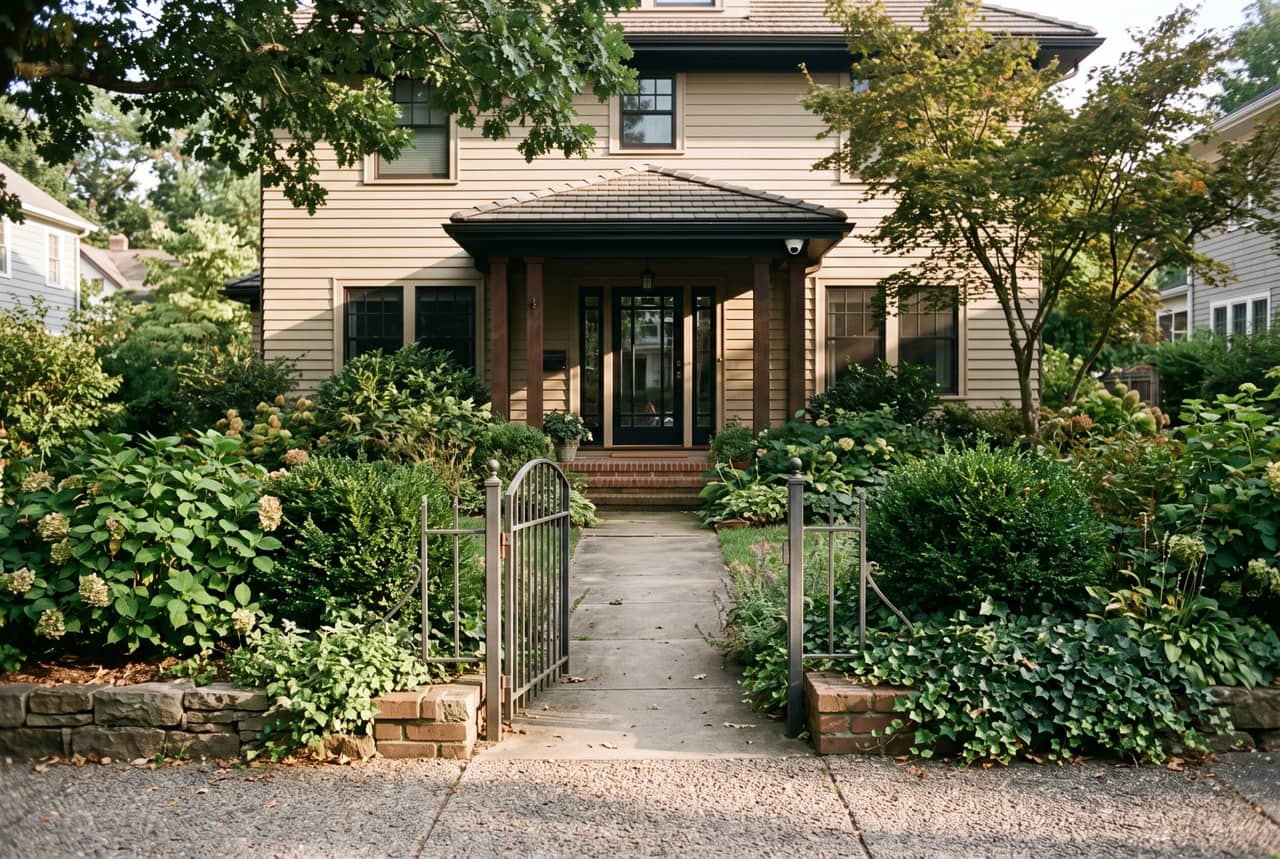
The approach, not the doorstep.
the most common mistake in the whole category: a camera mounted directly above the door, aimed straight down at the mat. what that records is the crown of a hat and a pair of shoulders, for about a second and a half, at an angle no human face survives.
aim along the walk instead. you want somebody in frame while they're still coming toward you — from the sidewalk, the gate, the end of the drive. that gives you a whole person, moving: build, clothing, gait, and a face turned roughly toward the lens rather than roughly toward the floor.
Step 02 · Spot two | the drive
The driveway, along its length.
cars, deliveries, and the thing that happens between the car and the front door. the mistake here is mounting high on the house and looking down, which flattens the whole scene into a top-down view where people become hats again.
mount so the camera looks along the drive — from the house toward the street, or from a corner across its length. you want the whole run in one frame: the vehicle, the walk from the vehicle, and the bit of pavement where boxes get left.
Step 03 · Spot three | the quiet door
The door nobody can see.
this is the one people skip, and it's the one i'd install second.
every house has a door or a window that can't be seen from the street, from a neighbour's kitchen, or from anywhere a person might casually be. a side gate behind a fence. a back slider screened by a hedge. a basement door down three steps in the dark. that's the entry that gets used, precisely because it's the one where somebody can stand and take their time.
and it's almost always the last spot to get a camera, because when you're standing at the front of the house with a box in your hand, you point the camera at the part of the house you look at every day.
Step 04 · Spot four | inside
One camera inside, at the choke point.
i know. indoors is a hard no for a lot of people, and if it's a hard no for you, skip it — i'm not going to argue about it.
but if you're open to one: an interior camera at the choke point does more than any two exterior ones. every house has a spot everything funnels through — the hallway, the landing, the bottom of the stairs. close range, even light, no weather, no glare, no distance. that's where footage stops being a grey shape and starts being a description.
one camera. pointed at a corridor. not the living room, not a bedroom — a corridor.
Step 05 · Spot five | the dark
Whatever's dark. Light it before you film it.
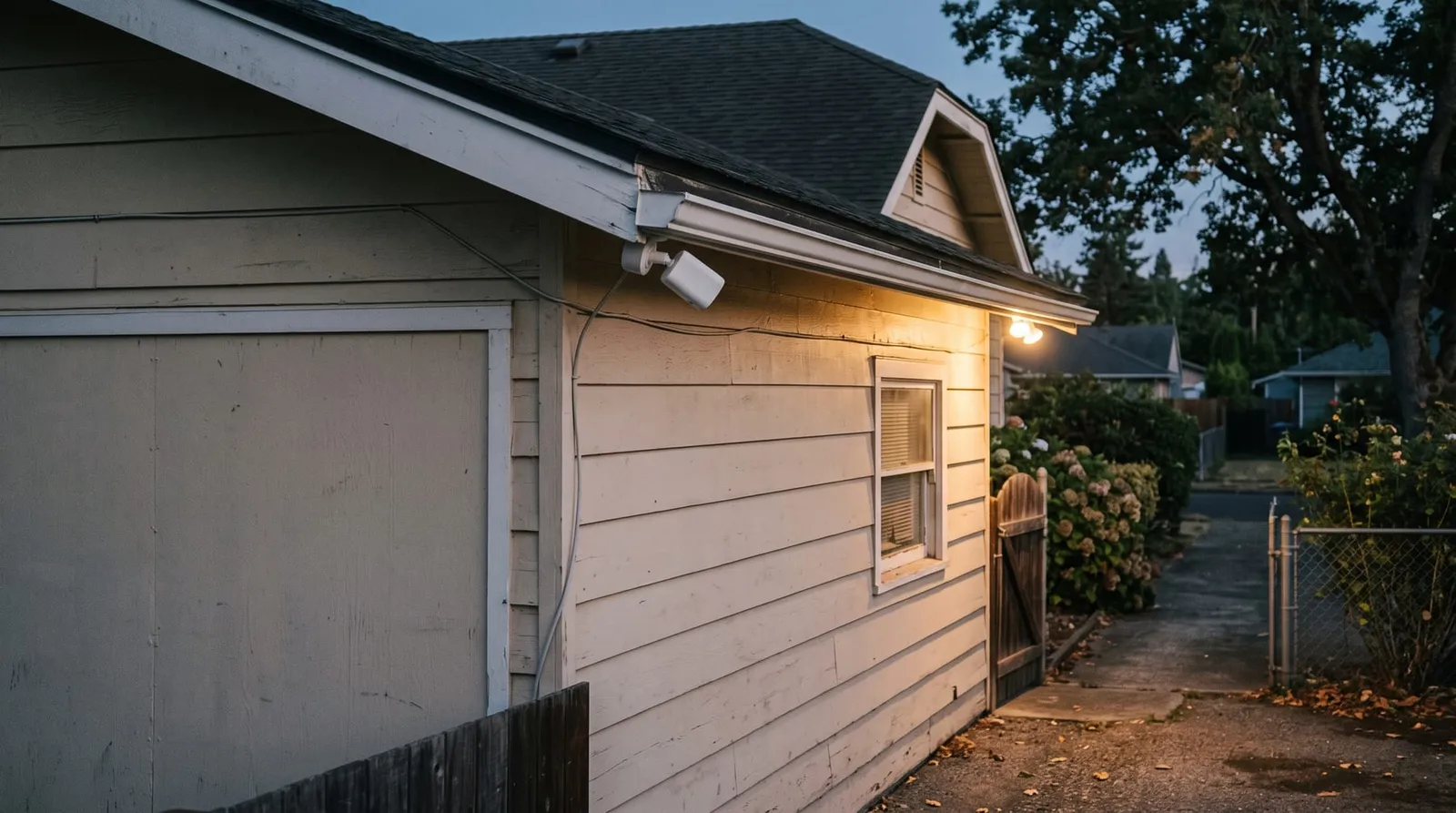
this one isn't a compass direction. walk the property at nine at night and find the piece of it you cannot see from any window. that's spot five.
and here's the order that matters: light it before you film it. a motion light does more of this job than a camera does, because it changes what happens instead of recording it. a camera in the dark gives you infrared, and infrared gives you a person-shaped thing in monochrome. useful for knowing something happened. not useful for saying who.
Aim is most of it. The rest is these.
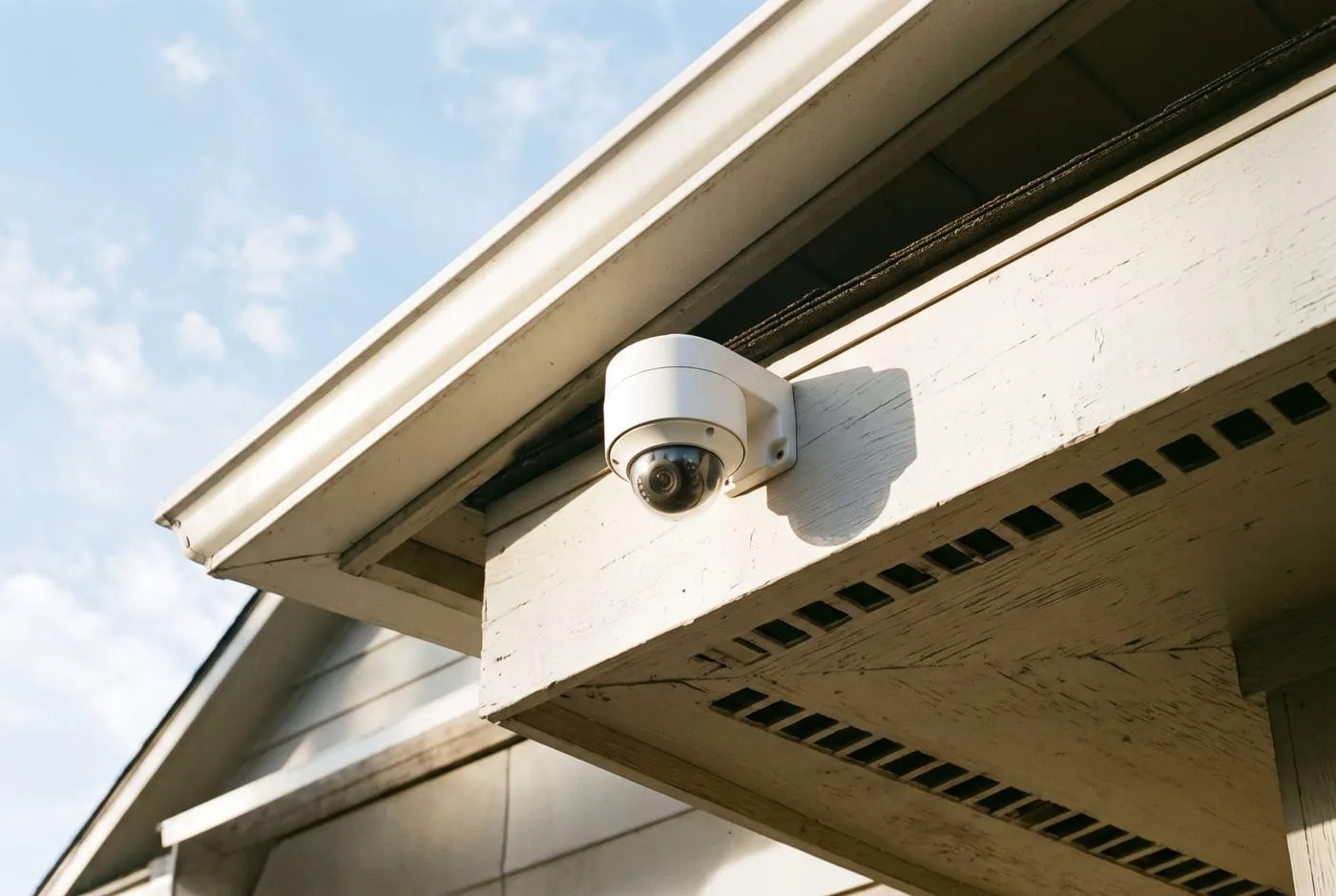
Height. roughly eight to nine feet. high enough that nobody casually swats it, low enough that it photographs faces instead of the tops of heads. fifteen feet up under the gable looks tidy and gives you aerial footage of strangers' scalps.
The sun. a camera aimed east spends every morning blinded, and one aimed west spends every evening the same way. worth going outside twice in one day before you drill anything.
What it's stuck to. exterior-rated fasteners, into something solid, cable routed so it isn't a handle. a camera on a bracket somebody can reach and twist is a camera aimed at the sky by tuesday.
Your neighbours. don't point a camera into somebody else's window, garden or door. beyond being genuinely rude, the rules on this vary a lot by where you live — and the time to find that out is before the bracket goes up, not during a conversation over a fence.
two things on the box before anything else: a weather rating that suits where it's going, and somewhere to store footage that isn't a monthly bill — a card in the camera or a drive in the house. decide storage before you decide resolution.
outdoor security cameras →some links on this page are affiliate links — if you buy through one, we earn a commission at no extra cost to you.
Three, aimed properly. Not six, aimed at scenery.
go outside, walk to your own door like a stranger, and watch the clip back. that's the whole audit, and it costs nothing.
two things to sort before the brackets go up. storage first: building a smart home without monthly fees goes through cameras that record to a card or a drive, and the questions to ask before you buy any of them. then the policy: if you are pulling a homeowners quote, ask whether a security system is on the discount list — first-home insurance covers the rest of that list. more for the house is on HowTo Home.
— sam