How to Display Slabs Without Fading Them
A slab seals a card but does not filter light. How to measure the light dose in your own room in lux-hours, what UV-filtering glazing does and does not buy you, and the four moves that cut fading fastest.
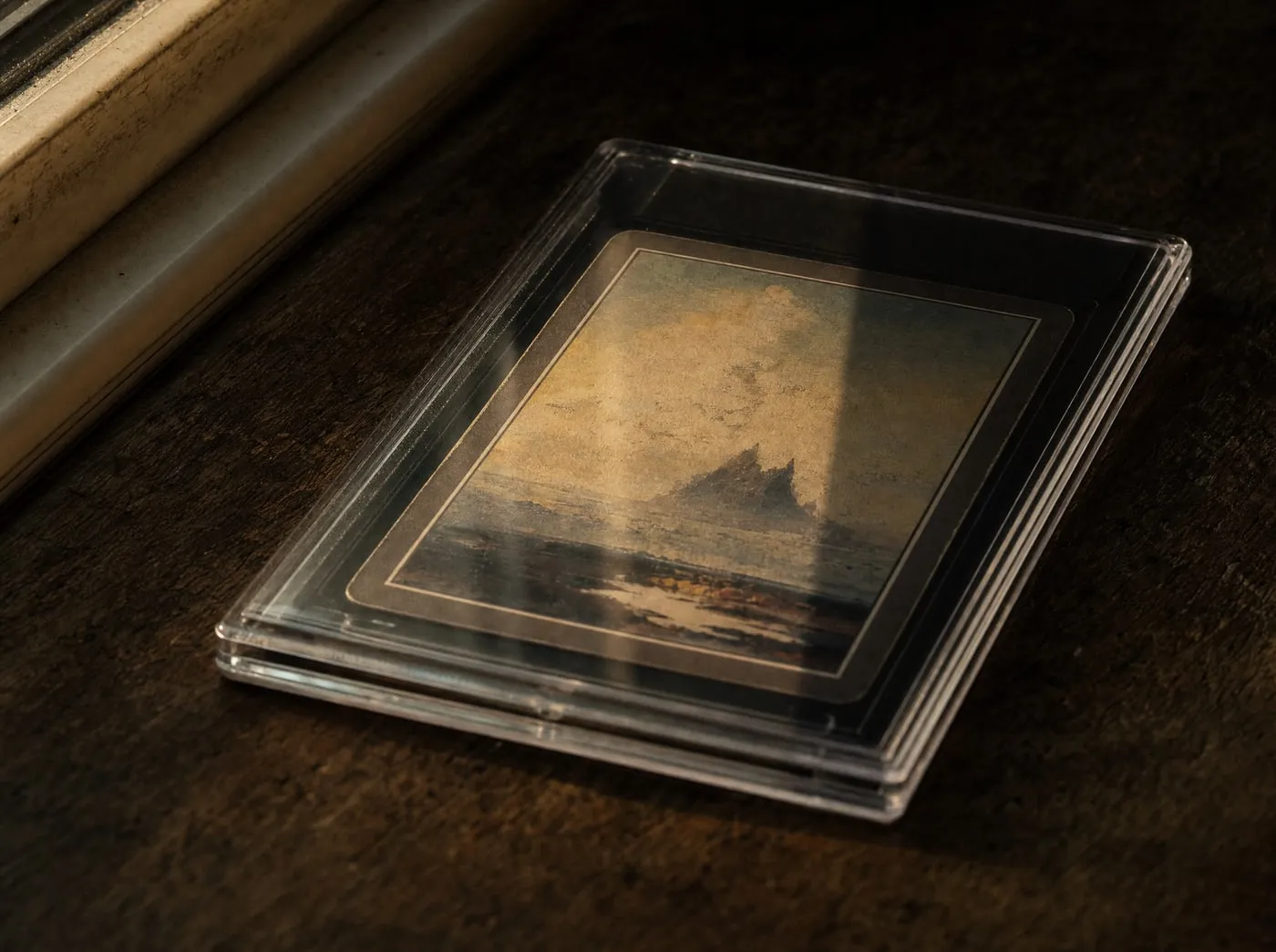
The shell keeps everything out except the one thing that ruins cards. Here is how to measure what your room is doing to yours, and what actually changes it.
A slab is the strongest thing you will ever put a card in, and the only layer in this chapter that cannot defend against the thing most likely to happen to a card on display. It stops fingers, dust, damp and drops. It does nothing about light. So the whole job of displaying a graded card comes down to a decision the slab has no opinion on: which wall, and how far from the glass.
▸ THE QUICK VERSION
Assume the shell filters nothing. Graders seal the holder for handling and permanence, not for ultraviolet.
Measure before you move anything. A phone light-meter app ranks four spots in ten minutes, which is all the accuracy this needs.
Distance and angle beat equipment. Getting a shelf out of the light path cuts more of the yearly dose than any sheet of plastic will.
Then buy the ultraviolet back. UV-filtering glazing removes a real slice of the damage and leaves the visible light alone.
Rotate. Two cards sharing one bright spot each take half a year of it. Nothing else halves a dose for free.
The shell is permanent, not protective
WHAT THE HOLDER ACTUALLY GUARANTEES
Grading companies call the plastic case the holder; collectors call it a slab. Either way it is an ultrasonically welded shell with the card suspended at its edges in a well of air — which is why a slab survives a knock that would crease a sleeved card. Sealed, rigid, permanent. Those are the guarantees, and they are worth having.
What no grader advertises is a filter rating, because the shell is not one. The plastic is specified to be optically clear so a grade can be read and photographed through it, which is close to the opposite of blocking light. Ordinary clear plastics typically absorb the shortest, most energetic ultraviolet — a real if accidental benefit. They pass most of the long-wave ultraviolet and essentially all of the visible light. Treat any slab as unfiltered unless the maker states a rating.
The slab settled that nothing will ever touch this card again. It settled nothing at all about the window.
Measure the dose before you move anything
LUX ON THE SHELF, LUX-HOURS ON THE CARD
Conservators treat light not as an event but as a dose — illuminance multiplied by time, counted in lux-hours — because a card at 100 lux for fifty hours has taken exactly what a card at 50 lux for a hundred hours has taken. That is what makes the problem tractable: you cannot stop light reaching a shelf, but you control both numbers in the product.
So measure. A phone light-meter app is not laboratory equipment and does not need to be — you are ranking four spots in one room, not certifying a gallery. Hold it flat against the wall where the card would sit, facing out the way the card would face, at the brightest hour of the day. Then multiply by the hours that spot is lit; this page assumes 3,000 lit hours a year, roughly eight hours a day, every day.
◆ FIGURE 1 · ONE ROOM, FOUR SHELVES, FOUR VERY DIFFERENT YEARS
DRAG THE PLAN SIDEWAYS — POSITIONS 03 AND 04 SIT OFF TO THE RIGHT →
Turn those readings into years and the argument stops being about taste. Each mark below stands for 75,000 lux-hours, so the rows compare directly — and no row is empty, because no position in a room with a window takes nothing.
◆ FIGURE 2 · THE SAME FOUR SHELVES, PRICED IN A YEAR
POSITION 01 · 0.6 mIn the light path
6,000,000LUX-HOURS / YR
POSITION 02 · 1.5 mSide-on, still lit
1,800,000LUX-HOURS / YR
POSITION 03 · 3.0 mOut of the path
450,000LUX-HOURS / YR
POSITION 04 · 4.5 mThe far corner
150,000LUX-HOURS / YR
◆ ONE MARK = 75,000 LUX-HOURS A YEAR · ONLY THE COUNT OF MARKS CARRIES MEANING; WHERE THEY FALL IN A BAND DOES NOT · ALL FOUR AT 3,000 DAYLIGHT HOURS
Position 04 still takes 150,000 lux-hours a year, and that is the best an ordinary room offers. Museum conservation guidance sets annual light budgets for the most light-sensitive material — watercolours, dyed textiles, colour photographs — well below that figure. The darkest corner of an ordinary room is therefore already running over what a gallery would allow its most fragile things. Hence the rest of this page: buying the dose down, not eliminating it.
None of it is reversible, and it happens slowly enough that nobody notices it day to day — so the day you see the damage is long past the day you could have prevented it.
Glazing buys you the ultraviolet. It does not buy you the light.
WHERE THE FILTER STOPS AND FADING CARRIES ON
What framers sell as conservation glazing — UV-filtering acrylic, of which ACRYLITE OP-3 is the type specimen — is defined by a threshold rather than by a product. Under the framing trade’s own guidelines (the PPFA’s, as glazing maker Tru Vue summarises them), glazing may be sold as UV protection only if it blocks at least 97 per cent of ultraviolet across the 300 to 380 nanometre band; the better sheets claim up to 99 (Tru Vue’s Conservation Clear spec). That is the number to buy on, and it is the same number the framing guide uses. Meanwhile most of the visible light goes straight through — that same spec sheet lists total light transmission above 89 per cent. Both halves matter. The first is why it is worth buying: ultraviolet is the most energetic thing arriving at the card, and a sheet in front removes almost all of it for good.
One caution about that band, because it is the source of most of the confusion in shop copy. The guideline is tested to 380 nanometres, which is where the trade’s test stops, not where ultraviolet stops — sheet datasheets quote their own absorption across 300 to 400 nanometres instead, so the two figures are not comparable line for line. Figure 3 draws both edges: the tested band, and the true top of the ultraviolet at 400.
The second half is why it is not a solution. Visible light fades cards too, and past the filter it arrives untouched. Glaze a shelf that sits in the light path and you have removed a slice of the damage, not the light path.
◆ FIGURE 3 · WHAT EACH LAYER ACTUALLY STOPS, BY WAVELENGTH
DRAG THE SCALE SIDEWAYS — IT RUNS ON TO 700 nm →
The four moves, cheapest first
IN THE ORDER THAT ACTUALLY CUTS THE DOSE
Do them in this sequence. Each is worth more than the one below it, and the first two cost nothing at all.
01
Get out of the light path.
Not further away — out. The step from position 02 to 03 is the edge of the wedge and takes three quarters of the dose with it. Stand where the card will stand and look back: if you can see sky, so can the card.
COSTS NOTHING · BIGGEST SINGLE CUT
02
Turn it to face into the room.
The move nobody makes: mount the display on the same wall the window is in, so the card looks inward at a dim surface and never faces the glass. This does not compete with Figure 1 — that plan ranks position with facing held constant, and the window wall is not one of its four spots. Facing is a second, independent dial: take the best position the plan gives you, then aim whatever you mount away from the glass.
COSTS NOTHING · FACING, NOT POSITION
03
Cut the hours, not just the lux.
Dose is a product of two numbers, and hours is the one nobody edits. A blind drawn on the days nobody is in the room removes light in exactly the same currency as moving the shelf does — and it takes the whole dose down, not one band of it.
HALVE THE HOURS, HALVE THE DOSE
04
Put UV-filtering glazing in front.
Last because it is the only one that bills you and the only one that leaves the visible light alone. Sold cut to size by framing suppliers, and specified by name — never by the word “protective” on a box. If a case states no filter rating, assume none. Fit the sheet to the frame or cabinet front, not to the slab.
A REAL SLICE · NOT ALL OF IT
Rotation makes display nearly free
THE ONLY WAY TO HAVE BOTH
Here is what turns all of this from a restriction into a system. A dose divides. Put one card in the good spot for six months and a second there for the other six, and each takes half a year of light instead of a whole one — with something on the wall throughout. Four on a quarterly rotation, and each takes a quarter.
Write the rotation down, because it only works if it happens; the card that quietly stays up for three years is the one paying for everyone else. Rest the off-duty cards flat and dark in the same room, so nothing swings between a bright shelf and a cold cupboard. Rotate the cards, not the frames.
The check worth doing once a year
HOW TO SEE IT WHILE IT IS STILL SMALL
Fading hides while it happens, because you see the card every day and your eye follows it down. So build a comparison instead of trusting your memory:
- Photograph it on day one — same spot, same hour, flash off, no filters — then again every anniversary. The photographs will disagree long before you do.
- Tilt it against a lamp and watch the reflection, not the colour. A surface that has begun to go throws a soft, spread highlight where it once threw a hard one.
- Compare the border to a shaded edge. Any strip that has sat under a frame rebate is still the original colour, and the difference is the whole record.
- Re-measure in high summer, not only the month you set it up. Sun angles move by season, and a shelf outside the path in November may not be in June.
None of this makes display free. It was never going to be. It turns an invisible, permanent, one-way cost into a number you can look at, argue with and spend on purpose — the only honest version of putting a card on a wall.
Light is one of two slow threats to a card on display. The other is moisture, and the guide to damp rooms covers where it gathers. Both belong to card care and storage.