The moisturiser I keep re-buying
One jar, six years, three reformulations. Why I keep coming back to the most boring step on the shelf — and what it is actually for.
One jar, six years, three reformulations. Why I keep coming back to the most boring step on the shelf — and what it is actually for.
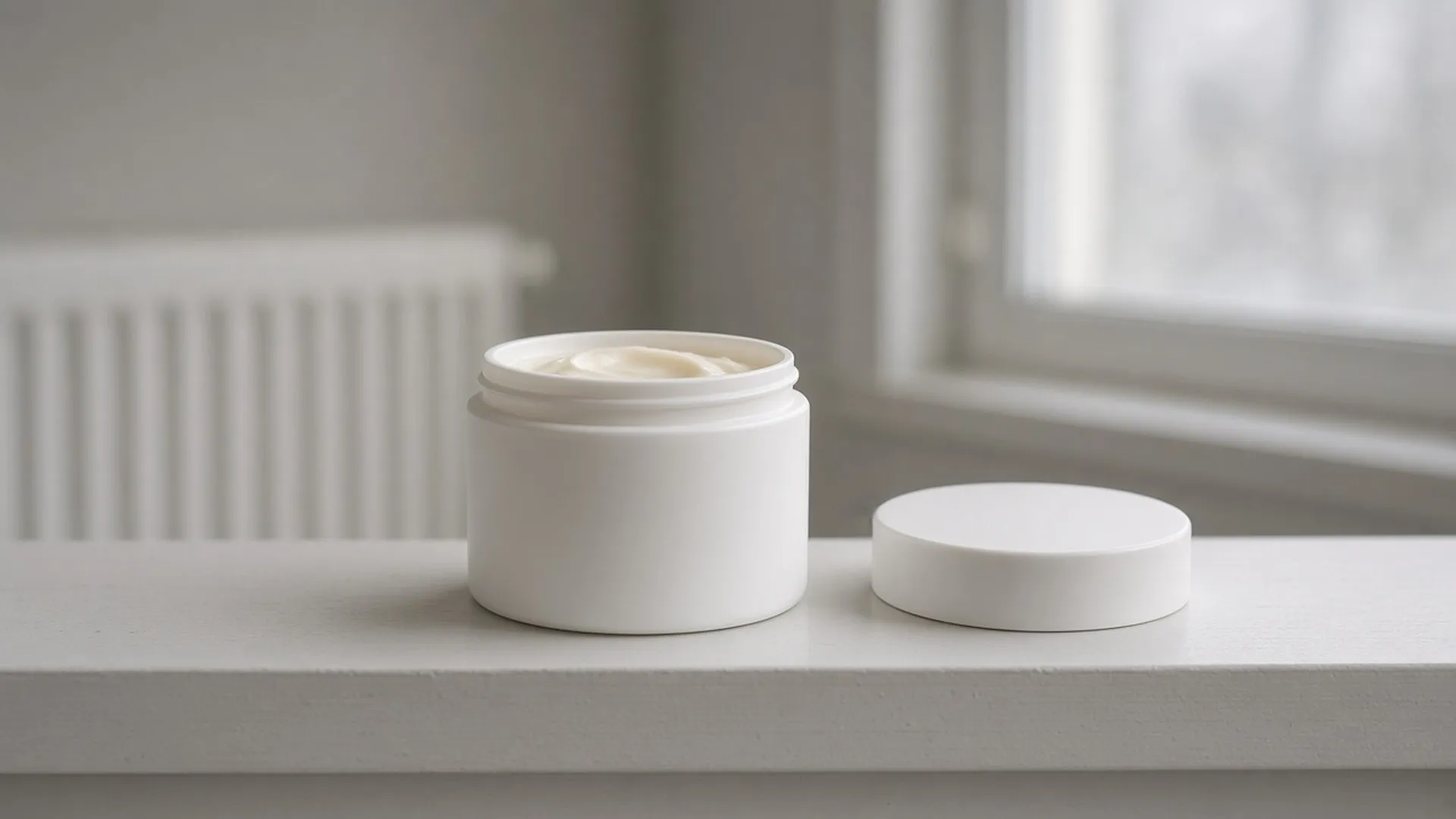
I am not going to tell you what it is. I know that is irritating, and I know a column titled after a moisturiser carries an implied promise to name it. But the jar on my shelf is right for my face in my flat with my radiators, and the moment I name it, it becomes the jar you buy instead of the jar you need. So it is the jar. White, unremarkable, with a lid that has never once closed cleanly on the first try.
I have been buying it for six years. In that time it has been reformulated three times, which is three times more than I was told about. I have thought about leaving it on each occasion. I have not left. This piece is partly about why, and mostly about what a moisturiser is for, because I think most of us have been sold the wrong job description.
What it is for.
A moisturiser does not put water into your skin in any lasting way. Your skin gets its water from the inside. What a moisturiser does is slow down how quickly that water leaves, and make the surface more comfortable while it does so. That is the whole job. It is a lid and a cushion, laid over a barrier that does the real work itself. It is not a treatment, and the ones that are sold as treatments are usually a lid and a cushion with a serum's ambitions printed on the side.
I find this freeing. Once you understand that the job is modest, you stop asking a cream to do things creams do not do. You stop being disappointed that it has not changed your life, and you start noticing the evenings when you skipped it and woke up with your cheeks pulled tight across the bone. That is what it was doing. It was preventing a small, ordinary discomfort every single night, and you only see it when it is gone.
A moisturiser is a lid and a cushion. It is not a treatment, and the ones sold as treatments are usually a lid and a cushion with ambitions printed on the side.
Why the boring one.
The jar has no fragrance. It has no headline ingredient. It does not tingle, glow, plump or promise. It goes on, it sinks in over a minute or so, and then it is gone and my face feels like a face. In six years it has never made me break out, never stung, never sat on top of my skin like cling film, and never made me think about it at all, which is the highest praise I have for anything in a bathroom.
I have tried the exciting ones. Of course I have; it is my job to try things. Some were lovely for a fortnight. Most of them, eventually, did something I did not ask for — a faint itch along the jaw, a smell I grew tired of, a texture that pilled under sunscreen on the mornings I was in a hurry. None of those is a disaster. All of them are reasons I stopped reaching for the jar's replacement and went back to the jar.
I have confessed elsewhere that my eye cream is this same moisturiser decanted into a smaller pot, which you can read about in the five products I'd re-buy tomorrow. I stand by it. If a cream is gentle enough for my whole face, it is gentle enough for the bit around my eyes, and I am not paying extra for a smaller lid.
Three reformulations.
Brands do not announce reformulations. They change the packaging slightly, sometimes not even that, and you find out because something feels different. The first time, the texture went a little thinner. The second, the smell changed — not to a fragrance, just from nothing to a faint something. The third time I only noticed because the ingredients list on the back was in a new order, and I am the kind of person who reads ingredients lists in the bath. I am insufferable.
Each time, I did the same thing, and I recommend it to anyone whose reliable product has quietly changed. I stopped assuming it was the same product. I patch-tested it for a few days on a small area along the jaw, as if I had never met it before. I used it alone, with nothing new around it, for a couple of weeks. Twice it was fine and I carried on. Once, after the second change, I was not sure for a month and kept a back-up of something plain in the cupboard in case. It turned out fine. The back-up is still in the cupboard. I think of it as insurance.
If yours changes and it does not agree with you — stinging, redness, itching that was not there before — stop using it. Loyalty to a jar is not a virtue. If the reaction carries on after you have stopped, see a pharmacist or your GP rather than trying to calm it down with more products.
How to find your own jar.
It will not be mine. It might be a cheaper version of mine, or a richer one, or something in a tube, which I would find aesthetically disappointing and you should ignore me about. A few things I would look for:
- No fragrance. Not because fragrance is evil, but because a product you use every day for years should be the least eventful thing you own.
- A texture you will actually use. A cream you dislike putting on is a cream you will skip.
- The right weight for the season. A lighter one in summer, something richer when the heating comes on, or the same one with a few drops of oil pressed over it in February.
- Nothing that stings. Not a tingle, not a moment. Comfort is the point.
- A price you can pay without thinking, because the best moisturiser is the one you use generously.
Then, and this is the hard part, stop looking. Give it a couple of months. If at the end of that your face is comfortable, unbothered and mostly forgettable, you have found it. The search is the expensive part of skincare. The jar is cheap.
The search is the expensive part of skincare. The jar is cheap.
The jar turns up in other columns doing the same modest job: as the only product on five recovery nights in a skin cycle that fits a week, and as the plain replacement for an expensive sleeping mask in the case against ten steps.
Filed by Nelly, from the desk · Skin / Essentials