The Turkish hammam, at home
You cannot recreate a hammam in a London bathroom, and you shouldn't try. But there is a version of the ritual that travels. The parts worth keeping.
You cannot recreate a hammam in a London bathroom, and you shouldn't try. But there is a version of the ritual that travels. The parts worth keeping.
The hammam I grew up with was not a spa. It was a neighbourhood building with a domed roof, warm marble underfoot, light coming down through small glass openings in the ceiling, and women of every age sitting about in a kind of unhurried, steamy conversation. You went in tired and came out feeling as though someone had sanded you down and put you back together. Which, to be fair, is roughly what had happened.
You cannot have that in a London bathroom. I have tried, in the way you try to recreate a holiday meal with supermarket ingredients, and it does not work. There is no marble, no dome, no attendant with forearms like a baker. There is a shower, a bath if you are lucky, and an extractor fan that sounds like a small aircraft.
But some of the ritual travels. Not the architecture, the sequence: warmth, then rest, then a gentle scrub, then water, then more rest. Done slowly and not very often, that sequence is the nicest evening I know how to have at home. Here is the version I keep, and the parts I have deliberately left behind.
Beginner · About forty minutes · Every few weeks at most · A shower, a kese-style mitt, plain soap, two towels, a jug
The point of a hammam was never the scrub. The scrub was the excuse to sit still for an hour.
Before you start.
Warmth and steam are not for everyone, and this is the part I would rather you read than skip. If you are pregnant, or have a heart condition or high or low blood pressure, check with your doctor before doing anything that involves sitting in a steamy room. Keep the heat moderate for everyone: warm, not hot. If at any point you feel dizzy, light-headed, faint or sick, stop, turn the water to cool, open the door, sit down, and drink some water. Do not try to push through it. Have something to drink before you begin, and do not do this straight after a large meal or a glass of wine.
The scrub has its own rules. Skip it entirely if you are using strong actives or retinoids on the areas you would be scrubbing, if your skin is sensitive or prone to eczema, or if it is irritated, sunburnt, broken or freshly shaved or waxed. If you are unsure whether your skin can take it, ask a dermatologist before you try. The warmth and the rest are lovely on their own.
Five parts, one slow evening.
Step one · 10 minutes — Warm the room, not yourself.
Close the bathroom door and run the shower warm for a few minutes before you get in, so the room fills with steam. Lay your towels somewhere they will stay dry and warm, a radiator if you have one. Put a glass of water within reach. Turn the overhead light off and use a lamp in the hall if you can. This is a ritual, and rituals deserve better lighting than an office.
If the room gets stuffy rather than pleasantly steamy, open the door a crack. You are aiming for warm and soft, not a sauna.
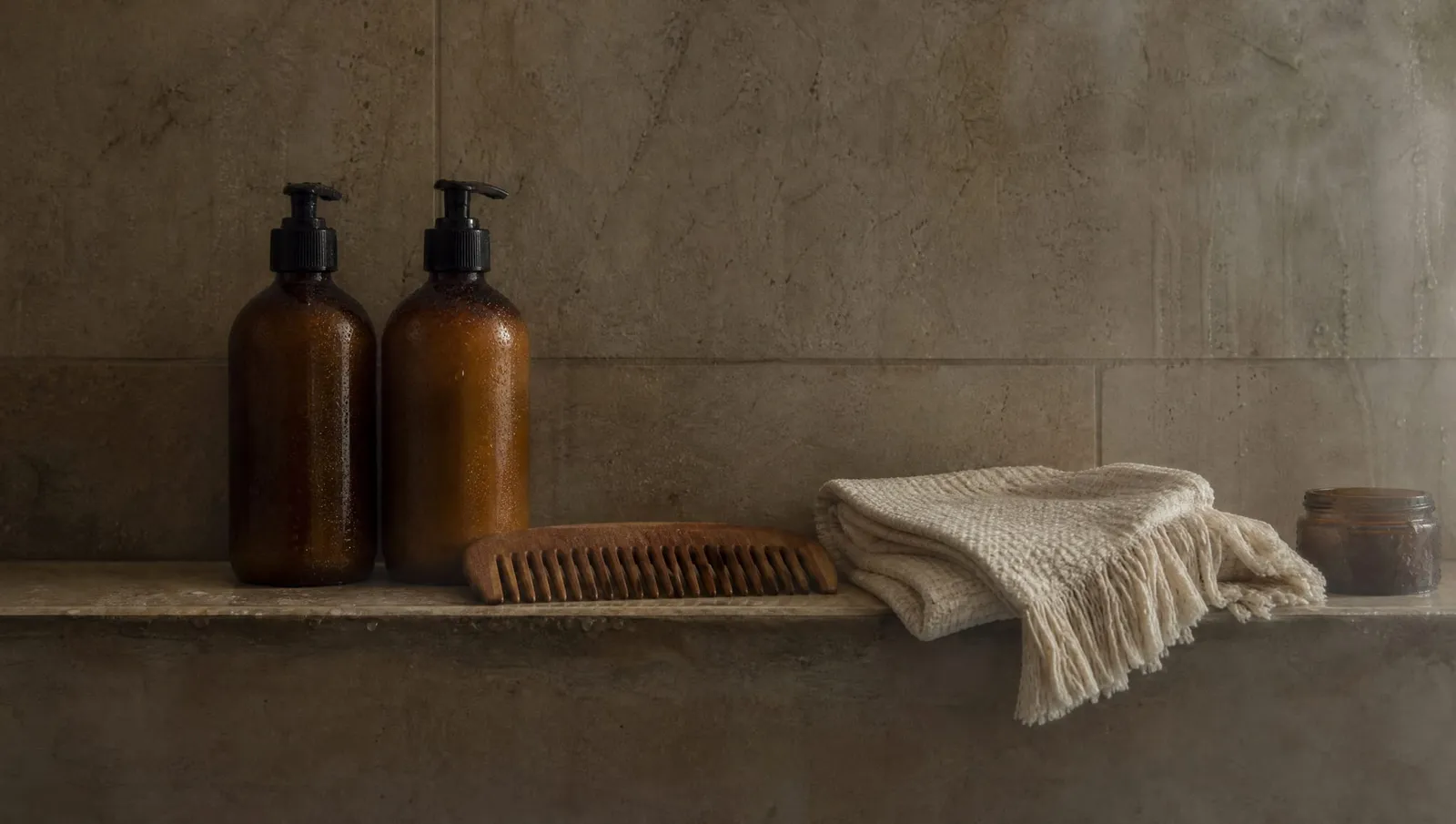
Step two · 10 to 15 minutes — Sit in the warmth.
Wash with plain soap first, then simply stay in the warm water and steam. Stand under the shower, or sit in a shallow warm bath, and let your skin soften. In the hammam this is the part where you lie on the warm stone and do nothing, and it is the part most people rush. Do not rush it. The scrub only works on skin that has had time to soften, and the rest only works on a mind that has had time to stop.
If you sit on the edge of the bath or on a stool, make sure it is stable and the floor is not slippery. A hammam evening that ends in a fall is not a hammam evening.
Step three · 5 minutes — The mitt, gently.
A kese-style mitt is a coarse, close-woven cloth glove. Wet it, wring it out, and work in long strokes along the arms, legs, back and torso, with light, even pressure. A few passes over each area, then move on. Some greyish rolls may appear. Part of that is skin and part is simply soap and friction, and you do not need to chase it. You are polishing, not sanding.
Leave out the face, the neck, the chest if it is delicate, and anywhere that is pink, irritated, broken, sunburnt, newly shaved or has a rash. Go around moles and anything raised. If a mole or patch of skin has changed, that is a conversation for a doctor, not a mitt.
Light pink afterwards is normal and fades quickly. Stinging, or redness that stays, means you pressed too hard or went over the same place too often. Ease off next time, or skip the mitt.
Step four · 2 minutes — Rinse, with a jug.
In the hammam, water is poured over you from a shallow metal bowl, and it is one of the most comforting sensations I know. At home, a jug does it. Fill it with lukewarm water and pour it slowly over your shoulders and back, then turn the shower slightly cooler for a final rinse. Not cold. Just cool enough to feel like the end of something.
If you felt at all light-headed in the steam, make the rinse cool and sit down for a minute before stepping out.
Step five · 15 minutes — Rest, properly.
Pat dry, do not rub. While your skin is still a little damp, smooth on a plain, unscented body moisturiser. Then wrap yourself in the second warm towel, or a robe, and lie down somewhere quiet for a quarter of an hour. Drink your water, or a cup of tea. In Istanbul this is where people sit about, wrapped up, talking and drinking tea. At home I lie on the sofa and talk to nobody, which is also very good.
Do not go straight out into the cold or into a hot kitchen. Let your body return to normal at its own pace.
The shelf — what this actually needs
- A kese-style exfoliating mitt, kept clean and dried between uses
- A plain, gentle soap or an unscented body wash
- Two towels, one for drying and one for wrapping up
- A jug or a large bowl for pouring
- A plain, fragrance-free body moisturiser
- A glass of water, and later a cup of tea
- A stable stool and a non-slip mat, only if your bathroom suits them
That is all. No special oils, no imported clay, no scented salts. The ritual is in the order, not the products.
Warmth, rest, a gentle scrub, water, rest again. The sequence is the luxury. The bathroom is just where it happens.
How to know it is working.
- Your skin feels smooth and soft the next morning, not tight, stinging or sore.
- Any pinkness from the mitt is gone within the hour.
- You feel drowsy and loose rather than drained or dizzy.
- You sleep well that night. This, for me, is the real measure.
- You find yourself looking forward to the next one in a few weeks, rather than wanting to do it again tomorrow. That is the right frequency.
When it isn't going to plan.
How often can I do this?
The warmth and rest, as often as you like. The mitt, occasionally: every few weeks is plenty for most people, and less if your skin is dry or sensitive. Scrubbing more often does not make you smoother. It just makes you sore.
Can I use the mitt on my face?
I would not. Facial skin is thinner and is already dealing with whatever you put on it every day. If your face needs attention, give it the gentle version, and if it is reactive at all, read the barrier week first.
My skin is red and stinging afterwards.
Rinse with cool water, skip the moisturiser if it stings, and leave the area alone for a few days. Next time, use lighter pressure or leave the mitt out. If the redness, stinging or a rash persists, or the skin looks broken or infected, see your GP or a dermatologist.
I felt faint in the steam.
Stop doing the steam part until you have spoken to your doctor. Shorter, cooler and with the door open is the gentlest version, but feeling faint is a signal worth taking seriously, not something to train through.
I use a retinoid. Can I still do this?
The warmth and the rest, yes. The mitt, not on any skin you are treating with a retinoid or other strong actives, and if you are unsure where that line is, ask a dermatologist. Exfoliating on top of strong actives is how a nice evening turns into a week of irritation.
“You cannot bring the hammam home. You can bring home the habit of sitting still in the warm for a while, and that was always the best part.” — Nelly
This is the occasional, longer evening. The weekly, shorter cousin — a mask, an oil, a warm bath and the phone in another room — is Sunday, the only day with a routine, and the rest of the ritual columns are gathered at HowTo Beauty.
Filed by Nelly, from the desk · Body / Ritual